The DOST and AAP Partner to Advance AI in the Philippines


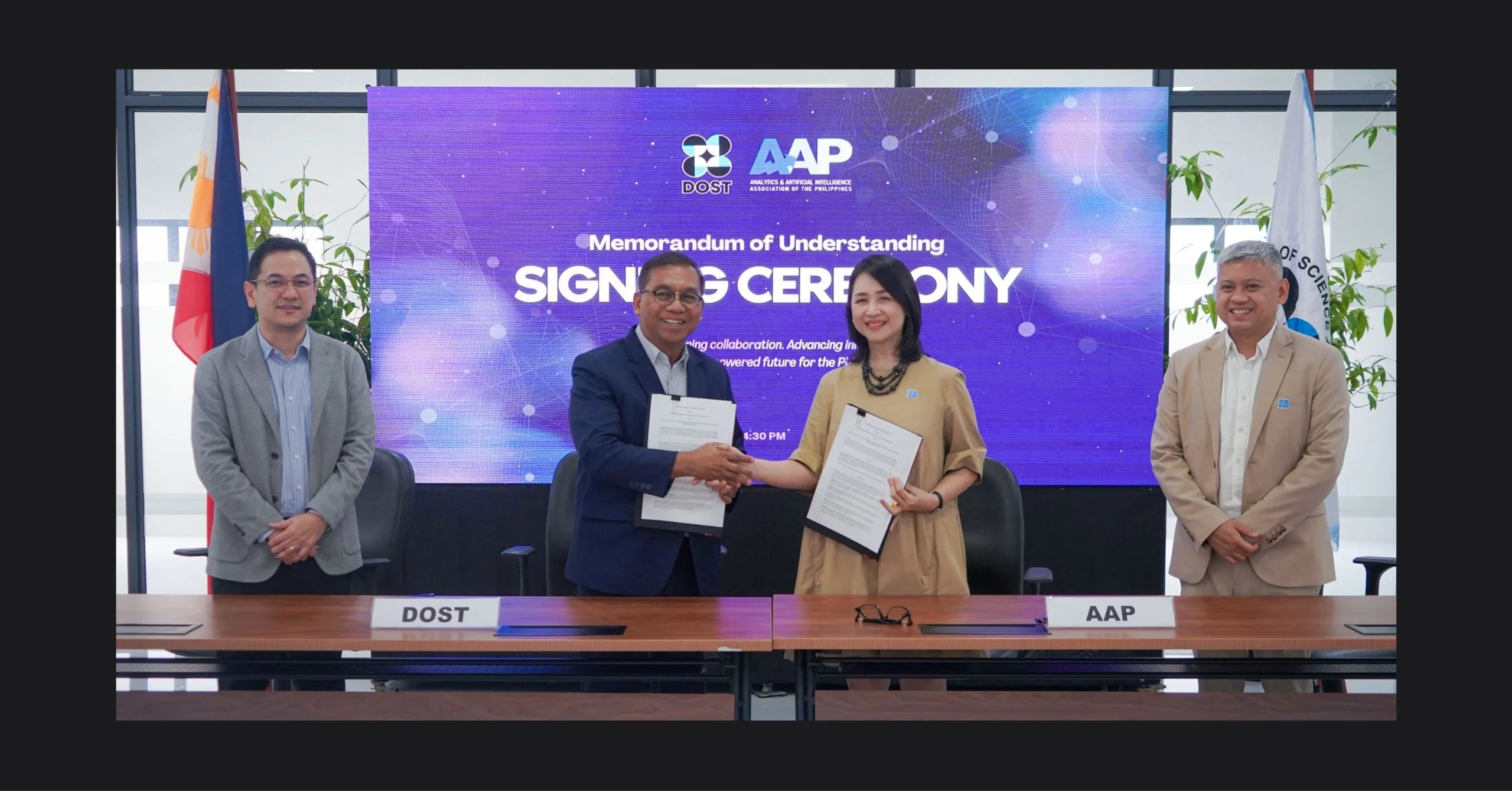
The DOST-AAP partnership aims to drive productivity and workforce upskilling for Philippine enterprises.
The Department of Science and Technology (DOST) and the Analytics and Artificial Intelligence Association of the Philippines (AAP) signed a Memorandum of Understanding (MoU) that establishes a framework for collaboration among government, academia, and the private sector to strengthen the country’s digital and scientific ecosystem.
The two organizations, which began their engagement in 2019, play an “instrumental role” in the implementation of the National Artificial Intelligence Strategy for the Philippines (NAIS-PH).
NAIS-PH is the Philippines national government’s framework on AI research, development, and adoption. President Ferdinand Marcos Jr. approved the NAIS-PH in May 2025 and assigned the DOST to lead its implementation.
“The real target is to improve productivity and improve the processes so that we can fast-track many of our operations, produce better products based on R&D [research and development], and make sure that employees within enterprises get the appropriate training and upskilling so that they can perform their job better in an environment where there is application of smart technologies,” DOST Secretary Renato Solidum, Jr. told The Business Manual in a July 1 interview.
The agency will provide policy direction and strategic guidance under the MoU. Its research and development arm, the DOST–Advanced Science and Technology Institute, will serve as the primary technical and implementing partner, leading AI R&D initiatives.
AAP, meanwhile, will tap its network of professionals, academic institutions, enterprises, and technology partners. The association will provide industry use cases, drive cross-sector collaboration, support workforce upskilling, and promote the responsible development and adoption of AI technologies.
The partnership also allows the associations’s members to contribute to nation-building programs and help the DOST create industry-relevant programs, said its president Michelle Alarcon in a separate, July 1 interview.
The association’s membership spans across sectors, ranging from aviation and fintech to retail.
“AAP members who are still building their AI capabilities can also benefit from our co-organized and co-designed upskilling programs. Those who already have expertise can help connect with in-house experts from the DOST to work in our co-designed projects on national AI use cases,” Alarcon told The Business Manual.
A Human-Centered Strategy for Philippine AI Adoption
DOST’s four-part framework consists of the “AI Factory” for foundational infrastructure and the “AI Refinery” for processing those resources into practical, problem-solving applications. These are supported by strategic partnerships and a human-centered approach that prioritizes upskilling to ensure AI innovations directly benefit individuals and organizations.
The agency is rolling out initiatives aimed at enterprise growth.
“We have an ongoing project to provide AI as a service for enterprises,” Solidum said. “We also have another project that approaches modernizing MSMEs through a smart factory approach.”
In the latter, specialist teams engage one-on-one with the enterprises to determine their readiness and openness to employ artificial intelligence, robotics, automation, mechanization, and other technologies in their operation.
“This is exactly what we want to make sure of—that we offer the best possible solutions to challenges faced by the industries, and we need more people to engage with our partner enterprises,” Solidum said. “We need to increase productivity so that we can produce more products, create more services, and create more jobs.”
He added that the NAIS-PH framework puts people at the center of its implementation.
“What we can do is really make sure that AI enhances the skills and work experience of our kababayans [fellow countrymen], those in the industry, and those in government,” he said. “We have to make sure that our kababayans are able to use AI to their advantage when they do their work.”
Frequently Asked Questions
The MoU between DOST and AAP establishes a framework for collaboration among government, academia, and the private sector to accelerate the development, adoption, and responsible use of artificial intelligence and data analytics, implementing the National Artificial Intelligence Strategy for the Philippines.
NAIS-PH, or the National Artificial Intelligence Strategy for the Philippines, is the national government’s framework guiding AI research, development, and adoption across sectors. President Ferdinand Marcos Jr. approved the strategy in May 2025 and assigned DOST to lead its nationwide implementation.
Under the MoU, DOST provides policy direction and strategic guidance, with its research arm, DOST-ASTI, serving as the primary technical and implementing partner for AI research and development. AAP contributes industry use cases, cross-sector collaboration, workforce upskilling, and promotes responsible AI adoption.
DOST’s four-part framework includes the “AI Factory” for foundational AI infrastructure and the “AI Refinery” for turning those resources into practical, problem-solving applications, supported by strategic partnerships and a human-centered approach that prioritizes upskilling workers over replacing their jobs entirely.
DOST Secretary Renato Solidum Jr. said the government does not intend to “automate everything,” noting that AI will mainly replace repetitive tasks rather than entire jobs. The strategy remains human-centered, prioritizing upskilling so Filipino workers can use AI to their advantage.