Features 16 hours ago
Bookmark feature is for subscribers only. Subscribe Now to save your favorites.

Pioneering the Philippine Sustainable Lifestyle Market

FacebookXEmailCopy Link
Before eco bags were common, three co-founders started a store that changed how Filipinos think about what they consume.

Before eco bags were common, three co-founders started a store that helped change how Filipinos think about what they consume.

In 2008, plastic bans were limited to Makati, reusable bags and tumblers were uncommon, and sustainability as a lifestyle was yet to become a mainstream consumer concept.

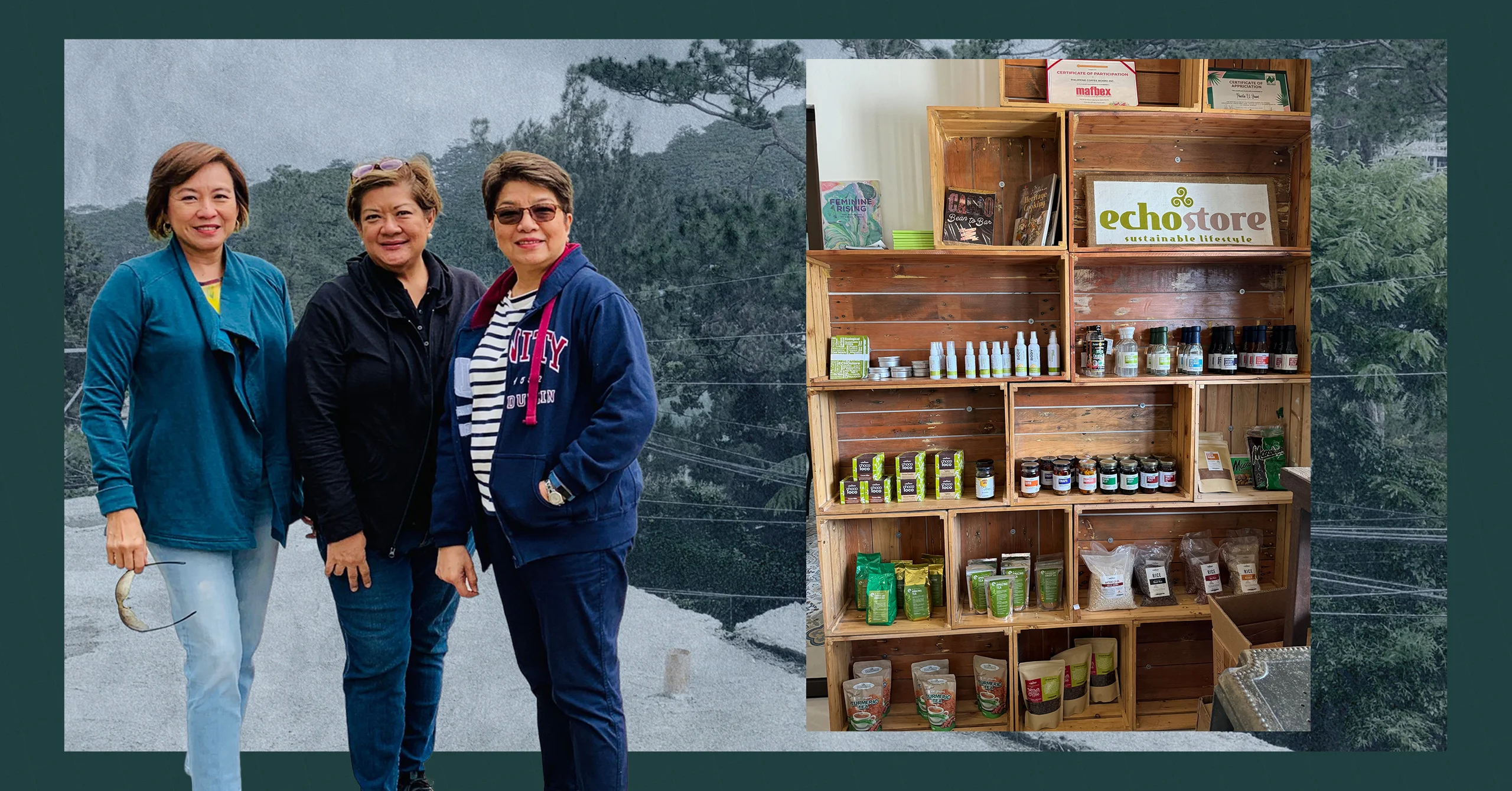
It was around this time that ECHOstore, often credited as a sustainable retail pioneer in the Philippines, was launched by Reena Francisco, Jeannie Javelosa, and Pacita Juan.

“We would use glossies and make them into bags,” said Juan, a social entrepreneur and ECHOstore co-founder, in a June 3 Google Meet interview. “We wanted to influence our customers that this could be done.” 

How Personal Needs Launched a Philippine Retail Pioneer

The concept for ECHO - which stands for environment, community, hope, and organizations - was driven by the founders’ personal needs.

“We ourselves were looking for stuff to buy, like ecobags,” Juan said. “They were made in Singapore, so we asked [bag designer] Zarah Juan, who had sewers in Bulacan, ‘Can you make bags for us that we can sell?’” 

They also wanted to eat well, but produce such as imported arugula, which fetched as much as P900/kilo, was “an indulgence.” 

Upon the suggestion of Javelosa, Juan sent her people to Negros to learn how to plant on a friend’s farm, after which she used her farm in Cavite to plant greens.

“I could now sell [arugula] for a third or a fourth of the price that I was buying for,” Juan said. “We also put it in our menu at the cafe because we were growing the vegetables ourselves.”

The founders eventually got involved in the slow food movement, where they learned the importance of getting to know the producers who nurture their food.

Slow Food, the organization environmentalist Carlo Petrini founded in Italy in 1986, is the origin of the broader slow food movement, which promotes local, traditional food production as an alternative to fast food and industrial agriculture. 

A Producer-Market Access Model Gave Local Farmers a Way to Sell

Market access became their next focus when early partners, like the foundations Pinoy ME and Peace and Equity, asked if they could help their economically disadvantaged beneficiaries.

The founders would visit communities in Guimaras, Camiguin, Maguindanao, Ilocos, and Benguet to train microentrepreneurs. The cafe then became a testing ground for community produce before it was sold. Crab paste was used for pasta, eggplants were added to sandwiches, and guavas made their way to salads as balsamic guava jelly dressing.

“We’d ask the Pinoy ME and Peace and Equity beneficiaries, ‘Where do you sell your produce?’ and we’d get all sorts of answers, from trade fairs to fiestas,” Juan said. “It wasn’t really sustainable. They were taught all these skills, but they didn’t know where to sell their products.”

Javelosa, with her background in the National Commission for Culture and the Arts, became the go-to person for weaves and such crafts. Juan, with her coffee farm, became the de facto mentor for related businesses. Cooking aficionado Reena, meanwhile, whipped up cafe offerings using community products.

“People would find it so interesting that we knew where the ingredients we used came from. We met the people making our cacao, and that story resonated with a lot of our customers,” Juan told The Business Manual.

What ECHOstore's Packaging Experiments Actually Taught Them

The three founders gleaned a lot of business lessons in their journey.

In food wrapping, for instance, the founders learned that, although banana leaves were eco-friendly, they made produce such as lettuce dry out too fast.

They also tried refilling stations for perishable items, but issues like food spoilage and contamination risk sprang up. It was also hard to sell merchandise that had already been handled.

“If you don’t vacuum pack rice or put it in hermetically sealed bags - because it’s natural and not sprayed with insecticides - it will have bugs, and people don’t want to buy rice with bugs in them,” Juan said. 

“If we can bring back the suki [a merchant who favors a returning customer] mentality in public markets, I think the refilling will work - at least for oil, vinegar, patis [fish sauce], sugar, the staples,” she added.

This content is available to our subscribers. Join our community to access premium content and elevate your business knowledge.

Already a subscriber? Login
OR
ANNUAL
1,000
per year
SEMI-ANNUAL
500
per six months
QUARTERLY
250
per three months
MONTHLY
100
per month

Frequently Asked Questions

ECHOstore is a Philippine sustainable retail store founded in 2008 by Reena Francisco, Jeannie Javelosa, and Pacita Juan. The acronym ECHO stands for environment, community, hope, and organizations. It is widely credited as the first sustainable retail concept of its kind in the Philippines.

ECHOstore partnered with community foundations, including Pinoy ME and Peace and Equity, to train microentrepreneurs in provinces such as Guimaras, Camiguin, Maguindanao, Ilocos, and Benguet. The store's cafe served as a testing ground for community produce before it was offered for retail sale.

High electricity rates are a primary driver — Philippine households paid $0.22 per kWh in 2024, nearly double the rates in Thailand ($0.14), Indonesia ($0.10), and Malaysia ($0.03). Labor costs and raw material sourcing compound the challenge, making local sustainable production difficult to price competitively.

ECHOstore found that banana leaf wrapping caused produce to dry out too quickly, while refilling stations raised food spoilage, contamination, and warranty liability concerns. The founders ultimately pivoted toward food storytelling and producer relationships as their primary value proposition rather than sustainable packaging formats.

ECHOstore co-founder Pacita Juan describes the store's approach as trust-based rather than certification-dependent. Rather than requiring formal organic certification from all suppliers, the store relies on direct producer relationships and community sourcing history — a model Juan describes as "selling trust" rather than labels.


Patricia Mirasol

Patricia Mirasol

Editor

More From Features

Features

Five Philippine Resorts Join the 2026 Michelin Guide Selection

Features

How Philippine Companies Scale Sustainably: Lessons from Four Industries

Features

How OFWs Drive Cross-Border Family Finances

Features

Upcycled Plastic Infrastructure Turns Waste Into Environmental Education

Learn straight from the top CEOs and business leaders. Access exclusive articles and videos.

Subscribe Now