Features June 15, 2026
Bookmark feature is for subscribers only. Subscribe Now to save your favorites.

Upcycled Plastic Infrastructure Turns Waste Into Environmental Education

FacebookXEmailCopy Link
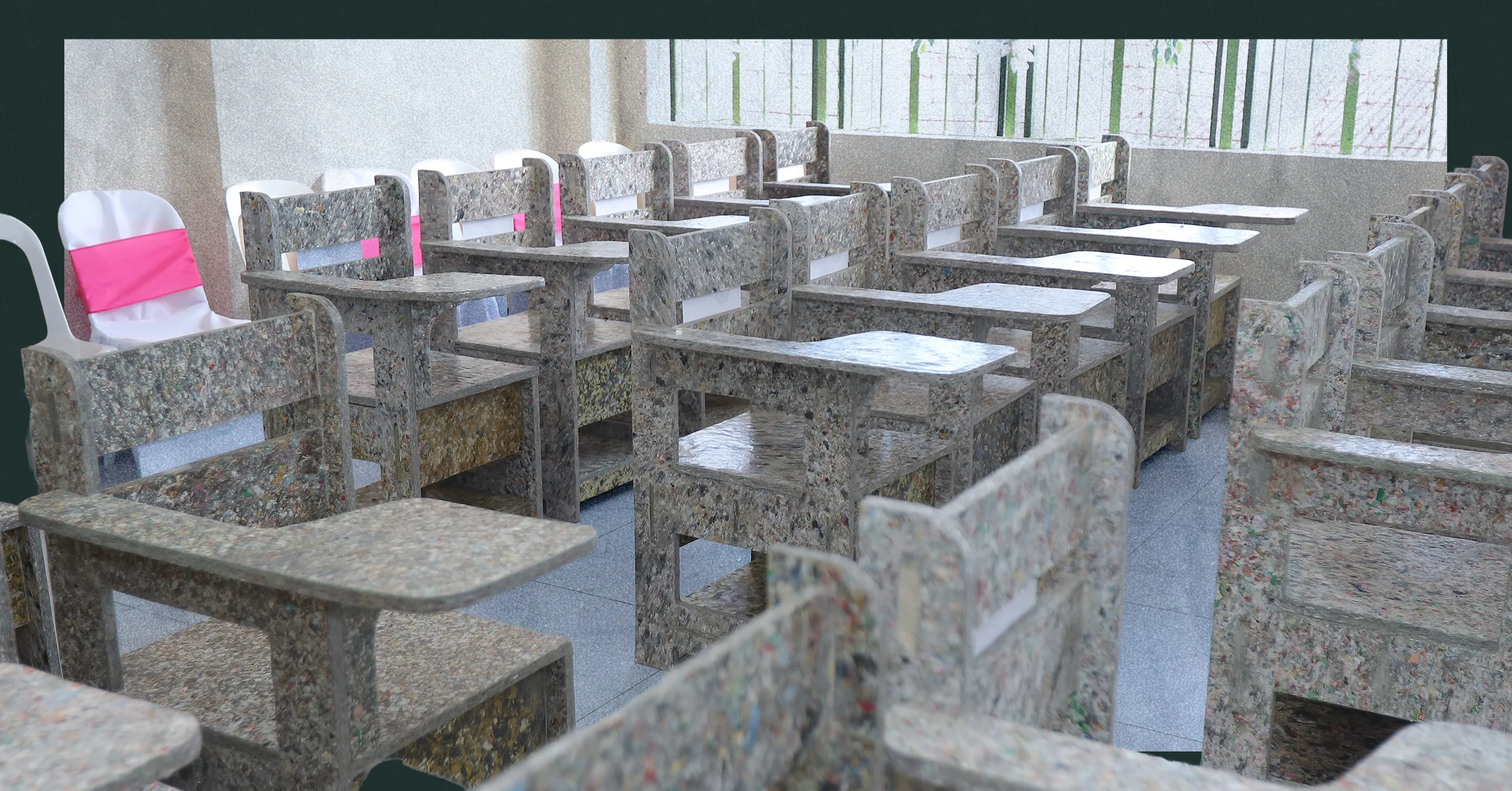
Transforming post-consumer plastic into school chairs demonstrates a viable concept for keeping waste out of waterways while fostering early childhood eco-literacy.

Transforming post-consumer plastic into school chairs keeps waste out of waterways and fosters early childhood eco-literacy.

Upcycling post-consumer plastics into durable infrastructure items, such as school chairs, offers a proof of concept that keeps waste out of waterways. 

Introducing environmental literacy during early childhood, meanwhile, protects vulnerable children, builds sustainable behaviors, and drives community resilience. 

“By linking waste recovery to education infrastructure, we hope to create benefits that are both environmental and social,” Sivakumar Thigambaranath, general manager of the container shipping group CMA CGM Philippines, said.

The company, together with social enterprise The Plaf, donated 500 school chairs made from recycled plastic waste to three Parañaque public schools on March 18.

The former sponsored the initiative, while the latter collected and processed the materials in their Muntinlupa City facility. 

Both then reached out to the Department of Education to facilitate the donation.

Held at Marcelo Green High School, the donation is the first in a series of planned contributions, with the partnering French-owned companies planning to give 1500 chairs between 2025 and 2028.

Of the 500 chairs, Marcelo Green High School received 300, while Masville Senior High School and San Antonio National High School each received 100. 

This content is available to our subscribers. Join our community to access premium content and elevate your business knowledge.

Already a subscriber? Login
OR
ANNUAL
1,000
per year
SEMI-ANNUAL
500
per six months
QUARTERLY
250
per three months
MONTHLY
100
per month

Frequently Asked Questions

CMA CGM Philippines sponsored, and The Plaf manufactured 500 recycled plastic school chairs, distributed across three Parañaque public schools in March 2025 — the first phase of a planned 1,500-chair contribution through 2028.

The Philippines produces 1.511 million tonnes of plastic waste per year. Around 56% is mismanaged — dumped in nature or disposed of in open or inadequate facilities — per a 2025 SWITCH-Asia report.

Chairs made from post-consumer plastic give students a daily, tangible example of circular material use — demonstrating that discarded waste can become functional infrastructure with lasting educational symbolism.

The Plaf is a Manila-based social enterprise that collects and processes post-consumer plastic at its Muntinlupa City facility. CMA CGM Philippines provided the sponsorship; both coordinated with the Department of Education for the donation.

Ambassador Marie Fonatel cited the need for political support for environmental action amid growing international resistance to ocean and climate protection commitments, noting that both partner organizations have French affiliation.

More From Features
Features

2026 Tambuli Awards Complete List of Winners

Features

How Posh Skin Co. Turned Pimple Patches Into a Self-Expression Movement Among Young Filipinos

Features

How Philippine Businesses Are Embedding Sustainability Into Their Growth Strategies

Features

How Sarabia Optical Built a Century-Long Eyewear Legacy in the Philippines

Learn straight from the top CEOs and business leaders. Access exclusive articles and videos.

Subscribe Now