Trends: Hybrid Work Continues to Evolve in 2024



Hybrid work will continue to evolve this year to include meeting team members outside of the office. That’s what Prithwiraj Choudhury, Associate Professor at the Harvard Business School (HBS), predicts for 2024.
Choudhury, who does research on the future of work, said that hybrid work will expand from the rigid definition of employees being onsite at the office two or three times a week. “Teams are innovating on both where to meet and when to meet. The downtown office building will be only one of the spaces where teams can meet for in-person work,” he said in an HBS report.
Choudhury’s research suggests that work-from-anywhere teams are meeting in places outside of the traditional office space, including suburban locations, trade conferences, and company offsite locations.

Teams are also assessing how often to meet in order to produce the best team outcomes. “Many of the teams I study have developed a ritual of being in-person together for a few days once a month or even once a quarter. Even brief periods of being in-person together help individuals innovate, especially when they meet team members from different time-zones or different cultures,” according to Choudhury.
Moving from a rigid version of hybrid working arrangements to more flexible forms will “help individuals work from anywhere and will help companies hire from anywhere,” he concludes.

Remote and Hybrid Work in the Philippines
An October 2023 study by professional services firm KPMG agrees that remote work has helped businesses in the Philippines to attract and retain top talent, especially in industries with talent shortages.
The study, in which a survey on current trends in remote working was conducted, found that 48% of the respondents have introduced policies on remote working, while 27% are planning to do so. Only 7% said they do not plan to implement remote work.
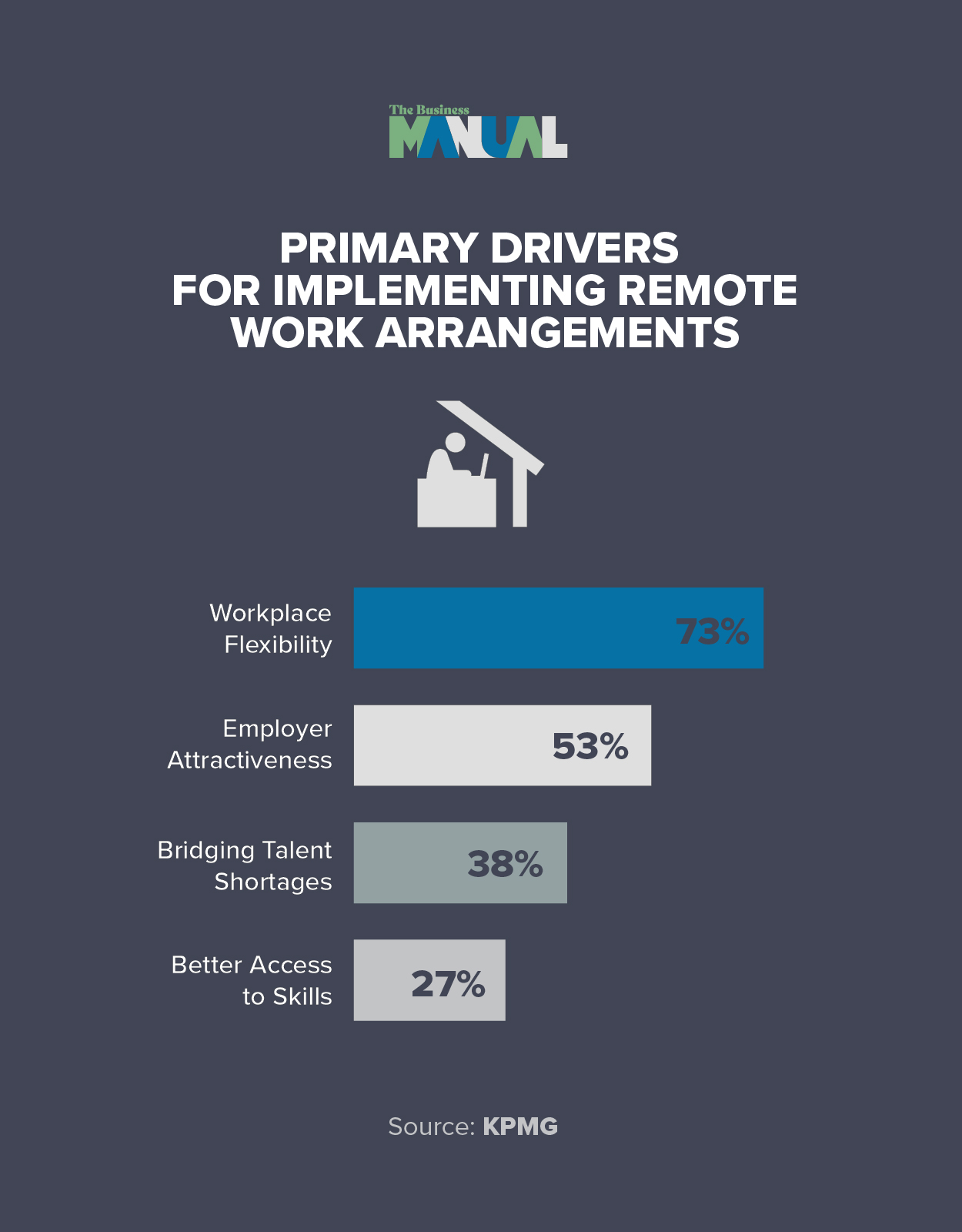
The KPMG study also found that the primary driver for implementing remote work arrangements is still employee demand for workplace flexibility, recorded at 73%. The other top drivers were improving employer attractiveness at 53%, bridging talent shortages at 38%, and gaining better access to skills at 27%.
According to “The State of HR 2023” report from Sprout Solutions, 51% of Philippine companies have implemented an on-site work policy.
Around half, or 50.5% of HR professionals foresee “hybrid work as the future,” according to the report, although “neutral responses towards on-site work suggest a lack of immediate urgency to adopt a hybrid model.” The report suggested that the hesitation towards the hybrid model “may stem from the perceived advantages and benefits associated with on-site work.”
Work-from-home Job Ads Still Near Peak
A November 2023 study by SEEK Asia found that the work-from-home rate in Australian job postings, which increased rapidly during the pandemic, has dropped slightly to 10% after reaching a peak of 11% in April 2023, but still remains much higher than pre-COVID levels.
The study also notes that other similar economies such as Canada are still at their peak work-from-home rate, or near the peak for the US and UK.
SEEK measured the work-from-home rate by counting how many job ads indicate that the role can be done remotely, as a proportion of all job ads in a particular month. The keywords or phrases searched for included “hybrid work,” “work from anywhere,” and similar terms.
Hybrid: The Ideal Middle Ground?
A 2022 research study by Choudhury found that hybrid arrangements seemed to work best for employees in terms of productivity and happiness. The study found that workers who spent around two days in the office each week on average self-reported greater work-life balance, more job satisfaction, and lower isolation from colleagues compared to workers who spent more or fewer days in the office.
Further, the hybrid workers received no different performance ratings compared to peers who spent more or fewer days in the office.
According to the study, hybrid work represented the “best of both worlds” in terms of the advantages and disadvantages of remote work and traditional in-person office work. Employees in a hybrid arrangement were able to gain the benefits of remote work – fewer distractions, less commuting, and more flexibility – while mitigating negative impacts such as a sense of isolation.
As the future of work continues to unravel before us, the one thing that ensures an optimal outcome for both businesses and employees is a continuing dialogue between both on how best to deliver the work output needed.
Frequently Asked Questions
Hybrid work in 2024 goes beyond a fixed schedule of reporting to the office a few days a week. It is evolving into a more flexible model where teams decide when and where they collaborate, including offsite locations and remote environments. Research from Harvard Business School highlights that companies are shifting toward “work-from-anywhere” approaches to improve productivity, talent access, and team collaboration.
Studies suggest that many high-performing hybrid teams meet in person about once a month or once a quarter, often for a few consecutive days. According to research from Harvard Business School, even short in-person sessions help improve innovation and strengthen team relationships. This approach balances flexibility with meaningful collaboration, especially for distributed teams across time zones or different regions.
Hybrid teams are increasingly meeting in locations beyond traditional offices, such as suburban hubs, company retreats, trade conferences, and co-working spaces. This flexible approach allows teams to collaborate in environments that suit project needs and accessibility. The shift reflects a broader trend of decentralizing workspaces, enabling employees to connect in more strategic and purposeful settings rather than relying solely on downtown office buildings.
Hybrid work offers employees better work-life balance, reduced commuting time, and improved job satisfaction. For companies, it expands access to global talent and helps fill skill shortages more effectively. A study by KPMG found that flexibility is the top driver of remote work adoption. Overall, hybrid models support both productivity and employee retention when properly implemented.
One common mistake is treating hybrid work as a fixed office schedule instead of a flexible system based on team needs. Another issue is failing to establish clear communication norms, which can lead to misalignment between remote and in-office employees. Some companies also underestimate the importance of intentional in-person collaboration. Research from Sprout Solutions shows that hesitation often comes from overvaluing traditional on-site structures.