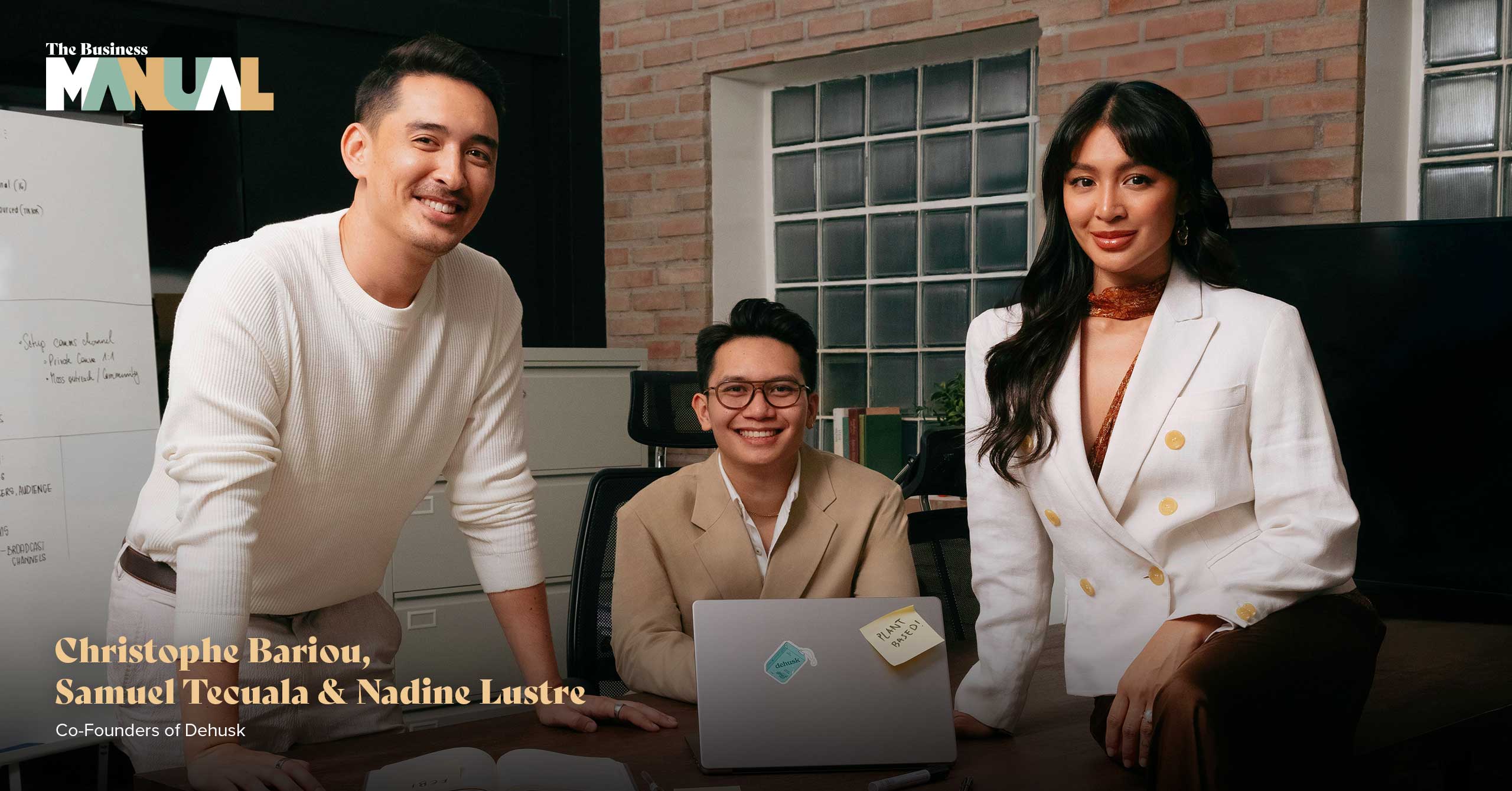
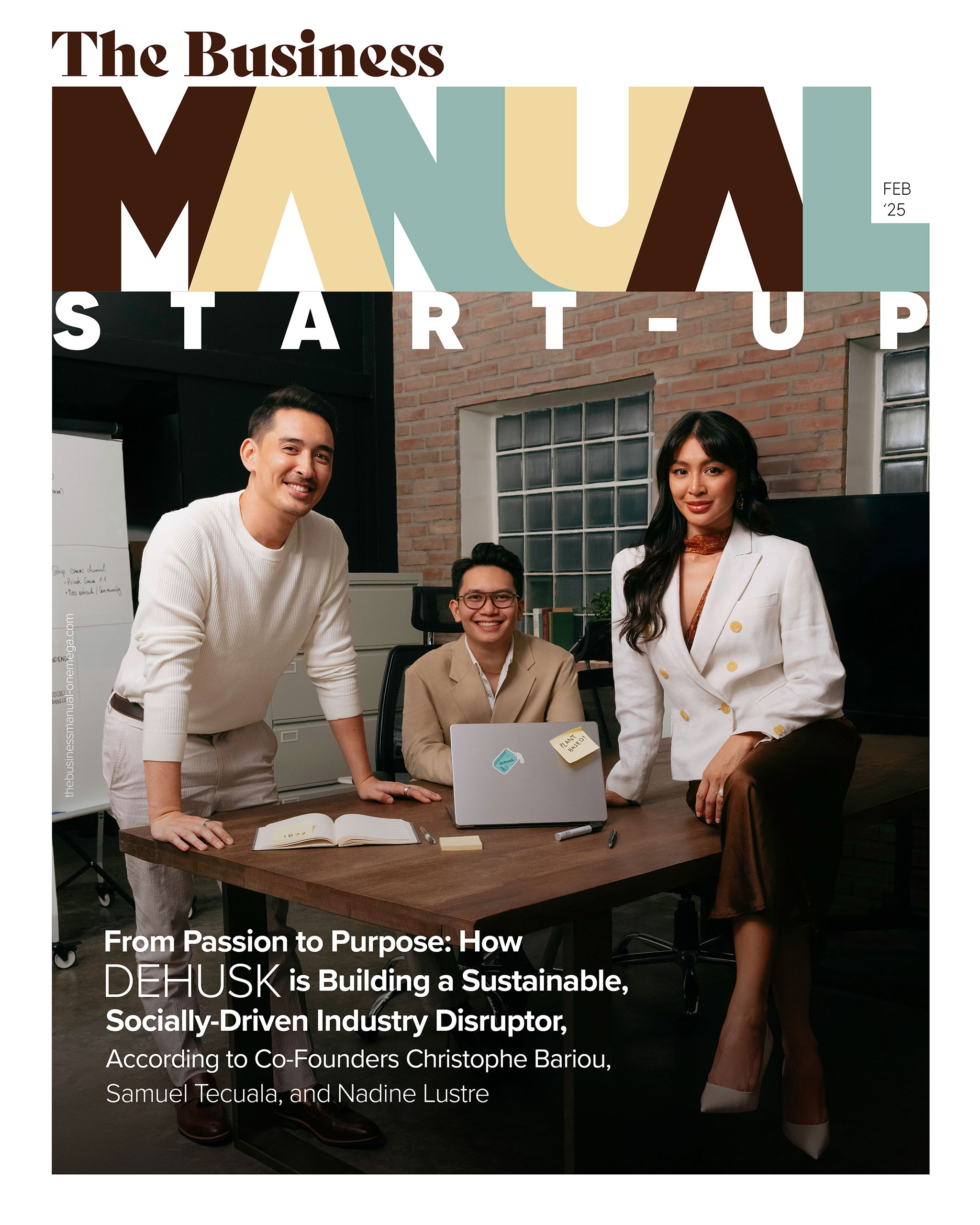
From Passion to Purpose: How Dehusk Is Building a Sustainable, Socially-Driven Industry Disruptor, According to Co-Founders Christophe Bariou, Samuel Tecuala, and Nadine Lustre


Dehusk’s founders share how the sustainable company’s vision of better nutrition, industry disruption and social good can also work for the startups of tomorrow.
In equal parts a business that seeks to revolutionize Filipino nutrition, support local coconut farmers, and disrupt the dairy industry, Dehusk is a startup unlike any other. In many ways, the company, which makes a coconut milk-based alternative to dairy milk, is a mirror of its founders–with Sam Tecuala leading the creation of the product and the operations side, and Nadine Lustre and Christophe Bariou leading marketing and the social aspect of the promising brand. Dehusk’s journey is one marked by bold ideas and immense challenges. But even in its early stages it is clearly a startup to watch as it scales to meet its ambition.
The Business Manual spoke to Dehusk’s three founders about how the plant-based milk company has already begun to disrupt the dairy industry in the Philippines and its road to early success. Together, the founders spoke about their passion and the strategic decision-making which led to turning their vision into a reality.
As a company that emerged from a shared vision of creating a sustainable, locally-sourced alternative to dairy while supporting Filipino coconut farmers, the experience of Dehusk’s founders in launching the company offers valuable insights for aspiring entrepreneurs. Here are five key business lessons from their journey.
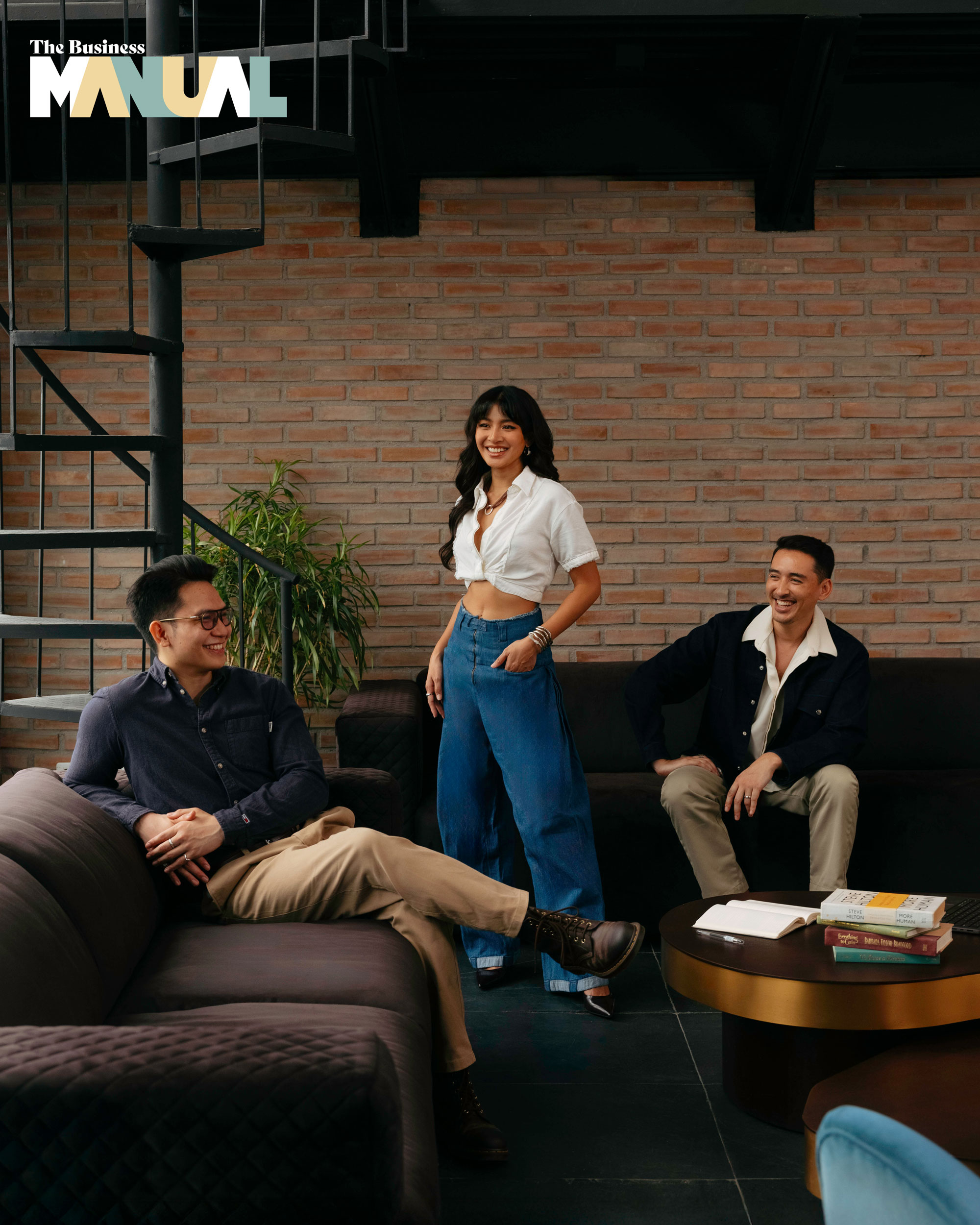
Lesson #1: Find Co-Founders Who Share Your Vision and Values
Choose co-founders who not only complement your skill set but also share your long-term vision. A strong personal and professional connection can sustain the team through inevitable challenges.
For the co-founders of Dehusk, their separate visions began individually but would later coalesce and unite into one.
Sam Tecuala, CEO or self-styled “Chief Coconuts Officer” of Dehusk, explains, “I think the number one glue here is that we understand the vision. We have worked separately on our own paths until our paths crossed, and we ended up doing what we’re good at. I’m on the operations side, Nadine and Chris are really good at building communities, talking to people, educating.”
Sam’s journey began when, during his time spent abroad eating dairy-rich cuisine, he realized he was lactose intolerant–a condition he shares with countless Asians around the world, with some studies estimating that around 70% of the world’s Asian population is lactose intolerant.
This led him to uncover larger problems in the consumption of dairy milk in the Philippines and Southeast Asia in particular. He cites “the fact that 99% of our dairy in the Philippines is imported” as one of the foremost challenges as well as “the environmental problem of dairy.” Together with these problems in the dairy industry, Sam also identified a nutritional problem.
“At the same time,” he says, “we have a micronutrient deficiency problem in developing countries, in the Philippines.”
Meanwhile, Christophe’s journey began when he switched to a vegan diet. To replace dairy milk in his diet, he began making his own plant-based milk. He soon discovered an opportunity.
“We can just take raw materials from nature that are abundant in our country and mix it with water and fortify it. So yes, my idea was like, ‘Oh, I’m going to do this someday.’”
Together with Nadine, Christophe sought to turn their vision into reality and began to search for a partner. It was at that point when the pair met Sam Tecuala, who was already hard at work developing a coconut-based milk.
“I just saw it as a stroke of destiny,” Christophe says of their encounter with Sam. Rather than view each other as competitors, they quickly joined forces because of their shared mission to champion plant-based milk.
“We needed this,” Christophe continues. “It already happened in other countries. But we need to bring it to the Philippines, because especially with coconuts, it’s so abundant.”
Speaking about their shared mission, Nadine says, “We know that we’re working towards the same goal. To disrupt the dairy industry.”
Instead of competing, the three founders of Dehusk realized their values, passion, and goals aligned—leading to an effortless collaboration.
Sam reflects on their partnership, saying, “The number one reason for startups to fail is when the people behind startups, the founders, are not aligned with work ethics, with personal life, with values. Realistically, startups—who do you invest in? The idea, but most importantly, the founders.” It is this unity of vision and values that gives Dehusk one of its greatest strengths.
Lesson #2: Embrace the Lean Startup Mentality
An effective strategy for many startups is to focus on lean operations, optimizing spending and maximizing impact. Instead of pouring money into unnecessary overheads, invest in what drives growth—whether that’s product development, marketing, or customer engagement.
Dehusk, like many startups, operates with a lean startup approach. As a small team, they prioritize efficiency, ensuring that every action contributes to growth without unnecessary expenditures.
“We are a true startup. We are a very lean team,” Sam Tecuala says. “We value the lean startup principle—why spend so much on things that don’t really add value to the startup?“
Despite the company’s lean philosophy, it has big ambitions, seeking to disrupt the dairy milk industry in the Philippines, which is valued at US$1.5 billion.
More than just being disruptive for disruption’s sake, the company seeks to achieve this goal by tapping into a source of massive potential: local coconut farmers.
“99% of [dairy milk] is imported,” Sam explains. “Think about who we are actually helping with this community, right? We are helping people outside of our country… When we produce our coconut milk here, we’re directly helping our own farmers. And it’s such a huge difference because we directly impact the economy and actually hundreds of farmers, eventually thousands.”
With the Philippines being the world’s second-largest producer of coconuts, the potential is clearly there. The coconut industry provides livelihood to about 3.5 million farmers and workers across the country. At the same time, an opportunity exists as the coconut industry faces challenges such as aging trees leading to declining yields. Dehusk hopes to give these farmers a new source of income with its revolutionary product revitalizing the industry and the communities they are present in.
On the marketing front, Dehusk’s lean team acknowledges the challenge of introducing a new product to the market. But with celebrity Nadine Lustre as a co-founder, the team is uniquely suited to meet this challenge.
“We’re really pushing on social media,” Nadine says, “introducing the brand. We have to keep talking about it.”
This push to Dehusk’s young, connected, health-conscious market has already proved to be successful.
“What we’re happy about is that people are very much interested in Dehusk,” Nadine says about the market’s response to the product. “So when we tell them that it’s actually drinkable, like you can drink it straight from the carton, everyone is so interested all the time.”
Sam takes encouragement from product reviews on online marketplaces, adding, “I think the number one win is really that we’ve introduced a product and people love it… The fact that people love our product, it’s just such a huge win.”

Lesson #3: Cultivate an Understanding of Your Product and the Market
A deep understanding of your market’s needs and how your product addresses these needs is essential in business.
Dehusk’s first product, as its founders point out, is not new. Yes, it is the first of its kind in the Philippines, but plant-based milk is commonly available in other markets around the world. What then sets the product apart? Sam Tecuala focuses on Dehusk’s formulation.
He explains, “We did the formulation to mimic dairy’s functionality and nutritional content. Without our formulation, it wouldn’t have the same nutritional content. As for its functionality, you can use it for your coffee, your cereals.”
The strength of Dehusk’s product lies in this uniqueness and how it is a response to what the market is looking for in a dairy milk alternative.
“We have a really strong understanding of how the product works,” Sam continues, “how the market works. We’ve done so much market research, we’ve talked to so many people. We’ve tested the product so many times, we’ve done so much R&D.”
Beyond the product, Dehusk’s founders emphasize how their understanding of the market has been beneficial for the company.
“I think for us, for me and Nadine and Chris, we have a really strong understanding of how the world works. And I think that’s really important because if you don’t relate to the people you’re trying to serve, if you don’t relate to understanding what people like, if you lie to yourself, like ‘This is the best product,’ when actually you haven’t talked to them, it’s a losing battle.”
Christophe adds how today’s consumer is generally more mindful–an important distinction that Dehusk addresses in their communication to the larger community.
“There’s really a demand for more mindful products overall,” Christophe says. “So more sustainable, healthier, better for humans and the animals also at the same time.”
Lesson #4: Build a Product You Genuinely Believe In
Passion and authenticity drive customer trust. If the founders are the biggest advocates of their product, their enthusiasm will naturally translate into marketing success.
There are few celebrities bigger than Nadine Lustre, who has spent years endorsing big brands. For her, the key to authenticity in business is genuine belief in the product. As the public face of Dehusk, she proves that the founders of the company are not just businesspeople—they are users and advocates of their own product, which strengthens their marketing and customer trust.
Nadine shares how endorsing a brand she has a personal stake in has changed how she approaches brand endorsements, saying “It has to be a product that you yourself believe in. When you genuinely love a product, people can feel that intention and authenticity.”
With such a powerful brand rooted in sustainability, in health and social good, consumers can, in turn, internalize and identify with the brand on a personal level.
“I think what’s interesting for me is that people can be proud of [the brand] and take over,” Christophe shares. “They can feel like, ‘Oh, this is from our country, this is us.’ We have our own stuff and they can be proud of it.”
Lesson #5: Make an Impact Beyond Profit
Having a clear mission can be a powerful differentiator. Businesses that focus on sustainability, ethical sourcing, and social impact not only attract customers but also build long-term brand loyalty.
Dehusk is not just about selling coconut milk; it’s about disrupting the dairy industry, promoting sustainability, and empowering local farmers. Christophe Bariou emphasizes that their motivation isn’t solely financial but rooted in creating long-term change.
“We didn’t think about numbers or profits first,” Christophe says. “We prioritized our vision and passion over the financial aspect.”

With this vision and passion at the heart of what Dehusk does, the young company has quickly grown to distribute its products in supermarkets and online marketplaces, recently achieving a significant and personal milestone of selling Dehusk products in Siargao island, an initial step Dehusk’s founders hope that will lead to distribution across the country.
A Startup with Purpose
Dehusk is a shining example of a mission-driven startup that combines innovation, sustainability, and entrepreneurship. By aligning their personal values with their business model, the founders have built a brand that stands out in the business landscape.
For aspiring entrepreneurs, the lessons from Dehusk’s journey serve as a reminder that passion, persistence, and purpose are essential ingredients for success.
Text VINCENT SALES
Photography ALEXIS DAVE CO
Videography OMAR VILLANUEVA assisted by RJ CRUZ
Art Direction ANDREA SANGCO
Sittings Editor RJ LEDESMA
Shoot Coordination TONI MENDOZA
Shot on Location DRAPER STARTUP STUDIOS, P. BURGOS ST., MAKATI