Digital Marketing May 08, 2026
Bookmark feature is for subscribers only. Subscribe Now to save your favorites.

How Millennial PR and Gen Z Social Redefine 2026 Marketing

FacebookXEmailCopy Link
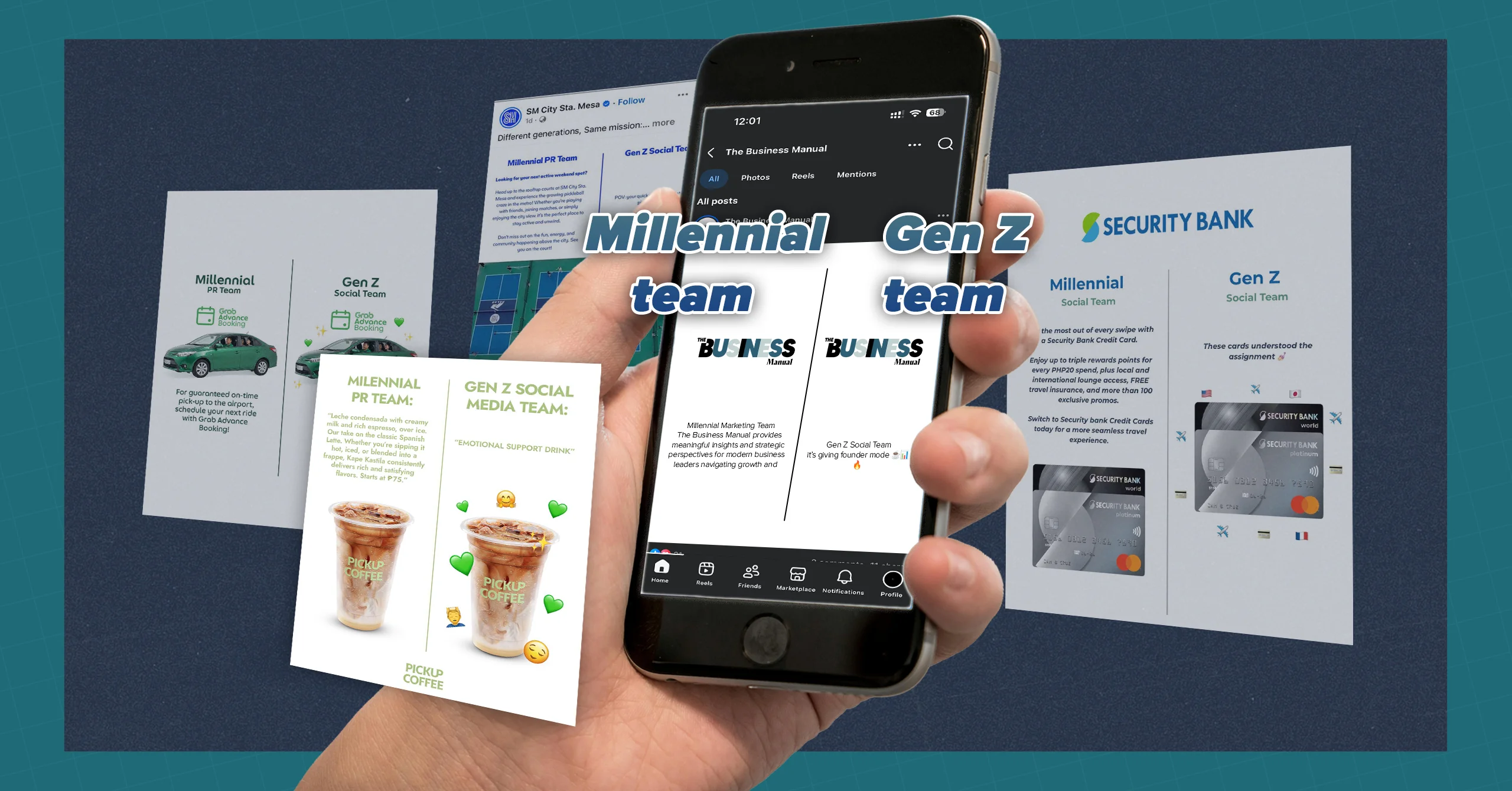
The "Millennial PR vs. Gen Z Social" Trend: What It Means for Digital Marketing in the Philippines. Design by Amiel Angeles.

What started as a humorous online "Millennial PR vs. Gen Z Social" trend has evolved into a reflection of how marketing is changing.

From banks and malls to cars and flip-flops, social media feeds in the Philippines have lately been filled with the same format: one side sounds like a traditional marketing pitch, the other reads as if it came out of a group chat.

Think: 

Secure, reliable, and efficient banking” versus  “Main character wallet energy ✨”

Or, 

We support future-ready innovation that empowers Filipino researchers, startups, and industries” versus “It’s giving ✨funding✨”  

On one side, the “Millennial PR Team” explains a product through polished, benefit-driven messaging rooted in traditional advertising. On the other hand, the “Gen Z Social Team” reframes the same product with Internet humor, emojis, and culturally familiar references.

“It’s a trend that hits on a real vibe shift between how generations perceive public relations [PR] and marketing - one sort of romanticizes it (which must have been approved by many before posting), while the other makes it more attuned to feelings in a more meme approach,” Alexei Villaraza, vice president for Media and Content at Bridges PR, said.

“Audiences today, especially the younger ones, detect 'corporate-speak' a mile away,” he said to The Business Manual. “They don’t want a brand that lectures, they want a brand that gets the joke.”

Why Conversational Marketing and Cultural Fluency Win Over "Corporate-Speak"

The shift from information-heavy marketing to cultural translation is a cornerstone of the 2026 marketing landscape.

Marketing revolves around informing consumers by highlighting features, innovation, reliability, or functionality. Attention, however, is no longer earned through information alone. Audiences want content that feels relatable, entertaining, and culturally aware.

Younger audiences gravitate toward brands that feel self-aware and conversational rather than overly corporate. Phrases like “it’s giving,” “soft life,” or “main character energy” have become emotional shorthand online. They communicate mood and identity in an instant.

Consumers remember how a brand made them feel more than the actual product description itself.

The change is driven by the increasing growth and adoption of Gen Z Filipinos across multiple media channels, said Miko David, managing partner and co-founder of David & Golyat, a digital strategy consulting company.

Data from Global Web Index for Gen Z Filipinos taken between Q4 2024 to Q3 2025 show that brand discovery via billboards rose by 30.8%, he said.

Word-of-mouth recommendations, meanwhile, grew by 22.4%. Discovery via search engines also increased by 19.2%, while awareness via online retail sites like Shopee, TikTok Shop, and Lazada grew by 14.9%.

"Marketers are paying attention to the messaging they relay to Gen Zs across all these channels (and not just social media)," Mr. David said to The Business Manual.

This content is available to our subscribers. Join our community to access premium content and elevate your business knowledge.

Already a subscriber? Login
OR
ANNUAL
1,000
per year
SEMI-ANNUAL
500
per six months
QUARTERLY
250
per three months
MONTHLY
100
per month

Frequently Asked Questions

The Millennial PR approach focuses on polished, benefit-driven messaging and "corporate-speak" rooted in traditional advertising. In contrast, Gen Z social media messaging is conversational and "unhinged," using internet humor, memes, and culturally familiar references to make a brand feel more relatable and self-aware.

Cultural fluency is vital because consumers, especially younger audiences, prioritize emotional resonance over information-heavy marketing. In 2026, 78% of marketers prioritize keeping up with cultural trends as a primary skill, as it helps brands earn trust and participate naturally in the digital spaces where their audiences live.

This phrase means that social media performance now depends on how well a brand aligns its creative strategy and messaging with genuine user intent. Instead of broadcasting a generic message, brands must align their content with what the audience actually wants to see to succeed in the 2026 digital landscape.

According to HubSpot’s 2026 report, personalized experiences are highly effective, with 93.2% of marketers stating that personalization has led to an increase in leads and purchases. Consumers today seek authenticity and content that "feels like them," such as seeing products on relatable body types or receiving behavior-based messaging.

The most effective strategy is to let the social media team take a bold, agile, and provocative stance to stand out digitally, while the PR team provides "Intelligent Protection" in the background. This ensures the brand stays personality-driven and conversational without sacrificing its long-term reputation and strategy.

Patricia Mirasol

Patricia Mirasol

Managing Editor

Patricia Mirasol has spent the better part of a decade telling stories that matter, and building the teams and platforms to tell them well. A former multimedia journalist and producer at BusinessWorld — where she covered health, technology, and MSMEs and eventually co-led the online team — she's now managing editor at the refreshed The Business Manual.

Her work has been recognized by the Philippine Space Agency, the Philippine Press Institute, and the Department of Science and Technology, and spans articles, podcasts, videos, and immersive long-form features on topics close to everyday Filipino life: motorcycle taxis, water systems, and beyond.

More From Digital Marketing

Digital Marketing

From Digital to Intelligent: The New Age of AI-Powered Marketing

Digital Marketing

How Women Drive Human-First Growth in Digital Marketing

Digital Marketing

DigiCon Tackles Interoperability and Collaboration in Its 11th Year

Digital Marketing

Canva, ChatGPT Bring AI Into Design Workflows

Learn straight from the top CEOs and business leaders. Access exclusive articles and videos.

Subscribe Now