Features July 01, 2026
Bookmark feature is for subscribers only. Subscribe Now to save your favorites.

Business Community, Stakeholders Back a Circular Economy Through Legislation

FacebookXEmailCopy Link
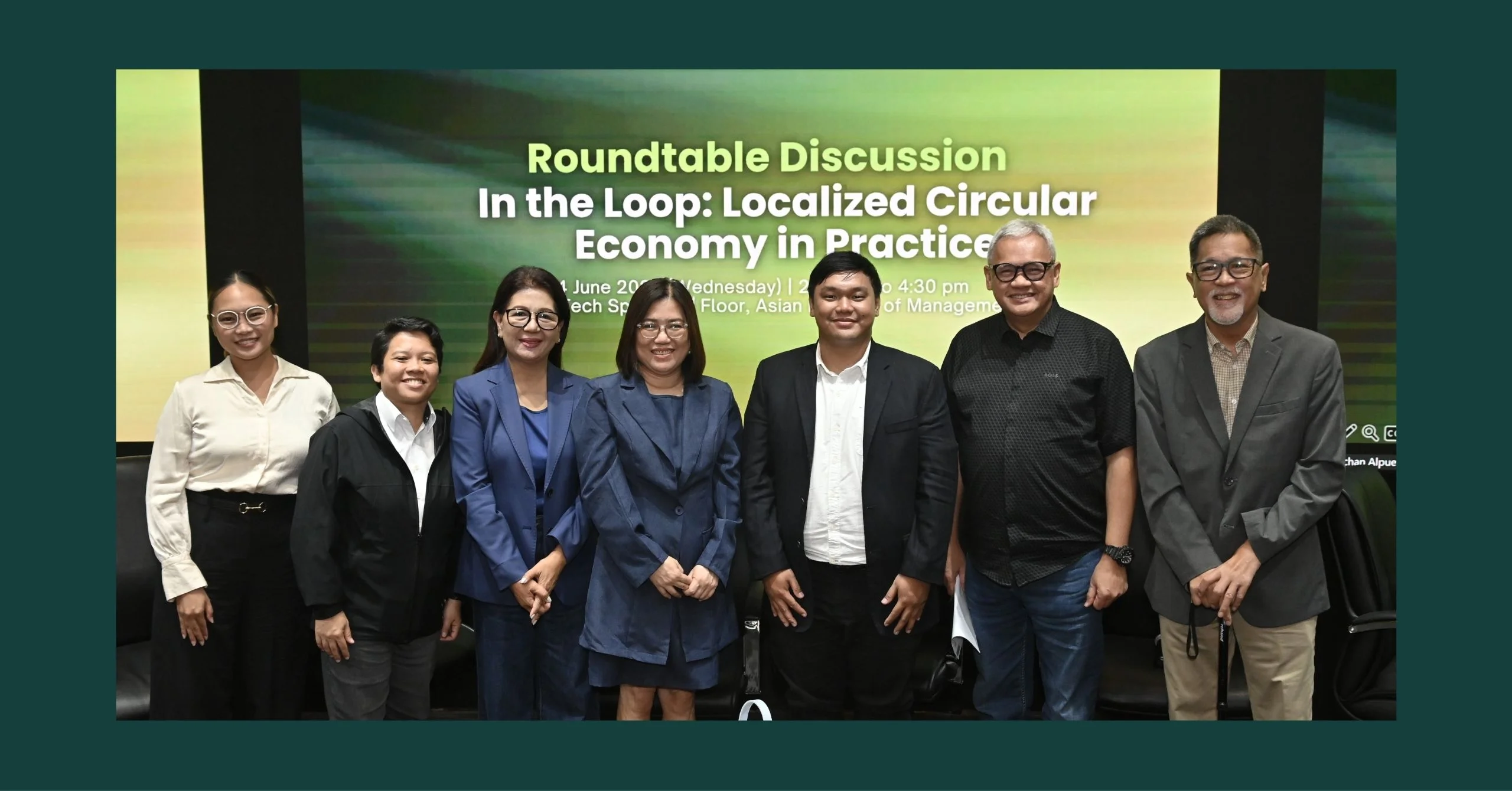
Business owners, local leaders, and government officials met at AIM Makati to discuss current waste management policies.

Business owners, local leaders, and government officials met at AIM Makati to discuss current waste management policies.

Community leaders, government officials, and business owners focused on building a waste management system as the foundation of the Philippine circular economy in a June 24 discussion by Liveable Cities Philippines.

Sustainability and the call to create a circular economy have now been embraced by many in the business community, Liveable Cities Philippines Chairman Guillermo Luz said.

Reducing the need to deplete new resources by recycling and reducing waste also has a business impact, he told The Business Manual at the sidelines of the event held at the Asian Institute of Management in Makati.

“It makes sense for society to divert away from landfill and either extend the life of a product or recycle it into a new product — not necessarily for its original use, but into another use — so that we save on raw materials and on real estate or landfill costs,” he said. “I think that's a powerful enough argument to make.”

Rethinking Waste Language to Drive Behavior Change

There needs to be a change in how waste management is conveyed, according to Ivanna Aguiling-Dela Torre, senior director for East Cluster ASP PACS at Coca-Cola Philippines.

Phrases like “recycle this,” for instance, can be used instead of the term “recyclable.”

These shifts in how waste management is talked about may also encourage people to be part of the solution, she said during the discussion.

“In terms of behavior, we’re hard-wired as people to follow things when it’s told, when it’s an action rather than having to understand the technical term,” she added.

The waste categories provided by the law do not match what is recyclable in practice, such as in the sachet packaging used in consumer products, pointed out Marilen Malabanan, supervising environmental management specialist at San Fernando, Pampanga.

“The problem is the packaging remainers (residuals of the packaging), which are low-value plastics, and the low-value plastics cannot be recycled anymore,” she said in the event.

Low-value plastics are discarded plastic materials where the cost of recycling exceeds the revenue generated from the recycled output. 

Another suggestion put forth was the simplification of waste categories.

“Those [garbage] going to the landfill, those that value, recycle, and can be used another time, and those that can be subject to composting,” said Isaias Ubana, mayor of Lopez, Quezon. “At least three.”

This content is available to our subscribers. Join our community to access premium content and elevate your business knowledge.

Already a subscriber? Login
OR
ANNUAL
1,000
per year
SEMI-ANNUAL
500
per six months
QUARTERLY
250
per three months
MONTHLY
100
per month

Frequently Asked Questions

The Ecological Solid Waste Management Act of 2000 is the Philippines' national policy governing solid waste handling, segregation, and disposal. Business and government stakeholders at a June 2026 Liveable Cities Philippines discussion at AIM Makati called for its review to better support a circular economy.

Business leaders argue current waste categories don't reflect what's actually recyclable in practice, particularly low-value plastics like sachet packaging residuals. Liveable Cities Philippines Chairman Guillermo Luz noted that diverting waste from landfills also reduces raw material and real estate costs for companies.

San Fernando's waste diversion rate rose from 12% in 2012 to 80.69% in 2018, per the UN Secretary-General's Advisory Board on Zero Waste. The city decentralized waste management to the barangay level, providing Materials Recovery Facilities and collection equipment to support source segregation.

Lopez, Quezon Mayor Isaias Ubana cited cultural resistance, households lacking segregation bins, and barangay officials hesitant to enforce rules for fear of losing elections. Lopez addresses this through provided bins, barangay incentive programs, education sessions, and penalties for non-compliance.

Coca-Cola Philippines' Ivanna Aguiling-Dela Torre argued that action-based phrasing like "recycle this" is more effective than passive terms like "recyclable," since people respond better to direct instructions than technical labels — a behavioral framing shift discussed alongside proposals to simplify waste categories into three types.


Mikael Borres

Mikael Borres

Writer

Mikael Borres is a writer for The Business Manual, authoring articles about Philippine small businesses, economics and finance. His work with the publication has a strong focus on uplifting Philippine micro, small, and medium enterprises (MSMEs) with fundamental business lessons and leadership insights.

Mikael has written pieces on evolving business trends and technology, as well as articles on branding and human resources. He also writes people-centred feature articles highlighting the work and stories of Filipino entrepreneurs and executives. He also covers events for the The Business Manual, highlighting developments in the Philippine business scene.

Mikael graduated from the University of San Carlos with a Bachelor of Arts in Political Science, majoring in International Relations and Foreign Service (IRFS).

More From Features

Features

How Philippine Consumer Fairs Create Opportunities for Small Businesses

Features

Levanto Restaurant Hub Hosts Lifestyle Asia’s ‘Crave’ Launch in Makati

Features

The Economic Impact of LGBTQ+ Entrepreneurship in the Philippines

Features

The Purple Gold Rush: Can the Philippines Keep Up With the Global Demand for Ube?

Learn straight from the top CEOs and business leaders. Access exclusive articles and videos.

Subscribe Now