Enabling Global Trade for SMEs: How ZendEase Opens Doors for Filipino Entrepreneurs Through Logistics Innovation


How Mel Nava of ZendEase by 1Export built a company dedicated to empowering local SMEs in global marketplaces

When a small Pangasinan-based company selling bottled bangus approached ZendEase, it knew little about exporting. Yet through ZendEase, the company called Elisha Bay, soon found itself exporting to the US and scaling up the business to become a valuable source of employment in the Dagupan community. In essence, this is what co-founder and CEO Mel Nava does with her startup ZendEase. “I want you to go global,” she says. “Our mission from the very beginning has always been helping businesses go global.”
This is a bold statement in an import-dependent country like the Philippines. Where other Asian countries have developed through export-based economic strategies, the Philippines maintains a large trade deficit, importing everything from cars and mobile phones to food staples like rice and onions. Despite this, in a counterintuitive twist, exports are a significant driver of the local economy–and they are growing. Electronic products like semiconductors and manufactured goods top the list of Philippine exports, which were collectively responsible for 28.39% of the Philippines’ GDP in 2023.
Large businesses are behind most of these export industries. But through ZendEase–and a fortuitous mix of tech solutions and globalized markets–Mel Nava wants to change this reality. “Exporting is possible whether you are from the province or Metro Manila,” she says, “whether you have a lot of money or not.”
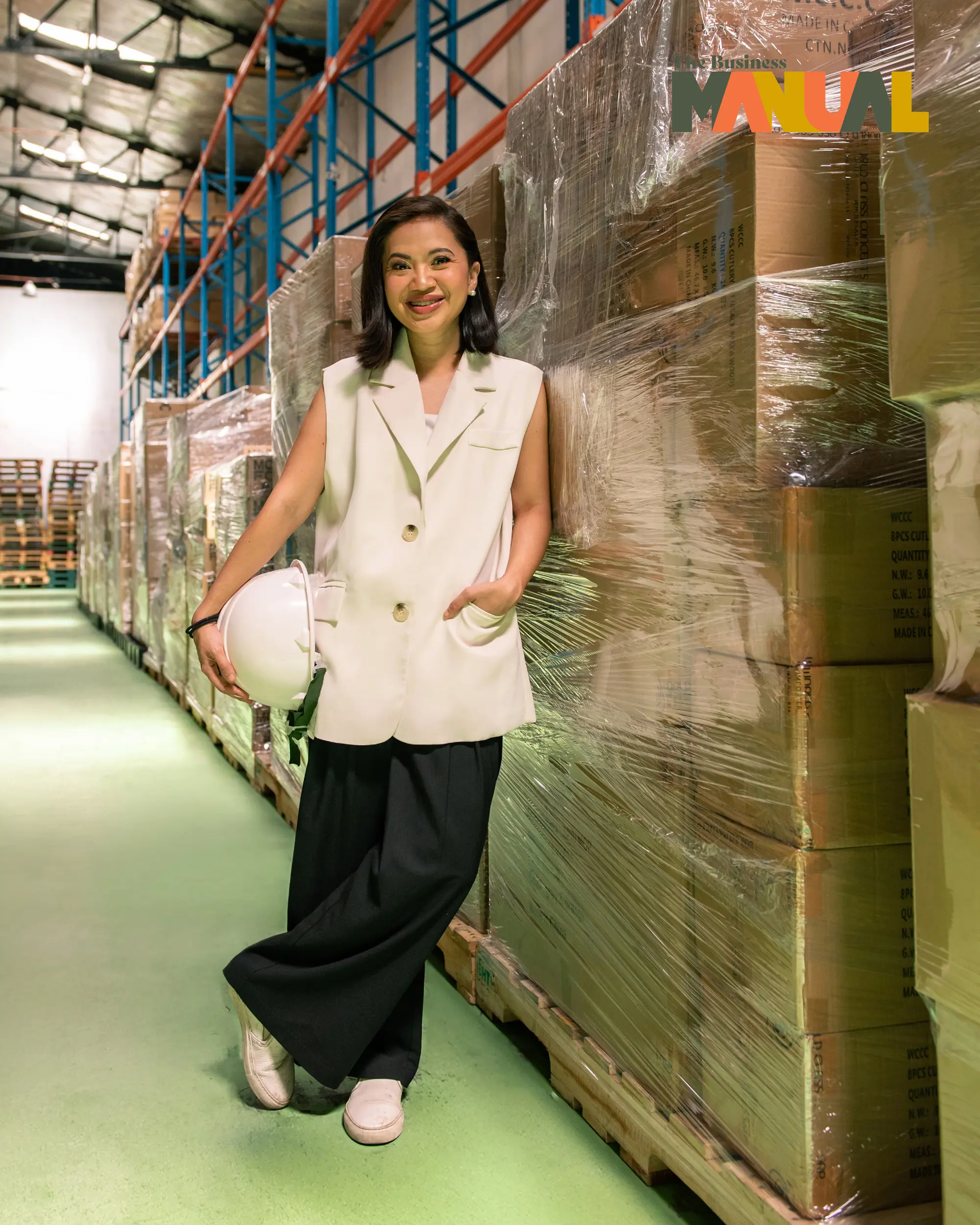
The Business Manual spoke to Mel Nava, co-founder and CEO of ZendEase by 1Export to talk about how she built her startup to empower SMEs. In ZendEase’s warehouse in Alabang, which was bursting with goods for export, Nava tells us how her company enables SMEs while sharing the remarkable story of her startup’s success. Her journey provides valuable lessons for both entrepreneurs and small business owners alike about the challenges of building a startup as well as the opportunities waiting for those brave enough to take the leap into exporting.
Lessons for SMEs
Lesson #1: Export Takes Investment
When Mel Nava co-founded what is now known as ZendEase by 1Export, her goal was simple yet ambitious: help small and medium enterprises (SMEs) in Southeast Asia “sell and send with ease.”
She established 1Export in 2016, and today, under the name ZendEase, the company has grown into a thriving cross-border trade platform, serving businesses from the Philippines, Indonesia, and Vietnam, and enabling them to export to over 90 countries.
One of Nava’s earliest challenges was overcoming perceptions about exporting.
“[Small business owners] thought that exporting was difficult, it was expensive, and it was time-consuming,” she says. “So being able to break those notions, being able to make them understand that exporting does not actually have to be difficult, and that global trade was possible with just a little investment, we thought that we would be able to really change the way people thought.”

Through educational initiatives, ZendEase taught SMEs that if they really wanted to go global, they had to make an investment.
“It’s not an overnight thing,” Nava continues. “It takes a lot of time and it takes a lot of commitment to be able to do that. But it does not have to be hard, and that’s why we are here. We really try to make this process of going global as easy and as seamless as possible, and even as cheap as possible.”
Lesson #2: Go Global, Leverage Local Strengths
With accessibility to local markets possible, what products then are best for export and what countries are hungry for Philippine exports?
Nava’s experience tells her that exporting is more than just moving goods across borders—it’s about storytelling, cultural pride, and empowerment. She champions the uniqueness of local products like Philippine mangoes, calamansi, and ube, and sees diaspora communities as natural bridges to global markets.
“In the United States, you have 2 to 3 million Filipinos,” Nava cites. With an eye on the disruptive tariffs imposed by US President Trump, she continues, “Regardless of anything that could happen over the next year or the next month, what we’re seeing is people will still need products that are distinctively Filipino.”
Beyond the United States, Nava names countries that have large Filipino populations such as Canada, Australia, and the Middle East.
Lesson #3: Take Advantage of E-Commerce
According to Mel Nava, e-commerce is a rising trend that favors SMEs looking to export.
“Global e-commerce has not been more accessible than it is today. You go online, you make an account, and if you’re committed to putting time and effort into that account, you’re able to sell worldwide.”
Perhaps what is most remarkable about e-commerce is this ease of accessibility. And because of its ease and simplicity, ZendEase has been able to cater to SMEs from all over the Philippines from Baguio to Davao, Zamboanga, and Cagayan de Oro.
“We really don’t discriminate in terms of the province you’re at,” Nava explains. “Regardless of how far you’re from, it’s important for us to be able to help you ship your products to the global market.”
ZendEase aids these SMEs in three key areas: compliance, sales and logistics. And today, the company ships to about 91 markets globally, boasting of a 100% port clearance rate in all of these markets.
Lessons for Startups
Lesson 1: Define What Matters—and Focus On It Relentlessly
One of the most enduring lessons Mel Nava learned was the importance of focusing on what truly matters. As the company evolved through the tumultuous years since its founding in 2016—including the pandemic and global economic shifts—Nava zeroed in on three critical priorities: her employees, her customers, and the market.
“I want to be able to make sure that the company will survive and withstand the test of time,” Nava says. “You need to be able to clearly define what matters in your head.”
This focus became her compass, helping her navigate uncertainties and make tough decisions, from changing business models to opening new markets.
Central to ZendEase’s focus to its customers is bringing down the cost of exporting. Comparing Southeast Asia to China, where the cost of logistics is minimal, Nava explains that it is important for ZendEase to reduce the cost of logistics in Southeast Asia.
She says, “We have to get to that point so that small businesses in Southeast Asia, regardless of the market, are competitive–and are competitive at scale.”
It is this dedication to customers’ needs that drives ZendEase to relentlessly find ways to do things better, cheaper and easier. Nava says, “For us, we really look to find ways in terms of how we can bring those costs down. It’s not because we want to get into a price war. We just feel like there has to be a better, cheaper, faster, and easier way to be able to do all of this.”
Lesson #2: Adaptability Is Essential
Like many startups, ZendEase has had to pivot and change its business model through the years. Instead of clinging to static plans, Mel Nava embraced adaptability.
“You have to be honest with yourself and learn how to adapt,” she explains. “If a business model is not working, let it go.”
An example of this adaptability is ZendEase’s shift into logistics. Initially, Nava avoided logistics because she candidly admits that she didn’t think she could do it well. However, customers kept voicing pain points around shipping and customs. And being focused on her customers, Nava eventually relented.

She says, “Our small businesses would tell us, we need a better way to be able to ship products abroad. And we need it not just to be cheaper, but [we need] to have a better experience in terms of customer service, in terms of being able to clear the goods, or being able to understand why the goods got held.”
This iterative, customer-led approach has become a hallmark of ZendEase’s growth. To help the company adapt, new business ideas are often tested as experiments, then later scaled into sustainable services.
“A lot of the things that we do are based on experiments,” Nava explains. “We run several experiments and then eventually convert them into a more sustainable business model. That’s how we’ve been able to adapt, not just to a pandemic, but also through different crises.”
The Vision for ZendEase
Mel Nava’s long-term vision for ZendEase by 1Export is crystal clear: to become the easiest way to sell and send worldwide. As her company nears profitability and eyes new markets, Mel remains grounded in a mission that’s as much about impact as it is about innovation.
“Every time we face a challenge, I ask: will this help a small business go global?” she says. “If the answer is yes, then we do it.”
With that clarity and conviction, Mel Nava continues to chart a path that’s transforming not just businesses from Pangasinan to Davao, from the Philippines to Vietnam, but also the livelihoods of countless entrepreneurs and the communities they are a part of.
Text VINCENT SALES
Photography KIERAN PUNAY of KLIQ INC.
Videography JR RAMIREZ of KLIQ INC.
Art Direction ANDREA SANGCO
Sittings Editor JILL TAN RADOVAN
Shoot Coordination TONI MENDOZA
Shot on Location LOGICORE SB2 WAREHOUSE, ALABANG, MUNTINLUPA
More From Features