Insight-Led Excellence: How Wildflour Cooks Up Success Using Analytics, According to CEO and President Ana Lorenzana de Ocampo


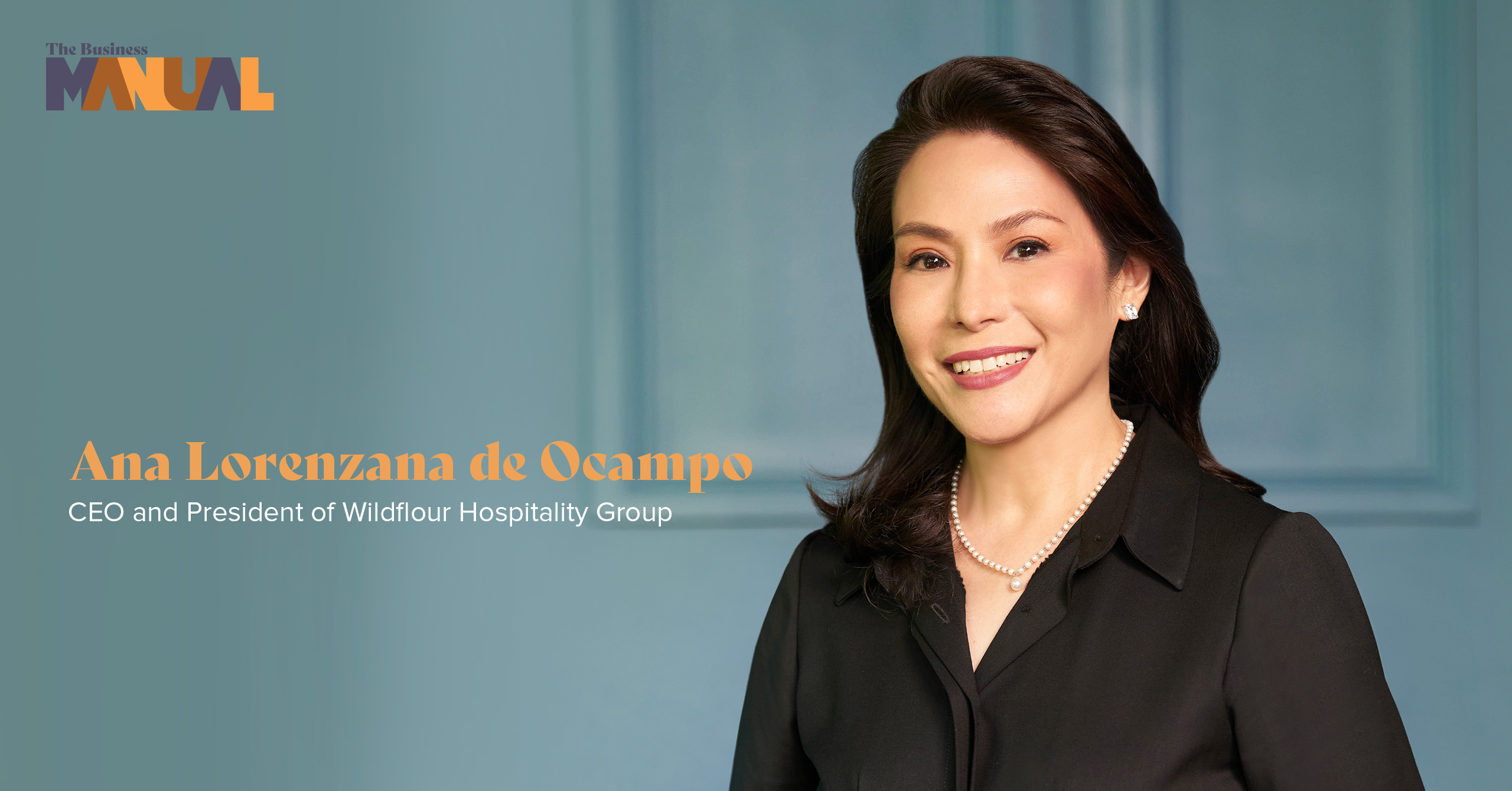
The Business Manual takes a closer look at the culinary art and corporate science that has led to the phenomenal rise of the Wildflour Hospitality Group.
Everyone wants to be like Wildflour. Particularly, if you’re an entrepreneur in the restaurant business—and entrepreneurs in the PHP 643 billion food service industry are legion—Wildflour is the company you aspire to be. In the past 12 years, the Wildflour Hospitality Group has grown at a staggering pace. At the same time, it has cultivated an enviable position in the industry by running with its organic success, franchising international brands and creating fresh new restaurant concepts. Together, these efforts have provided golden prospects ahead—a period of sustained growth when the food service sector is expected to grow into a trillion-peso industry by 2027.
Ana Lorenzana de Ocampo, the Wildflour Hospitality Group’s CEO and President, has done all of this while staying true to the chef-driven passion that birthed the first Wildflour restaurant. At the same time, she has nurtured the business, grown her corporate team, and embraced technology and data, the transformative tools of today’s entrepreneurs.
In 2012, Ana and her sister Margarita Lorenzana-Manzke put up the first Wildflour branch at the ground floor of the Six/NEO building in Bonifacio Global City. Since then, the original Wildflour concept (“straightforward brunch, all-day dining, comfort food”) has evolved and multiplied into restaurant concepts such as Little Flour, Wildflour To-Go and Pizza Sisters. The company has ventured into international franchises like Pink’s Burgers, Hot Dogs & Shakes and created homegrown concepts like George and Onnie’s. In total, one restaurant concept has multiplied into eight thriving brands, with more on the way. One restaurant branch has grown into 22, with 10 more to be launched in the coming year. And a small passionate team of chefs has become an army of 1,500 employees in the Wildflour Hospitality Group.
The Business Manual spoke with Ana Lorenzana de Ocampo, CEO and President of the Wildflour Hospitality Group to gain insight on the company’s phenomenal success, at the Village Bar in Salcedo, Makati—which is, yes, yet another Wildflour company. In this exclusive interview, she shares her entrepreneurial journey and the ingredients that shaped the company’s success from its inception to its bright future.
Key Ingredient #1: Being a Chef-Driven Organization
The dramatic growth of Wildflour has always dominated headlines, as have the accompanying accolades to the restaurant’s cuisine. And yet, the rise of Wildflour is only half the story. The other half, which Ana shared with The Business Manual, is, in a manner of speaking, behind the scenes, behind the wait staff, in the kitchen.
Throughout the interview, Ana spoke again and again about two ingredients that contributed to Wildflour’s success.
The first ingredient is being a chef-driven company.
“I'd like to think that Wildflour is led by a very chef-driven organization,” Ana says. “A lot of our chefs have decades of experience in the best kitchens abroad and have gone to, also, very good schools… It's not only the passion that they have, but it also is the first-hand knowledge that they have in terms of food preparation, in terms of concocting recipes and all these things. And I think that's one of the edges that we have, that we have a very chef-driven organization… We don't take shortcuts in anything that we do.”
She adds, “I do strongly believe that most of our executives being chefs themselves means there’s more authenticity and genuine passion in the way the company is steered, and gives an edge over those whose management are only one or the other.”
Like a great chef, the chef-driven organization that is Wildflour, operates with passion and meticulous detail. At the same time, it allows for intuitive leaps, improvisation and creative flights of fancy.
Key Ingredient #2: Corporate Organization
The second ingredient is the Wildflour Group’s corporate organization.
Like a great baker, the corporate organization of the Wildflour Group, relies on proper structure and adherence to best practices and procedures. It measures itself to exacting standards to ensure its growth.
“Even if [the company is] chef-driven,” Ana says, “I'd like to think that we have a very strong corporate organization that is behind the chef, that supports the chefs. And this helps the chef make the right decision.
“It kind of guides their intuition instead of just guessing or maybe [relying on] gut feel. And I think, with the chefs or the restaurant side working together with the corporate side of the business, when these two go hand-in-hand, it really makes for a great formula to fuel the growth of a company.”
Together with corporate organization, Wildflour is also a data-driven company.
Technology has been instrumental in meeting customers where they are—which is online. From point of sale to online ordering platforms, technology has been critical in helping Wildflour to scale up. And with this investment in technology comes information: data that informs Wildflour management in its decision-making.
Ana explains “Our company is a very data-driven company now, and we see the numbers, we see reports. And it's also based on data that guides us.”
A Life-Long Passion for Food and Business
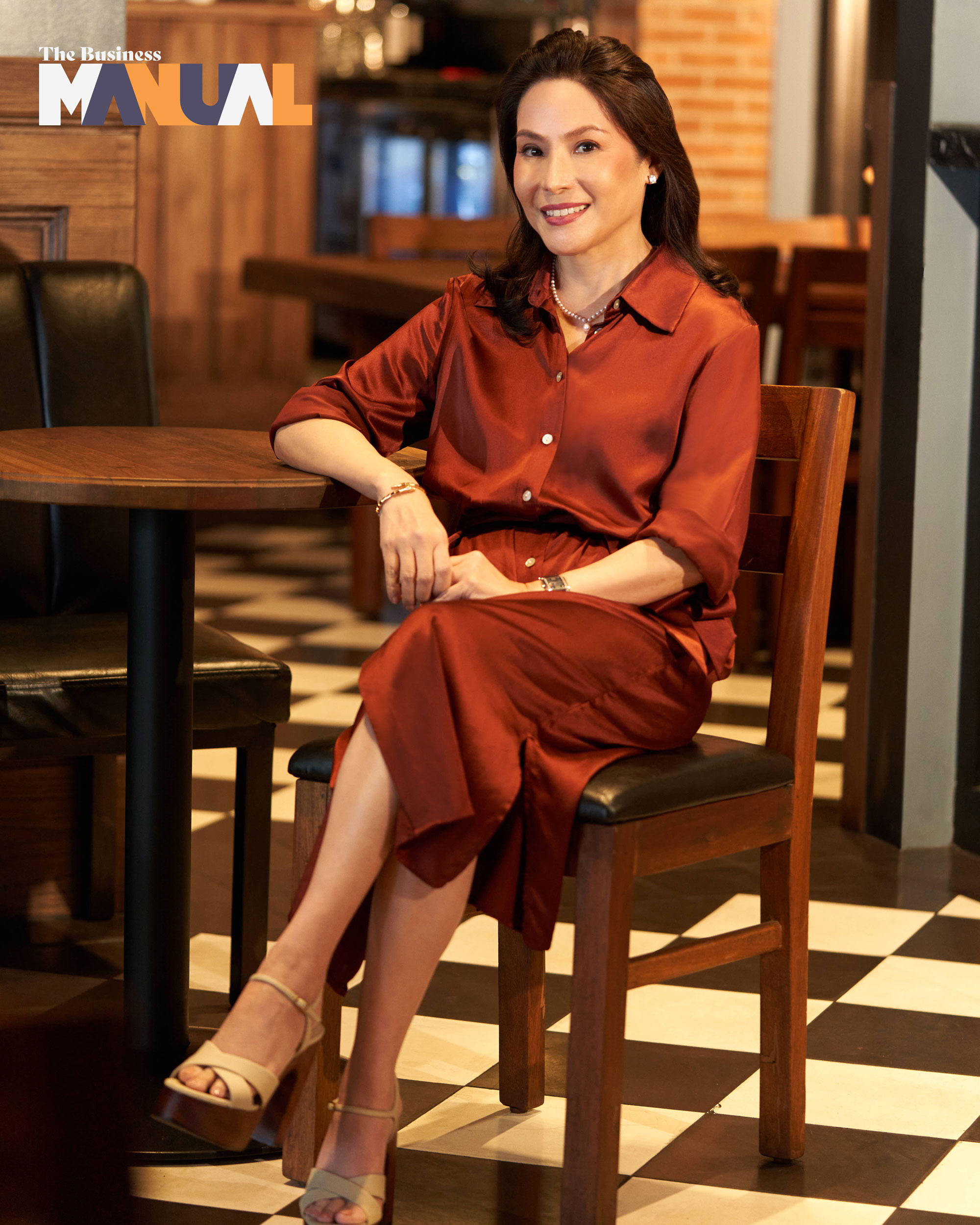
Seeing the end-product that is the Wildflour Group’s restaurants, it can be easy to overlook the long journey that led to each concept. In Ana’s case, Wildflour was born from a lifetime’s worth of experiences, which began with her family.
Speaking about her formative years, Ana says, “My family’s life-long passion for food and business, and my experiences working with and around their businesses growing up, taught me the meaning of good food and industry and inspired me to eventually pursue culinary and dream of one day becoming a restaurateur in my own right.”
Ana recalls learning how to bake bread and working as a cashier at her grandmother Amelia’s bakery in Olongapo. She remembers summers spent in the kitchens of her parents’ Whiterock Resort in Subic. As a child, she even worked the line at her father’s factory for the iconic Lorins Patis brand.
“I think these experiences were very formative in really inspiring me with my love for food and my passion for food,” Ana continues.
She credits the women in her family for this passion for food and business, saying, “I come from a family of very strong women. My mom and my grandmother, they're both entrepreneurs, and their love language is food.
“And because of that, I got exposed to sharing, sharing food. And now I want to share as much food as I can to as many people as I can in the form of my restaurants.”
Early Entrepreneurship
When it comes to entrepreneurship, Ana credits her father for influencing her in that direction. She says, “It was my late father encouraging me and my siblings to eventually engage in our own business ventures that really taught me what it means to be an entrepreneur.”
Out of college, Ana and her brothers put a restaurant called Barbecue Hut in a small 30 square meter space.
Ana says, “We thought we had the best barbecue. We thought we had the best location because there was a lot of foot traffic. We thought we had a beautiful little store and we said, okay, we're going to make money here.”
Nevertheless, the venture failed. “It was really a very good product,” Ana says. “But you know what? After a few months, we just had to close the business.”
Today, Ana is thankful for failing early. Like many entrepreneurs, she takes failure as a learning experience.
“I think this was even a better lesson,” she says, “even more than a real MBA program.”
She returns to her father’s guidance and how he never blamed Ana and her brothers for failing in this business. She recalls, “He said, ‘This is something that you should keep and learn, in the future.’ I guess I learned a lot from those mistakes. And I carry it with me.”
Through this first attempt at entrepreneurship and through the various experiences in her life, Wildflour began to take form. Ana took each learning and carried it with her until the time was right.
From her education in the University of the Philippines studying Hotel and Restaurant Management, Ana says she learned the fundamentals of running a business.
From her studies in Le Cordon Bleu in London, she learned “the technique and the skill.”
And from being Director of Purchasing in Office Warehouse, another family business, she learned how to negotiate directly from her father.
“A lot of learnings, really, from all these experiences,” Ana says. “And I'm glad that I can still carry it with me up to this day.”
Starting Wildflour
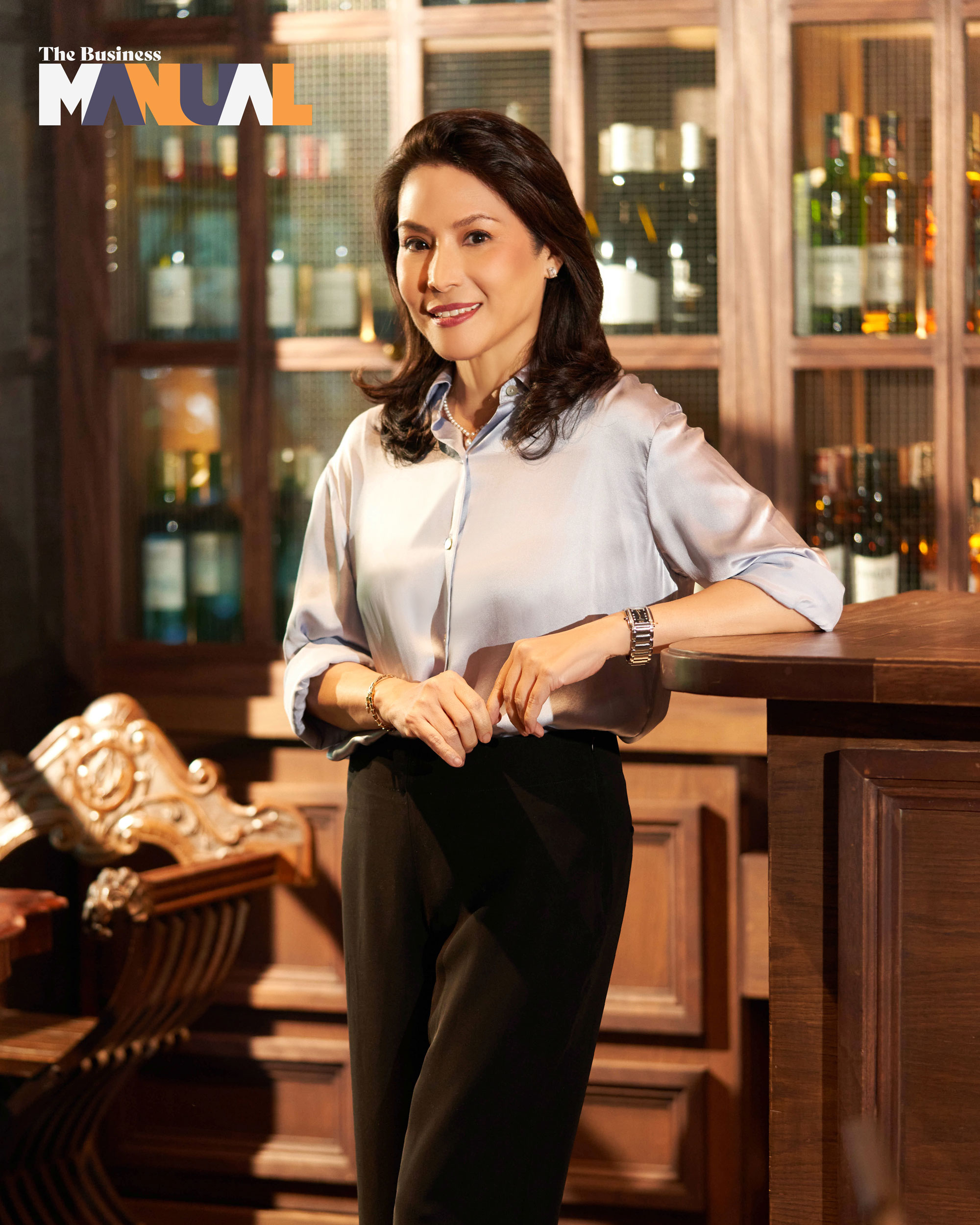
The origins of Wildflour began during Ana Lorenzana de Ocampo’s time in Office Warehouse, a business founded by her two brothers. While serving as Director of Purchasing, she decided to open a small bakery with her sister and co-founder Margarita, as a hobby.
The hobby soon took over. Ana recalls, “And then it ended up like me having to take a leave. And then I told my brothers, I don't think I can go back to Office Warehouse… It was becoming very busy. And I had to devote more time to Wildflour.”
Initially, Ana wanted Wildflour to be in the malls. Fortunately, things didn’t work out as she had hoped.
“12 years ago, the malls were the place to be. All the foot traffic was in the malls… Hardly anybody was in a building where we are right now, in the CBD... But I was rejected. And that's another lesson.”
While searching for a location for a branch of Office Warehouse, Ana found the space where the first branch of Wildflour would grow: the ground floor of the Six/NEO building in Bonifacio Global City
“I said, it makes so much sense to put a business here in a space like this… And so I submitted my proposal. And I was surprised that they accepted it.”
Against the advice of many, she went ahead with that first location.
Ana recounts, “Even the broker said, ‘I think it might not be a good idea because those things are reserved for multinationals or banks or whatever.’” But Ana found a supporter in the owner of the Six/NEO building and the CEO of NEO, Raymond Rufino.
“So [Raymond Rufino] was the only one who believed in it,” Ana says. “But just try, you know, why not? And I was surprised. I went home that day. I wrote that whole proposal and I gave it.”
Organic Growth
For Ana and Wildflour, success didn’t come right away. “So when we opened,” she says of Wildflour’s launch, “it was very dark.”
In those early days for BGC, buildings were still sparse and there was hardly any foot traffic in the area.
Ana recalls, “My friends were saying, ‘Ana, I think you made a big mistake. Why did you build there? It's so dead.’
The first days of Wildflour were difficult for Ana. She says, “So the first day was empty. And then the second day, we decided to open just for breakfast and then breakfast and lunch. And it wasn't getting busy.”
However, fortunes would soon change. All the hard work and the lessons Ana had learned would pay off.
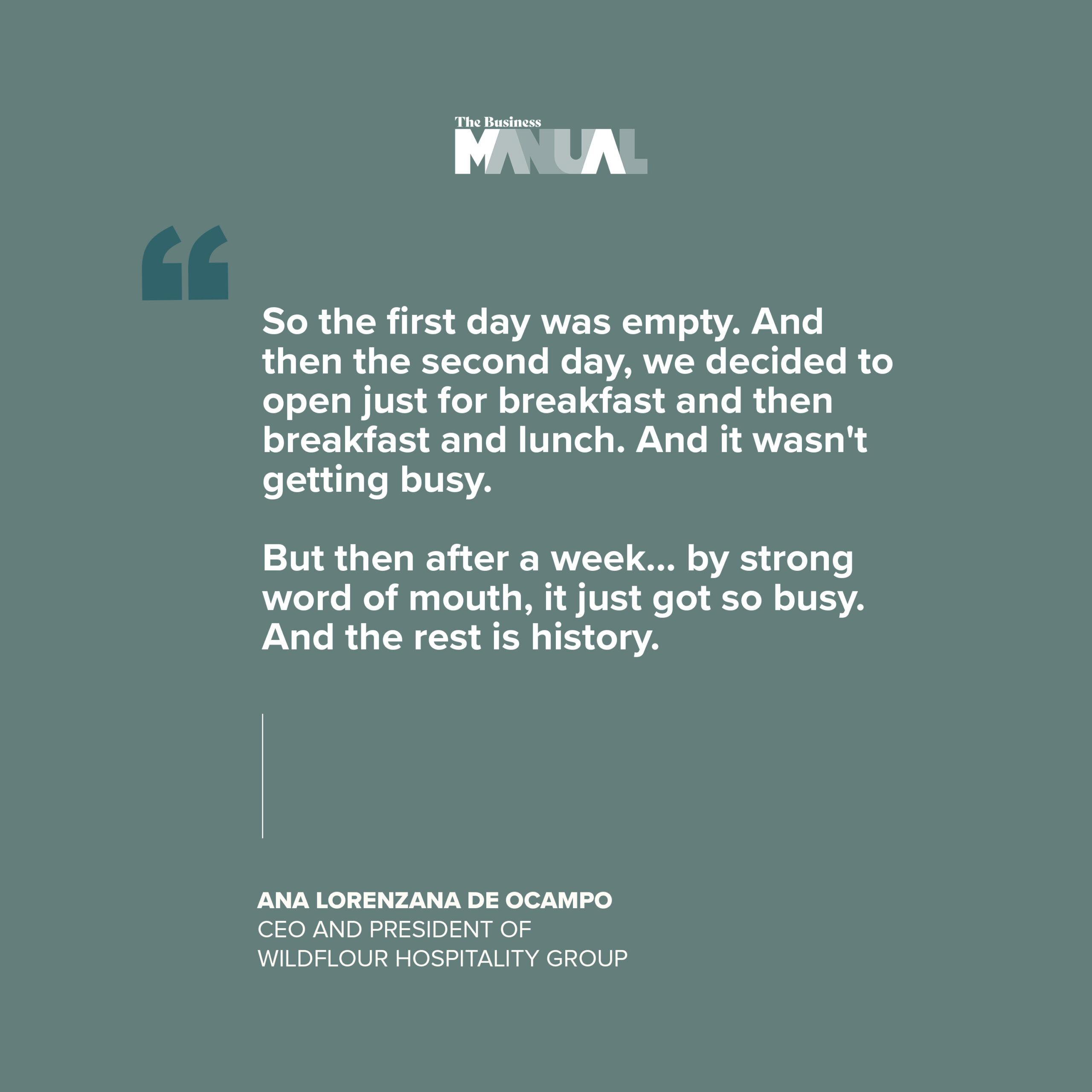
“Then after a week,” Ana says, “by strong word of mouth, it just got so busy. And the rest is history.”