Power Pairing: Expanding Global Restaurant Chains as Partners in Business and Life According to CEO Eric Teng and CFO Emelda Teng of Mango Tree, Genki Sushi, and Sen-Ryo


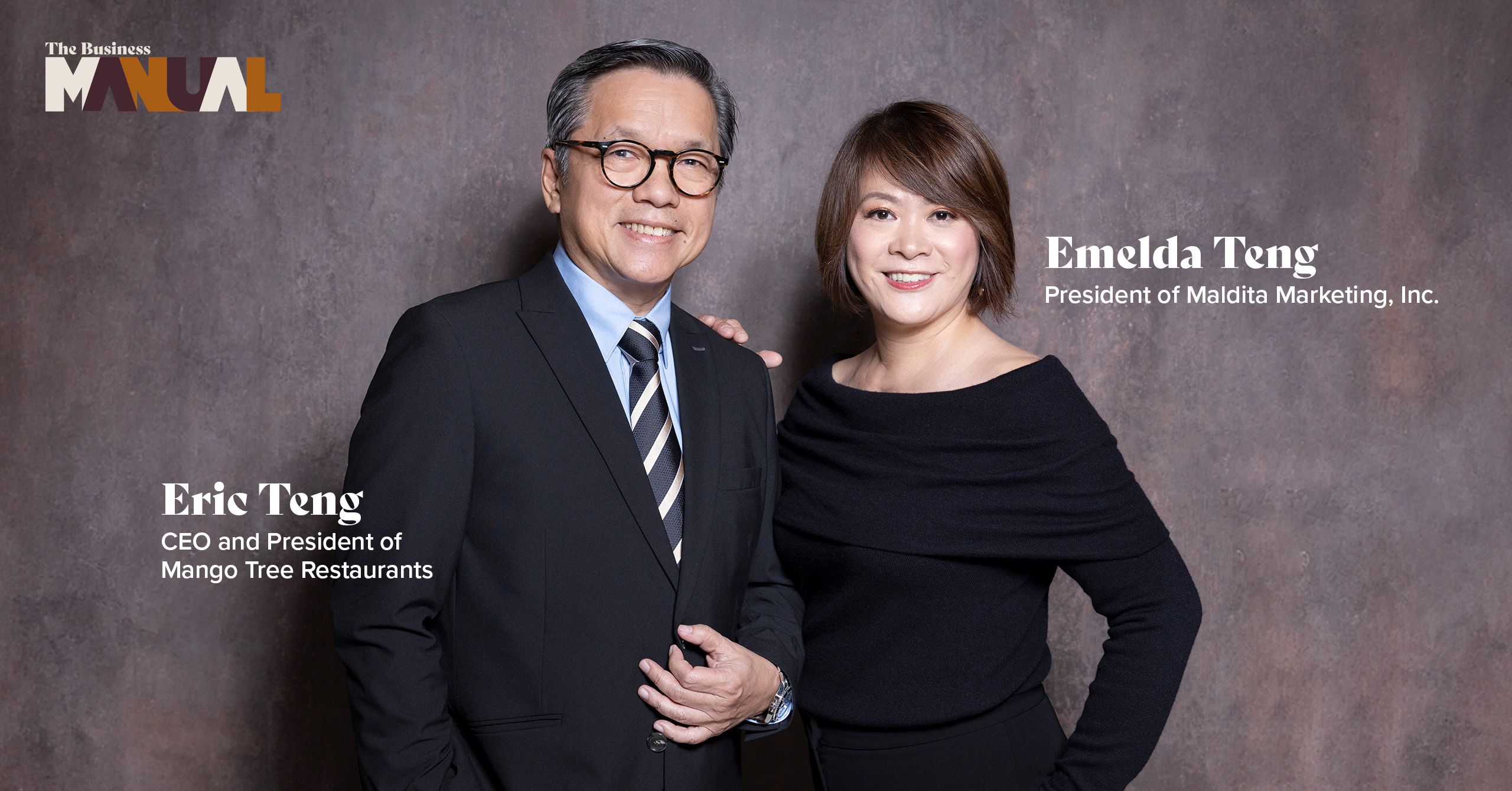
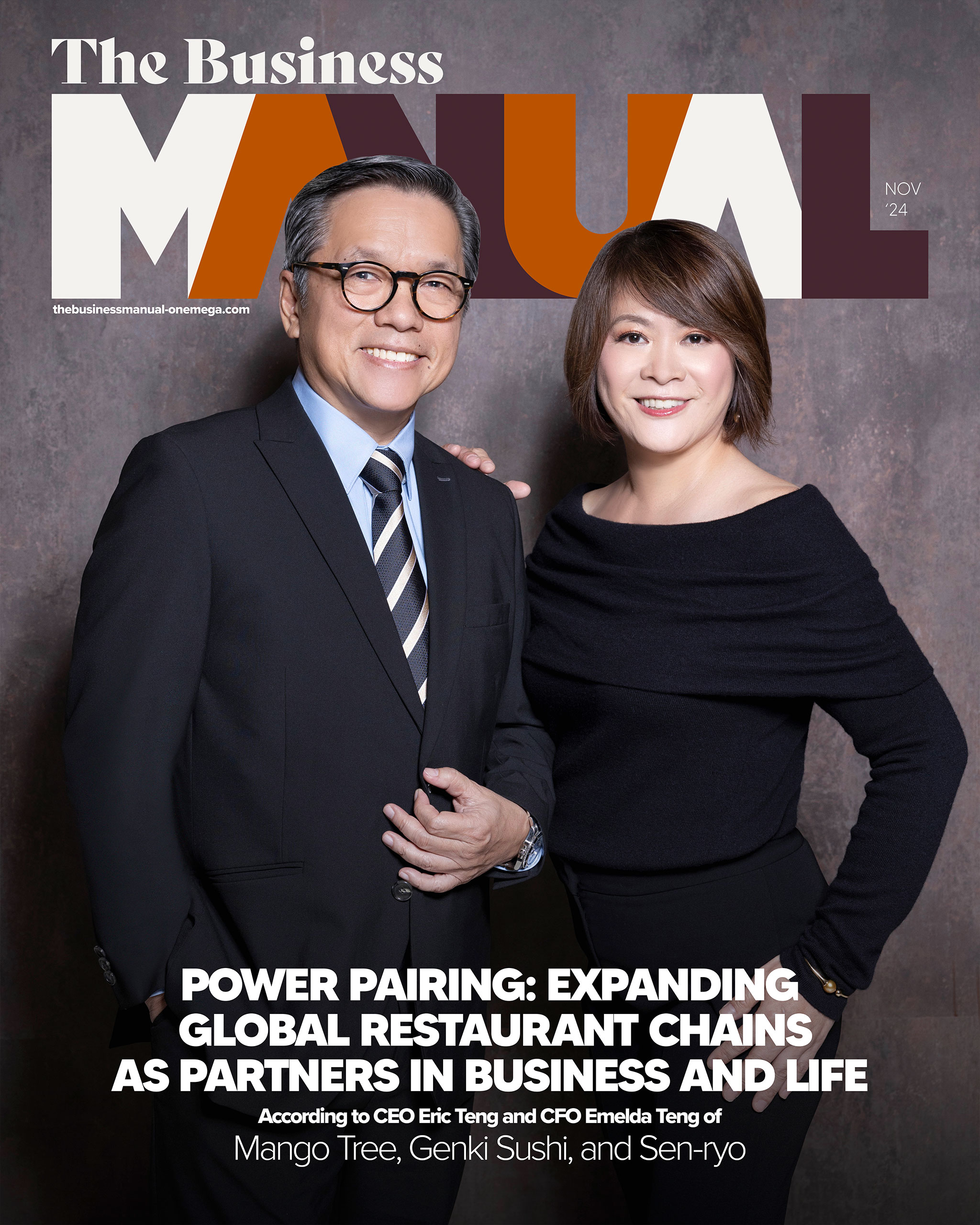
Serial entrepreneurs Eric Teng and Emelda Teng, CEO and CFO of Mango Tree Restaurants, share their secrets to consistently achieving success after success.
Among entrepreneurs there is a rare breed who, after putting up one business, don’t stop and keep going, establishing successful business after successful business. These serial entrepreneurs move fast and strike where opportunity presents itself. And though not immune to failure, these entrepreneurial savants often have shockingly high batting rates. Emelda Teng and Eric Teng of Mango Tree restaurant are two such entrepreneurs.
Entering the restaurant business in 2010 with the first Mango Tree restaurant in the Philippines, the husband and wife team have expanded the Thai restaurant chain to 13 branches. At the same time, they have launched and grown several international restaurant chains such as Genki Sushi, Senryo and Tunglok Seafood. And they show no signs of stopping there.
Before this rapid expansion in the restaurant business, Emelda Teng and Eric Teng were the power duo behind Maldita, the one-time darling of the Philippine retail clothing scene, the 99 Pesos Store, and they’re also a distributor for the Adidas brand. Together with their current run in the food service industry, the low-key Tengs have an enviable business portfolio, one which is marked by success at every turn. The Business Manual spoke to the serial entrepreneur couple to gain some insight on what it takes to achieve this kind of good fortune. What are the secrets to their success?
‘The Next Culinary Capital of Asia’
The Philippine food service industry is booming. According to some estimates, the industry is set to double by 2029 to USD 31.47 billion from an estimated USD 16.12 billion in 2024.
It is these numbers that Eric Teng is quoting when he tells us, “Our restaurant industry is set to double in five years' time, by 2029, from last year. And that's from looking at all the projections from the other research groups. And when I look at this year alone, the number of new restaurants that opened, the number of foreign restaurants that came in, it's mind-boggling.”
With such powerful economic forces at work, there is a bullishness in the air. Eric continues, saying, “And that seems to be holding true for the trend that the Philippines can be the next culinary capital of Asia.”
It takes no stretch of the imagination to say that there’s a gold rush in the food service industry. And yet, Eric’s approach to this opportunity is one that is typical of the entrepreneurial mindset: that of problem-solver.
He says, “You know, every time you see a problem, there's a solution to it. There might not be a solution yet.”
The solution may be challenging to find and require sacrifice, but Eric is willing to do the hard work.He explains, “To this day, I have a lot of foreign brands who come to the Philippines and look at the Philippines and they think, ‘No, we'd rather be in Paris. No, we'd rather be in Singapore. We'd rather be in a nice, clean country.’ But I always tell them, you know, gold mines don't look like five-star hotels. It can be messy. It can be crazy. But that's where you'll find your opportunity.”
The Making of a Serial Entrepreneur
This approach to business and opportunity was honed from a lifetime in entrepreneurship for both Eric Teng and Emelda Teng. Before Mango Tree and before restaurants, the couple had established business after business–most famously the clothing retail store Maldita.
Eric was born and grew up in Tondo, coming from a family of business people. There was never any doubt as to his future; he also wanted to go into business.
Emelda, meanwhile, grew up in Divisoria–ground zero for the Philippine wholesale and retail scene. Exposed to this world, she quickly developed a knack for business, in particular, sourcing.
She says, “You started really in Divisoria. You can see anything you wanted to buy, cheap, branded, whatever, you know, everything you see there. So, it's like, I'm enjoying buying and selling during that time.”
Business eventually united Eric and Emelda, and a deeper union would follow.
Eric recounts, “I kind of like it when I see somebody having a problem with something, and how do you solve that problem? Or they cannot get something, and there's a way for you to provide what they need. In fact, one time I called Emelda because we needed something for our class, for our school, and I was one of her customers. So, the supply that I needed happened to be from my future wife.”
Business was an inseparable part of both Emelda’s and Eric’s life. Eric started a construction business with his brother while Emelda moved from strength to strength. As a Divisoria “biyahera” she would travel to Hong Kong, Bangkok and Taiwan and buy clothes to sell wholesale. In fact, by the age of 18, her clients included large department stores, earning Emelda the reputation of being “the youngest queen of Divisoria.”

Venturing into Retail: The 99 Pesos Store
It was during Emelda’s travels that she and Eric began a retail business of their own. Taking inspiration from the $1 store, they thought, “Why don't we create a 99 peso store?”
Eric says, “We opened the first store in Tutuban and it did very well… And later on, [Emelda] said, we need to expand. We can't just have one store.”
The secret behind the 99 Pesos Store was sourcing.
“She's a sourcing master,” Eric says. “When we go and do those buying missions, it's like a single day. There'll be hundreds of SKUs that she can handle… But luckily we don't have to set any price because it's also 99 pesos. So the margins change, the cost changes, but the price is always the same. If you want to look for a monkey that can sing, she can probably find it.”

For Emelda, the 99 Pesos Store was a source of enjoyment. She says, “When I see people are satisfied with the products that I give to them or when I have those repeat customers, that makes me feel, ‘Oh, I did something right.’” And with the success of the 99 Pesos Store, came more opportunities.
While sourcing ladies apparel for the store, Emelda found a supplier that made high quality clothes. And the entrepreneurial couple realized that these designs were so good that they needed “a new home.” Thus, a new boutique concept was born. They called it Maldita.
Raising Maldita
“All the women I love tend to be Malditas,” Eric says about the boutique name, a sometimes affectionate term for a naughty or misbehaving girl. “My Lola, my mom, my wife, my daughter, they're the malditas of my life.”
Maldita, which was founded in 1999, was among the first boutiques of its kind. And at its peak, it expanded to over 30 stores across the country. Decades later, the Maldita brand still resonates with women.
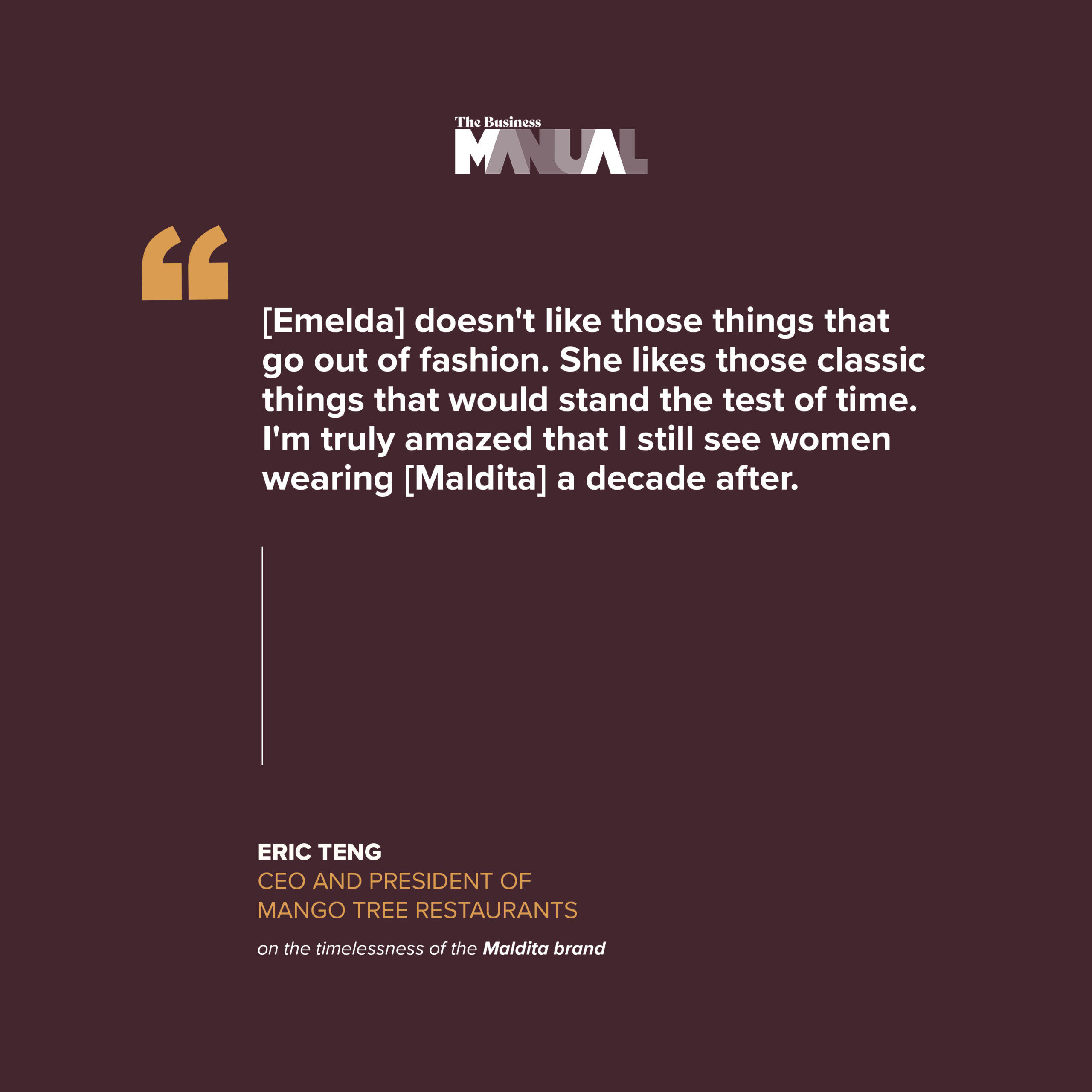
Eric shares, “I still meet friends or women who say they're wearing this dress, it's a Maldita, and they got this over 10 years ago and they're still able to wear it because that's what she likes.”
While the success of Maldita can be taken for granted, Eric and Emelda share that there were challenges.
“We didn't know what we were doing,” Eric shares. “It was kind of fun. We were outsiders in the fashion business, but that's also a very different way of looking at things. When you're the outsider, you tend to question everything. You don't take anything for granted…Whatever was on trend, we were sort of always going against it.”
This quality is a characteristic of the Tengs’ entrepreneurship. Jumping into a business they are not familiar with, they learn on the job, adapt, and innovate according to the needs of the moment.
“And to some extent,” Eric goes on, “it worked very well because it created an identity that we're not conforming to what Europe or Asia is saying. We want to do it our own way.”
After many years, the influx of international fashion brands and the rise of fast fashion would transform the fashion scene and force the closures of many local fashion retailers. But before these brands had arrived, Maldita had already made the transition into a smaller, niche operation.
“Sometimes it's like an instinct that we cannot explain,” Emelda says. “We're thinking definitely all these big brands are already coming. So how can we compete? So I think we're one of the first fashion retailers that went into the food business.”

Mango Tree Restaurant
While the Tengs’ businesses had so far evolved logically from wholesale to retail to retail fashion, the seed of Mango Tree began with a serendipitous chain of events.
“We didn't look for the restaurant business. The restaurant came looking for us,” Eric says. “It was fate, I guess.”
One day Emelda received a cold call from the Thai embassy, asking if she would be interested in a restaurant business. She passed the call to Eric.