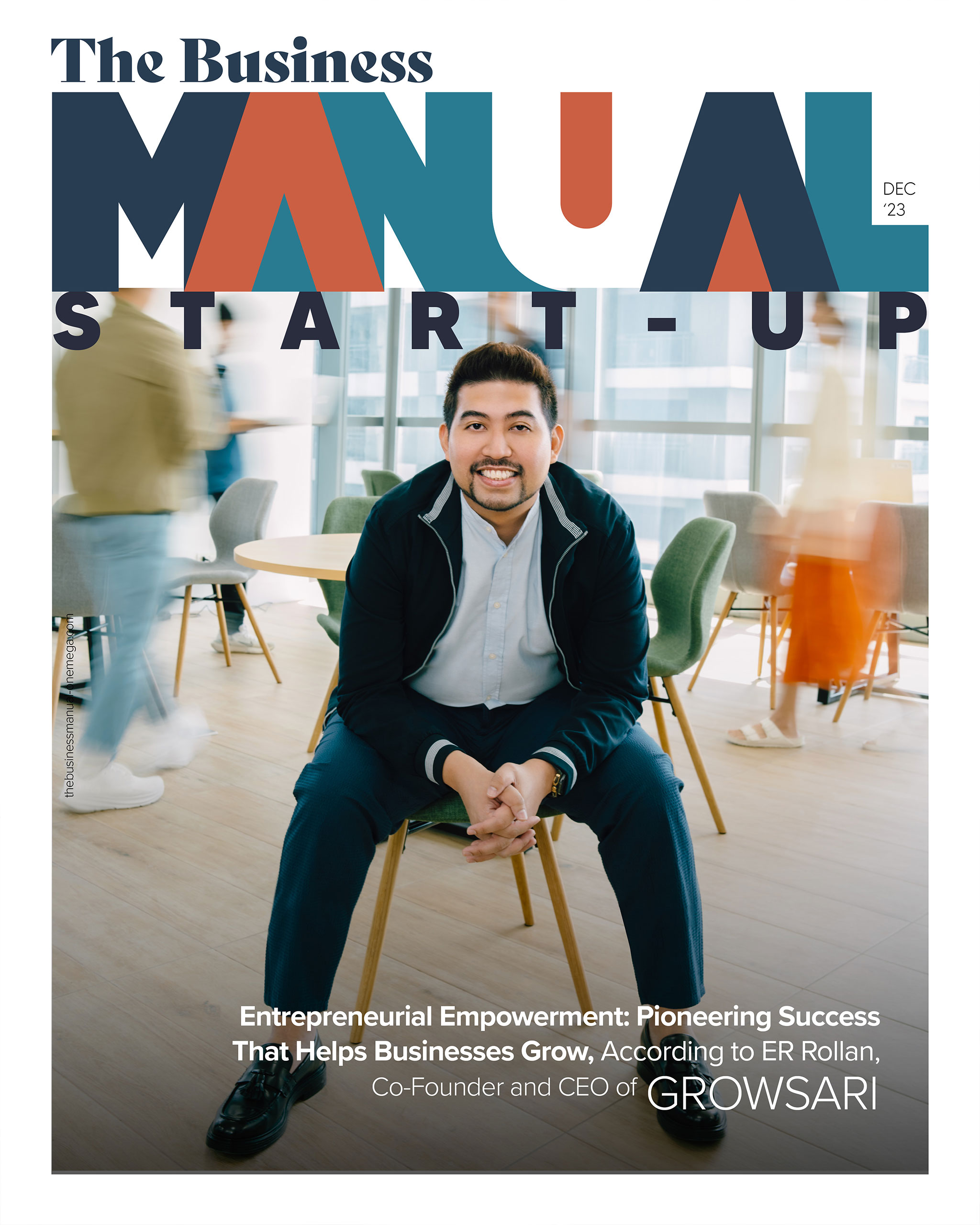
Entrepreneurial Empowerment: Pioneering Success That Helps Businesses Grow, According to ER Rollan, Co-Founder and CEO of GrowSari


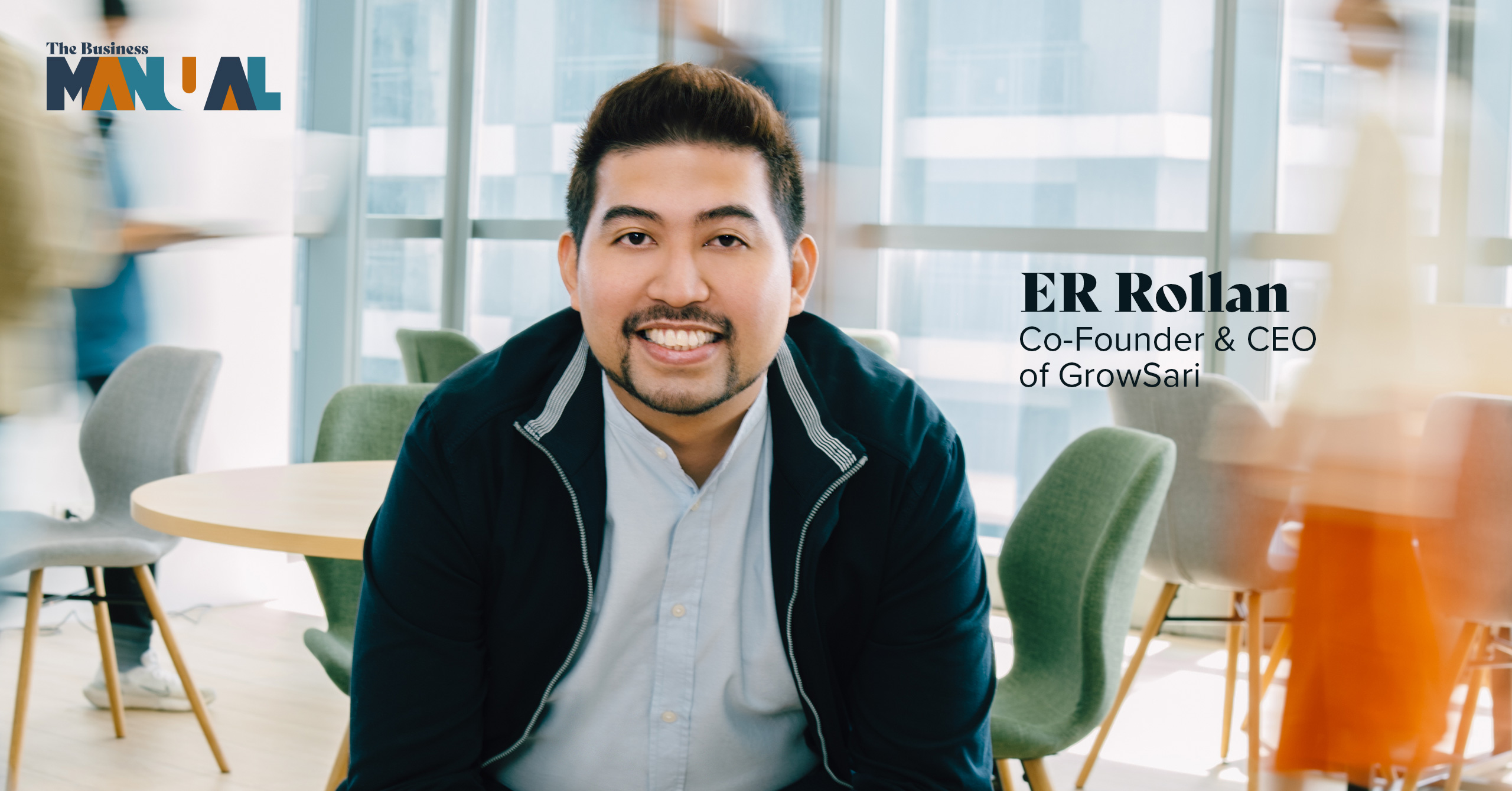
Setting his sights on an underrepresented business sector, ER Rollan started GrowSari—a business dedicated to alleviating the supply chain hurdles faced by millions of sari-sari store owners in the Philippines.
While the country’s retail landscape is dominated by large-scale chains, diverse local brands, and just as many international players, it’s the unassuming sari-sari stores that emerge as timeless heroes. Located on almost every street corner, about 1.3 million of these neighborhood sundry stores can be found across the Philippines—providing daily essentials for around 94% of Filipinos.
Despite its large numbers, however, sari-sari stores face setbacks that hinder their growth—with supply chain issues a prevalent concern. After all, as small-time businesses that are commonly run by families, it can be difficult to get the same suppliers as most retail chains do, with minimum order quantities reaching the thousands and having not a lot of capital to work with.
The result? Sari-sari stores are forced to buy from these groceries—procuring supplies that allow very minimal markup, given that these goods have passed down many middlemen already.
While touting convenience for millions of Filipinos, unfortunately, these sari-sari stores aren’t given the same accessibility as business owners. Handicapped and with little room to grow—yet just as essential as any business—these limitations are what hinder sari-sari stores from growing.
This prevalent pain point is where GrowSari comes in. Led by Co-Founder and CEO ER Rollan, this app aims to eliminate the middleman by becoming an ordering platform for fast-moving consumer goods (FMCGs), while offering a myriad of other services, from free delivery to distributor product prices to sari-sari stores.
In this exclusive interview with The Business Manual, learn about the origins of GrowSari through the lens of ER Rollan, and how this social enterprise continues to champion the underdog through its many initiatives.
Knowing Your Purpose
Before starting GrowSari with fellow founders Oggy Ogonowski, Shiv Choudhury, and Sid Kongara, Rollan had a thriving career in Singapore, where he worked in a corporate job.
“I was super blessed because right after college, I got a job abroad in Singapore,” Rollan began. “I spent 10 years in Singapore before I had an opportunity to be an entrepreneur. But I finished school in [the University of the Philippines] UP, so I’ve always had this thing na because [the] taxpayers’ money was used to educate me, I have to go back.”
And go back to the Philippines he did. “After ten years, I realized I wanna go back home and in my mind, to somehow maintain the lifestyle [that I once had in Singapore], I thought—[though] I was obviously wrong—I should get into entrepreneurship nalang.”
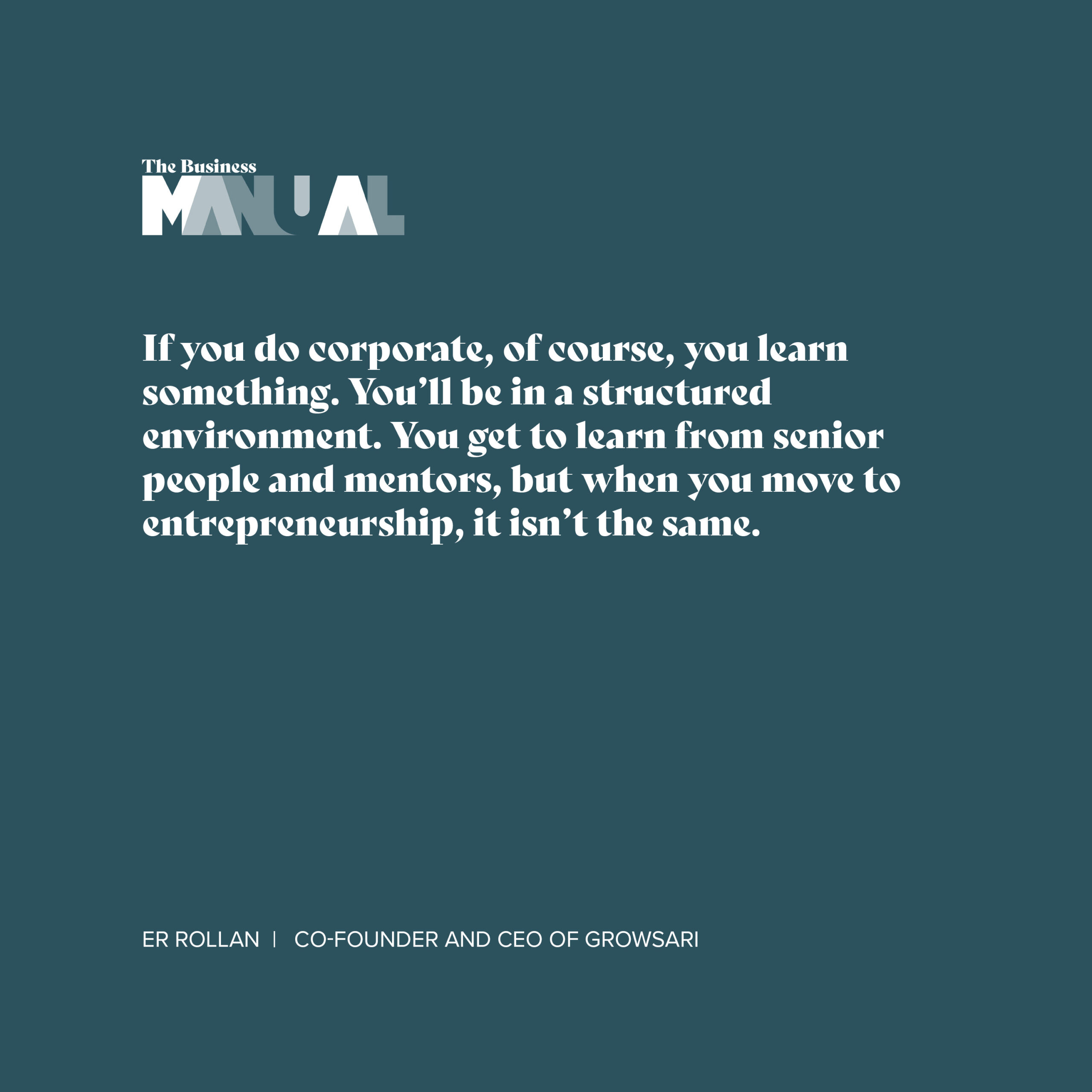
While corporate and entrepreneurship seem similar—both within the realm of business—the two are anything but that. “I think that those two are, first and foremost, very different worlds,” the CEO explains. “If you do corporate, of course, you learn something. You’ll be in a structured environment. You get to learn from senior people and mentors, but when you move to entrepreneurship, it really is not the same.”
“But it’s a good thing because, while you can learn [in corporate], it also means you can also bypass it,” he continues. “If you want to skip being corporate and just jump into entrepreneurship, I don’t see a reason why that wouldn’t be as successful. I think the important thing to note [though] is acting like it’s yours. You own it.”
Solving a Pain Point
But before getting into the rudiments of how GrowSari came to be, Rollan seeks to dispel an age-old misconception: that starting a business equates to an end goal for a steady stream of income after years of working for a company. “People think about [starting a business] as a retirement option, only to realize na actually, when you move there, you don’t have control over your own time. You’re the one who’ll get paid last.”
“If you think about it as the next phase of retirement, I don’t think that’s going to work,” the CEO declares. “[Starting a business] has to be because you genuinely want to make a difference. You want to make an impact by writing your own rules. You want to employ people, and that has to be the motivation. It can’t be a retirement plan.”
In fact, starting a business is more than just knowing what product or service to sell. The very purpose of starting it is just as important. And for Rollan, this means finding a challenge or prevalent concern to address. “You’re going after a very particular pain point—a big enough pain point—and sort of execute against that. You learn [that] on the job. You learn as you go,” he explains.
For Rollan, his story began after he found the right idea. “I was actively looking for opportunities. And then when the [idea of] GrowSari came, that’s when I thought that this might be big enough for me to take a leap of faith. Obviously, I didn’t know a lot even when I made that decision, but no regrets naman in that sense.”
“There’s a theory that you need 10,000 hours to understand [something] enough for you to appreciate the nuances around it,” he continues. “A lot of people say ‘Oh, GrowSari is super interesting. How did you [learn to] appreciate sari-sari stores?’ But the reality is that even before college, we all grew up around sari-sari stores, but we never looked at them that way.”
“It was only when I worked for P&G, Unilever, and all of these FMCG companies that I realized [how sari-sari stores are] so important because they’re the biggest channel, but they’re also so underserved. So, in a way, my 10,000 hours were helping companies decode that channel. And the reason why we got into GrowSari was because, frankly, that was the only industry we knew. I couldn’t get into any other industries that I didn’t have any prior experience in.”
That being said, the CEO stresses knowing what you’re getting into before actually getting into it—this case being a business venture. “My advice would be…if you’re trying to hit a big pain point, it has to be something you’ve at least experienced yourself, or it’s in an industry you know enough of to actually have some credibility in disrupting it,” he shares.
“It also sort of guarantees that you worked on it long enough that you can sustain the energy to sort of keep at it.”

Learning From Market Behavior
While GrowSari is now known as a social enterprise and ultimately, Rollan and his fellow co-founders’ way of giving back to the community, its origin was slightly more different. But even so, the target was the same: the small but mighty sari-sari stores of the Philippines.
“When I was in BCG—[the] Boston Consulting Group—a lot of companies were asking BCG to do a census of all sari-sari stores in Vietnam and Malaysia,” Rollan notes. “Obviously, that’s a very extensive effort because you have to send people, do surveys, etc. In my mind, I was like ‘You know, after three months, that data is obsolete. Why spend millions of dollars on this?'”
“And then another client came and asked us to do the exact same thing. So it appeared to us that this must be super valuable for companies to be willing to do this over and over again,” he adds.
This planted the idea in his mind—that, in his words, “If we can ‘tech-ify’ this distributive trade and somehow put some control…some influence of structure around it…[then] this must be worth a lot of money to companies.”
The result? Rollan and his fellow co-founders tested different approaches on how to get the data—some of which included giving sari-sari stores point of sales (POS) materials that were meant to capture data and send it back to the company. But seeing as how these mom-and-pop stores operated with just a notebook to track sales and a box for their money, that failed massively.
It did, however, teach Rollan something new about the behavior of his intended market. “What we learned very quickly was that, for us to get the engagement of [these] sari-sari stores, we needed to solve what’s the problem on their side naman,” he notes.
And that problem was very clear. “There was an information gap and a reach gap. The problem on the side of the suppliers or companies…we were not addressing it. So at that time, the company was called MPOS. Napaka-dry, di ba? [Very dry, right?] Mobile POS. It was a tech-focused company.”
The real learning came when Rollan asked the sari-sari stores themselves about how he could help them. And their answer was unexpected. “You know, when I have to buy products, I have to close my shop, which means for half a day, I don’t have any sales,” he retells.
“I have to take a tricycle [and] pay for it. I have to pay expensive prices because I’m buying from my competitor effectively, which is the wholesaler. I have to carry them back, and I have to do that multiple times a week because I don’t have enough capital to buy for the whole week. So I lose money on opportunity sales, on transport, etc.”
This drove Rollan and his partners to build a business on that pain point. “We needed to give them an ordering platform,” he says simply. And thus, GrowSari was born.
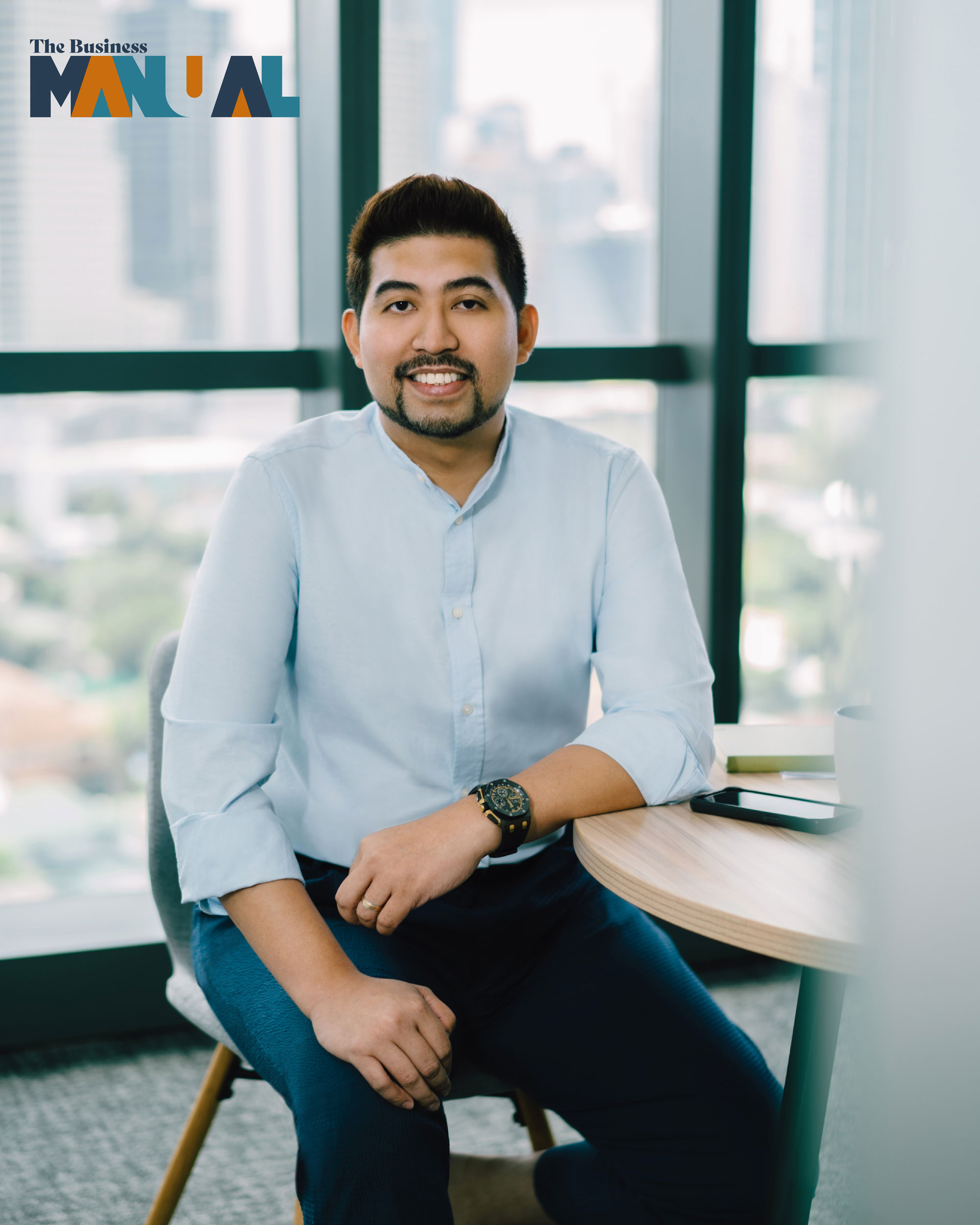
![Although Rollan's goal hit the mark—that is, by catering to sari-sari store owners, it was only by talking to them directly that he understood the true pain point that needed to be addressed. "We made a symbolic shift from calling the company MPOS to calling the company GrowSari," he explains. "It was a way for us to say that from this day forward, we will align ourselves [with] the needs of these small merchants."](https://assets.thebusinessmanual.ph/wp-content/uploads/2023/12/ER-Rollan-CEO-and-Co-Founder-of-GrowSari-The-Business-Manual-2023-1.jpg)
Creating a Business Model That Works
Solving the supply chain issues of sari-sari store owners and serving an untapped market is an arduous task that can be approached in many ways—whether from a macro perspective or by focusing on the little details.
Contrary to what most may think, however, scaling the business wasn’t their top priority. “Many of the young businesspeople I meet…they’re trying to rush to scale because they want the business to be big,” Rollan notes. “[But] I think the journey of building a business, in my experience, is a series of answering questions—a series of solving problems. And you can’t solve all 100 problems at the same time.”
“So when you are starting [your own business], the question you have to ask yourself is ‘What is the most important problem to solve right now?’ Some people call it product-market fit, [while others] call it a [minimum viable business, or an] MVB, but what do you really want to see?”
For Rollan and his fellow co-founders, it also meant undergoing trial and error, alongside firsthand experience to understand what sari-sari store owners needed to refine GrowSari. And of course, answering questions that may arise from this new service they plan on offering.
“How will we fulfill these orders? How will we deliver? What’s the warehousing strategy? What’s the pricing strategy? What’s the supplier strategy?” Rollan recalls.
“Today, we still have a bunch of questions we still need to work through. But over the last seven years, it was a series of answering them one-by-one,” he goes on. “And if you try and do it all at the same time, then you’ll burn money because we also wouldn’t be able to model out where I went wrong because I’m trying to do 10 or 15 different things.”
Building the Foundation of a Social Enterprise
But what exactly does GrowSari do?
“In the Philippines, we have over one million sari-sari stores,” Rollan explains. “Because the mom-and-pop stores have very small orders, no one serves them directly. GrowSari’s goal is to create an efficient logistics infrastructure so that companies can serve these individual sari-sari stores directly without going through any middleman.”
To do so, GrowSari employs a different approach—that is, to “invest with them, grow with them, and partner with them.”
First, that meant making supplies accessible to these small business owners. Given the little working capital they have to acquire stocks, they can only order in minimal quantities. This is what Rollan aims to address at the forefront. “We’ve effectively taken out the minimum order quantity (MOQ). That’s the enemy, di ba? You cannot really serve everyone because the order size is too small,” he explains.
“If we remove the concept of minimum order quantity at this level, we can remove it at all levels, which means we can also co-load logistics with other people who are also delivering in the same barangay but maybe deliver to a small bakeshop and not [just] to a sari-sari store. That way, we can build a logistics revenue stream that co-loads into that ecosystem,” he continues, citing another pain point he noticed early on: deliveries.
As for the third hurdle for these small business owners? Finances. “Because we have people who deliver to the sari-sari stores, we can also collect cash from the sari-sari stores, and therefore it enables us to do very, very small loans, which is another challenge [for them],” he notes.
“Sometimes, you don’t want to give a loan that is too small wherein the cost of processing that loan will not make it worth the while to collect it, to process it. But because you’re operating at such high density but very, very small transactional value, you are able to create that capability to say, ‘I can give you a 3,000 loan and I’ll collect it in seven days, and I’ll do 150,000 loans every month at that scale.'”
The end result is what Rollan calls “a last-mile ecosystem that helps companies serve the smallest transactions, whether it’s a physical product, a digital service, or a financial service.”
Partnering With the Right People for the Job
Bootstrapping—or “building a business from scratch without attracting investment or with minimal external capital“—is how many startups in the Philippines start out. And GrowSari is no exception.
GrowSari, being a very tech-heavy business, needed the right support and ample funds to execute its plans in its formative stage. Aside from getting a tech-savvy businessman to join the force as the company’s Chief Technology Officer (CTO), the co-founders collectively relied on their strengths initially to amass working capital that they themselves could use to run the company’s day-to-day operations.
“We relied on our consulting and industry experience to do small projects on the side to help fund the bootstrap,” Rollan explains. “Because we didn’t have a strong supply chain, we would buy from an expensive supplier and sell [at a] loss. All of the money went into essentially funding the price difference.”
Eventually, Rollan’s bootstrapping days were over, as he and his fellow co-founders were able to grow their network and resources. “When we had 50 loyal stores ordering regularly, we started to get interest na from our formal investors,” he reveals. “So we were able to get a culmination of angel [investors], but it was a pre-A round. That was really our first serious money at that time.”
From an initial series funding (Series A) round in 2018—with participation from JG Digital Equity Ventures (JGDEV), Robinson Retail Holdings Inc. (RRHI), and Wavemaker—GrowSari was able to obtain its Series B round funding in 2021. This time, global investors like Pavilion Capital, Tencent, and International Finance Corporation (IFC) aided the social enterprise.
As of 2022, GrowSari has achieved massive growth on its Series C funding—the largest raise in the business-to-business (B2B) and MSME space in the Philippines, and one of the largest in the Southeast Asia region. This meant that Rollan finally had the means to expand his reach and amass a network of FMCG partners—a far cry from the past.
“Now, we have about close to 2,500 employees. We serve 100,000 sari-sari stores every month and we have 600 trucking partners,” the CEO says proudly. “So there’s a lot of people that rely on GrowSari—on steering the company in a certain direction.”
“I think that’s what’s sort of gives me a good burden in that sense,” he adds. “It’s a good burden, but it also humbles us in the sense that it’s really a community that’s executing a lot of these things. And GrowSari will continue to grow if we can find more of these partners that are sort of aligned with our interest in growing the MSME ecosystem.”
Learning and Growing as a Business Owner
Many businesses face their fair share of ups and downs, but these failures often point to financial struggles or even the COVID-19 pandemic—outside forces that can make or break a business. But for Rollan, his failure is something he saw in himself, which he continues to work on to this day.
“I think the biggest one for me personally was having to deal with the fact that I was running on ego for a majority of my life, pre-entrepreneurship,” the entrepreneur confesses. “Kasi when you’re working for a company, the metrics are very clear, and it’s sort of easier to over-deliver because there’s a structure that helps you to over-deliver.”
“But when you’re in business, you’re the one setting the structure eh. You realize that, especially in the beginning, you’re the only one with your co-founders who [believe] in this company,” he points out. “Everyone’s against you. Everyone’s skeptical, di ba? So you have to fuel your own motivation. You have to pass that motivation to your small team, so that’s very tiring.”
In fact, Rollan gets real by admitting that these failures have taken a toll on his mental health. But even so, the survival of these sari-sari store owners and even their own workforce was at stake—thus prompting him to power on.
“When things don’t work out, you start to question yourself. And to me, I got into a very depressive state. I sort of got into a lot of personal issues, but the biggest realization for me was this is not about me,” Rollan declares. “This is about the company trying to sort of get into a certain place. The resources that were given to me—I’m just a steward.”
This meant a change in perspective. “I had to re-introduce myself to me again in that sense, and that was transformational because I’m sort of working on this perspective that none of this is mine. In fact, I feel like when I was going through that dark time, I also had to make questionable personal choices, which I feel made me undeserving of this position that I have.”
Now in a better place than before, Rollan is equipped with a renewed vigor to lead the team. “I’m nothing but grateful moving forward, which hopefully makes me a better leader because I’m just trying to figure out how I [can] unlock problems for my employees, for my partners, [and] for the suppliers to really get to where they need to be.”
Leveraging Opportunities
For the aspiring entrepreneur and the business owners who want to make a difference, Rollan shares insights that he has gleaned in his many years as a businessman-turned-entrepreneur.
“First and foremost, contrary to what some people believe, the opportunities in the Philippines… grabe. As in limitless,” Rollan says wistfully. “Number two, I think you just have to get over the fear that just because you’re starting or you’re small, that your idea is not good or is not better.”
“Obviously, all of these companies that are successful are successful for a reason, but they don’t have a monopoly on all good strategies, [or] all good ideas,” he adds. “Sometimes nga what happens is—and I’m learning this now—[is that] if you want to scale the business, you have to commit to certain things that lock your business model. And when your business model is locked, that is one point of agility away from your company.”
Simply put, Rollan believes that while growth is inevitable for any business—a successful one at that—he thinks that there are still opportunities in it that can be leveraged. “Use those as opportunities to identify places where you can reinvent how things are done—[like] new processes, new products, or new services,” he explains.
Next, he tackles the root of every first-time entrepreneur. “People are afraid that if they work with some of these giants, [and] that they will copy the idea, and then, wala na. [The opportunity is gone.] But my advice for that is [not to] overthink ‘cause it’s not yet there. It’s better when there’s something to fight about, but if there’s nothing to fight about, it’s all in your head.”
And finally, the most important one yet: to just do it. “For me, it’s a good problem to have when there’s conflict, but you just have to be in the mode of creating, creating, and creating. That’s what I want to challenge the young guys out there—to just start.”
“Part of the reason why they think of the Philippines…why there are not enough startups… [is because] I believe there’s not enough people trying it out, starting, and failing. [For me], get out of your head and just do it. Make mistakes. Fail,” he ends.

Text DIANE NICOLE GO
Photography KIM ANGELA SANTOS of KLIQ, INC.
Videography KIM ANGELA SANTOS and JR RAMIREZ of KLIQ, INC.
Art Direction MARC YELLOW assisted by ANDREA SANGCO
Sittings Editor RJ LEDESMA
Shoot Coordination TONI MENDOZA and PILAR ANGLIONGTO
Shot on Location GROWSARI HEADQUARTERS
Special Thanks to JOHN CARLO CHUA
More From Features