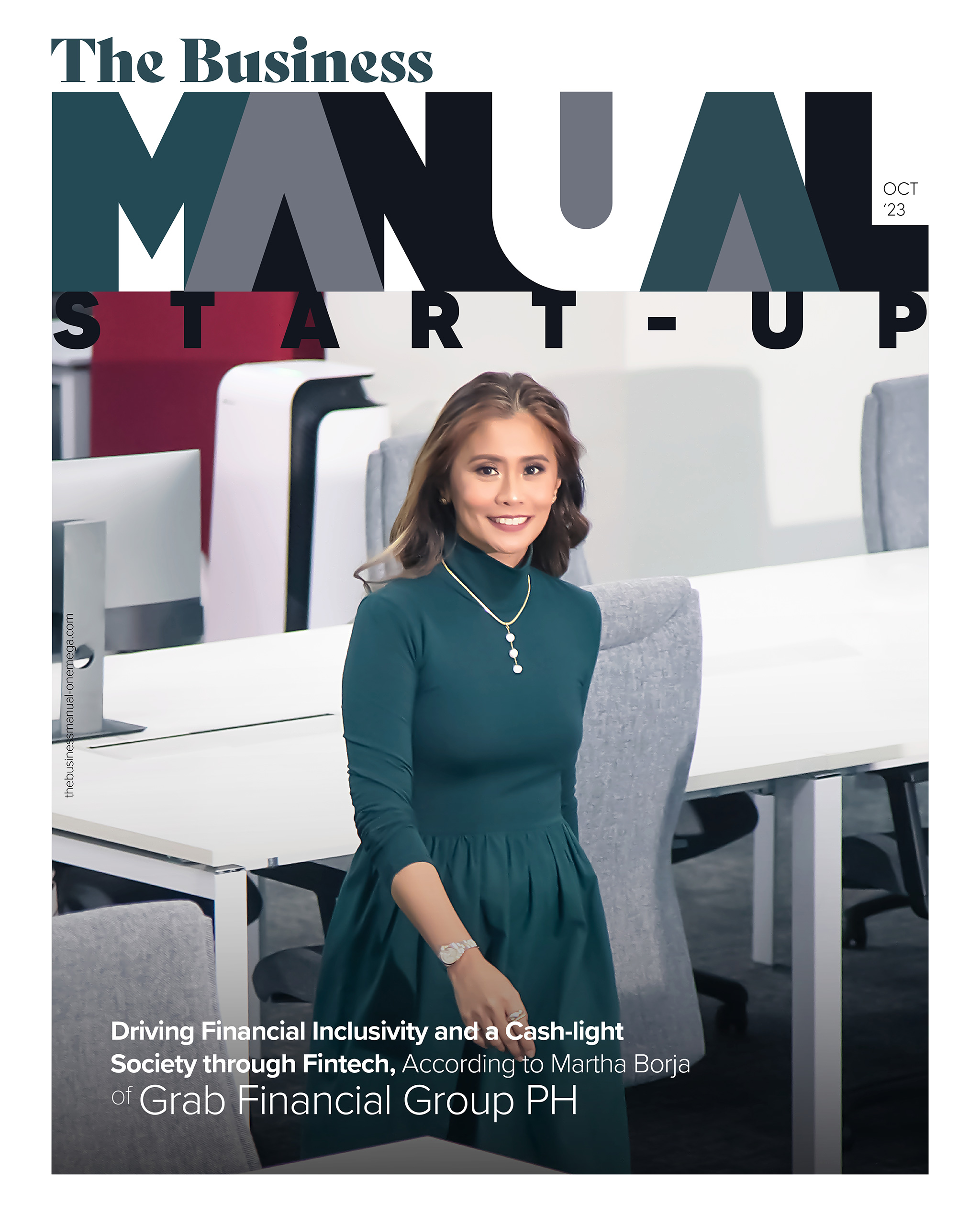
Driving Financial Inclusivity and a Cash-light Society through Fintech, According to Martha Borja of Grab Financial Group Philippines



What is Fintech and how can it power a more inclusive financial landscape? Martha Borja, Country Head of Grab Financial Group Philippines, shares the company’s ethos and vision for its customers.
Grab Philippines is delivering on the promise of being a superapp—a robust marketplace that connects consumers to essential services like mobility, on-demand food and grocery deliveries, and even parcel delivery. Furthering the seamlessness of the journey of consumers and promoting accessibility to financing of Grab partners are the fintech solutions under the Grab Financial Group (GrabFin).
Fintech is a thriving industry that has been accelerated by the pandemic and further propelled by the digital-first post-pandemic environment. For Martha Borja, the Country Head of GrabFin, unleashing the power of Fintech is an evolutionary thrust that companies need to undergo to elevate their financial systems as the world moves forward in this new, cash-light reality.
In the Philippines, it could be surmised that Grab has played a vital part in the Fintech revolution. Over the past few years, Grab’s Fintech services have seen fast-rising adoption among Filipino consumers and its partner communities within the Grab ecosystem.
The Business Manual recently sat down with Martha, conversing on the future of Fintech and the power it holds in powering financial inclusivity and a cashless economy.
Redefining the Meaning of Fintech
While discussing any Fintech company is like entering muddy waters, to Grab, the role of financial technology is crystal clear because it is a significant, sustaining factor in its core business.
“The main ethos of the Grab Financial Group is to provide accessible and inclusive financial services to the Grab ecosystem, which is composed of our driver-, delivery, and merchant-partners. And of course, promoting a more seamless and convenient journey for the consumers that are supporting and loyal to the Grab superapp,” Martha shares.
“So being able to provide to all of them the critical financial services that they need under one superapp—that’s what Fintech means for us at Grab.”
In 2022, Grab combined its financial service products under a new brand called GrabFin. Flying under the banner of GrabFin are digital payments, insurance, as well as lending, and wealth management offerings, which are available in other markets.
It was roughly around the same time when Martha joined Grab. Previously, she was part of Citibank’s Consumer Business as the Senior Vice President for Credit Payment Products. She then shifted careers in 2018 and became the Country Manager for a global Fintech company, which was later acquired by Nomupay Ltd.
“I’ve been in the banking industry for most of my career,” Martha says, speaking about the differences between her previous work and her current role in Grab, “The banking industry is quite conservative. We were catering to a specific target segment.”
“Now, here in Grab, the difference is that we’re really able to cut across all market segments. And that journey has been quite exciting for me because it no longer limits the products, the ideas, or even your creativity, to just a certain segment of Filipinos. Now, it’s being able to serve a wider spectrum of people needing various Financial solutions—from our driver-partners all the way to our VIP customers,” she adds.
Growing a Fintech Company
What best characterizes GrabFin as a Fintech company is how it leverages technology to cater to consumer and partner needs. Far from being trendy, it eschews the usual Fintech buzzwords and promises of quick wealth. Instead, it pursues a basic business fundamental: providing solutions to the financial needs of customers.
Martha explains the early days of Grab as a Fintech company: “It all started with the lending division ten years ago. We had to encourage drivers to have the app, download the app, and drive for us. They did not have a smartphone. So it was important for us to provide a smartphone because it was essential for them to run the business. And back then, smartphones were quite expensive.”
“That’s how the idea of being able to provide a facility by which they can finance their smartphone came about,” she adds. “Grab was actually their first formal source of credit because here in the Philippines, your usual source of credit for a lot of the Filipinos, our kababayans, would be their neighbors, family, and even informal lenders,” she recalls.
In essence, GrabFin became a financial institution for those who would never dream of setting foot inside a bank and applying for a small loan.
“We were surprised to see that for a good majority of them, we were their first formal source of credit. This inspired us to evolve and expand the financing solutions we have on the platform to address a broader array of needs, like car maintenance, laptops for their kids, and even loans for their medical needs. And every single day we are able to empower partners to continue pursuing their goals and successfully surpass financial hurdles, the more we are determined to innovate products tailored to their situations,” Martha explains.

Tailored for Merchants and Delivery Partners
From its initial offerings, Grab started to expand until it ventured into food and grocery deliveries. Along with such growth, the financing side of the business evolved as well. Indeed, growing GrabFood and GrabMart for consumers was only possible by growing the capabilities of Grab’s merchant-partners.
“We’ve also launched Quick Cash. It’s a merchant cash advance product offered to our GrabFood and GrabMart merchants, which they can use for capital requirements for business expansion. Quick Cash was designed specifically for MSMEs on the platform who do not usually have access to formal credit institutions.”
Critical to GrabFin’s success is how responsive it is to its merchant-partners’ needs. Similar to how it responded to the need to finance drivers’ smartphones in its early years, GrabFin has a deep knowledge of its merchants, who typically have problems saving every month for loan payments. In light of this, GrabFin allows them to pay loans through micro repayments, which are automatically deducted on a daily basis. This enables merchants to efficiently meet their payment targets and monitor their loan progress.
“We know how much our drivers are earning, therefore we’re able to assess their creditworthiness,” Martha explains. “For merchants, we also know how much GrabFood sales they make in a day. So that is our basis of how much we can lend to them. This makes the application process of our partners much easier since they no longer need to prepare documents on their earnings capabilities and present case studies just to support their application. As a pioneer of micro repayments in the Philippines, we see how important it is to lower the barriers to make financing accessible to more Filipinos.”

Leading the Cashless Revolution
Aside from financing, one of the tent poles of GrabFin is cashless payments. Here, GrabFin has made huge strides, and more importantly, it made significant contributions in pioneering cashless system adoption in the country.
One of the promises of Fintech has long been the establishment of cashless societies, a future where—without cash—transactions can be made in a safe, secure, and frictionless manner. Currently, Sweden, Finland, and China are leading the race in creating cashless societies, according to the Financial Times. Asian countries aren’t far behind, and in the Philippines, few companies can boast of contributing to leading the cashless charge as much as Grab.
According to the Consumer Payment Attitudes Study conducted by Visa, cashless payments are on the rise in the Philippines. In 2021, 60% of Filipinos carried less cash in their wallets and 84% had tried going cashless.
Moreover, the Consumer Payment Attitudes Study shows that cashless payment usage in the country is dramatically on the rise. Comparing cashless payment options, the study shows that Filipinos have a preference to use mobile wallets (64%), card payments online (52%), card payments at physical merchants (44%), and QR payments (31%).
For a Fintech company like GrabFin, the drive for a cashless society is not a goal that can be achieved alone. “Achieving a cash-light society is a humongous task that not one, two, three players can actually achieve here in the Philippines,” Martha points out. “And truly in support of the Central Bank’s thrust to push financial inclusion, we felt that it’s very important for us to partner with like-minded companies such as GCash and Maya in order for us to propel the business and increase our cashless acceptance as well.”
“Expanding our modes of payments with more cashless payment options allowed us to exponentially grow the number of cashless transactions on the platform—from passengers availing our mobility services to foodies ordering for their cravings via GrabFood,” she adds.
“So basically, you can now use your GCash or Maya wallet and pay for your purchases in Grab whether it’s GrabCar, GrabFood, or GrabMar. GCash and Maya customers can now pay for their transactions on Grab sans the need to go through multi-layered cash-in processes.”

Fintech Trials: GrabFin During the Pandemic
The pandemic was almost like a double-edged sword for Grab.
On one hand, online purchases soared, as the lockdowns spurred the growth of online shopping —in particular, digital purchases made via e-commerce apps. In fact, more consumers turned to online shopping and started using apps or websites to shop for the first time. This proved to be a boon for a Fintech company like GrabFin.
At the same time, the pandemic posed a significant challenge for several businesses, leading to the closure of restaurants and retail establishments, and causing many to lose their jobs. This situation had a direct impact on the drivers, merchants, and partners associated with Grab. Throughout the pandemic and up to the present day, GrabFin has been keenly aware of the needs of those affected.
“During the pandemic, the north star was very clear—to provide financial lifelines to our partners. We’ve strengthened GrabFin as a facility where drivers can refinance their loans and merchants can have supplementary capital. We continued to calibrate our products as the mobility and on-demand delivery industries changed vis-a-vis COVID-19 protocols and the eventual exit from the pandemic,” Martha reveals.
Today, GrabFin continues to innovate on financial products geared at giving its partners access to their key means of livelihood, like car loans for driver-partners who do not have their own cars or Quick Cash loans for merchants wanting to expand their business.

Seizing the Future of Fintech
What lies in the future for a Fintech company like Grab? The answer is layered and nuanced. “I’d say the vision, for me, would be three things,” she goes on to add. “First is being able to support a strong infrastructure. Secondly, promoting a robust cybersecurity agenda. And lastly, having the right products accessible to our stakeholders.”
When asked what advice she would give young professionals, Martha says: “I’d say KYB and KYC. Know your business and know your customer. If you think you know everything already about your business, stop and think again. Look at what the others are doing. Research on what’s available. What are the new trends and being able to put that together in a solid business plan that will allow you to grow.”
“Know your customer, of course, is important,” she adds. “You can’t be giving your customers something that is not relevant to them. So researching who exactly your customer is, what time they want this product or service, or when they go to your restaurant or to your business. So all of these things put together will make a strong proposition for your business.
While others are talking about the Fintech revolution, GrabFin has already made significant strides towards changing the game. Aspiring companies looking to enter the Fintech industry can learn a lot from GrabFin, an already successful company that has been actively helping transform the world through its services.
“What I can advise aspiring entrepreneurs is to really find that passion. What is it that you’re looking for? What is it that you’re hungry for? And then being able to find the proper mentor or guidance of people around you that will direct you, that will enable you to live your passion and guide you through the right principles of running or setting up your own business,” she ends.

Text VINCENT C. SALES
Photography EXCEL PANLAQUE of KLIQ, INC.
Videography EXCEL PANLAQUE and JR RAMIREZ assisted by KIM SANTOS of KLIQ, INC.
Video Producer GRANT BABIA
Art Direction MARC YELLOW assisted by DENIELLE CARAG
Sittings Editor RJ LEDESMA assisted by DIANE NICOLE GO
Stylist CARL PABILONA
Hair and Makeup ANGIE CRUZ
Shoot Coordination GODWIN DOMINGO, SAMANTHA ABIERA, and TONI CALINGASAN
Shot on Location GRAB PHILIPPINES HEADQUARTERS
More From Features