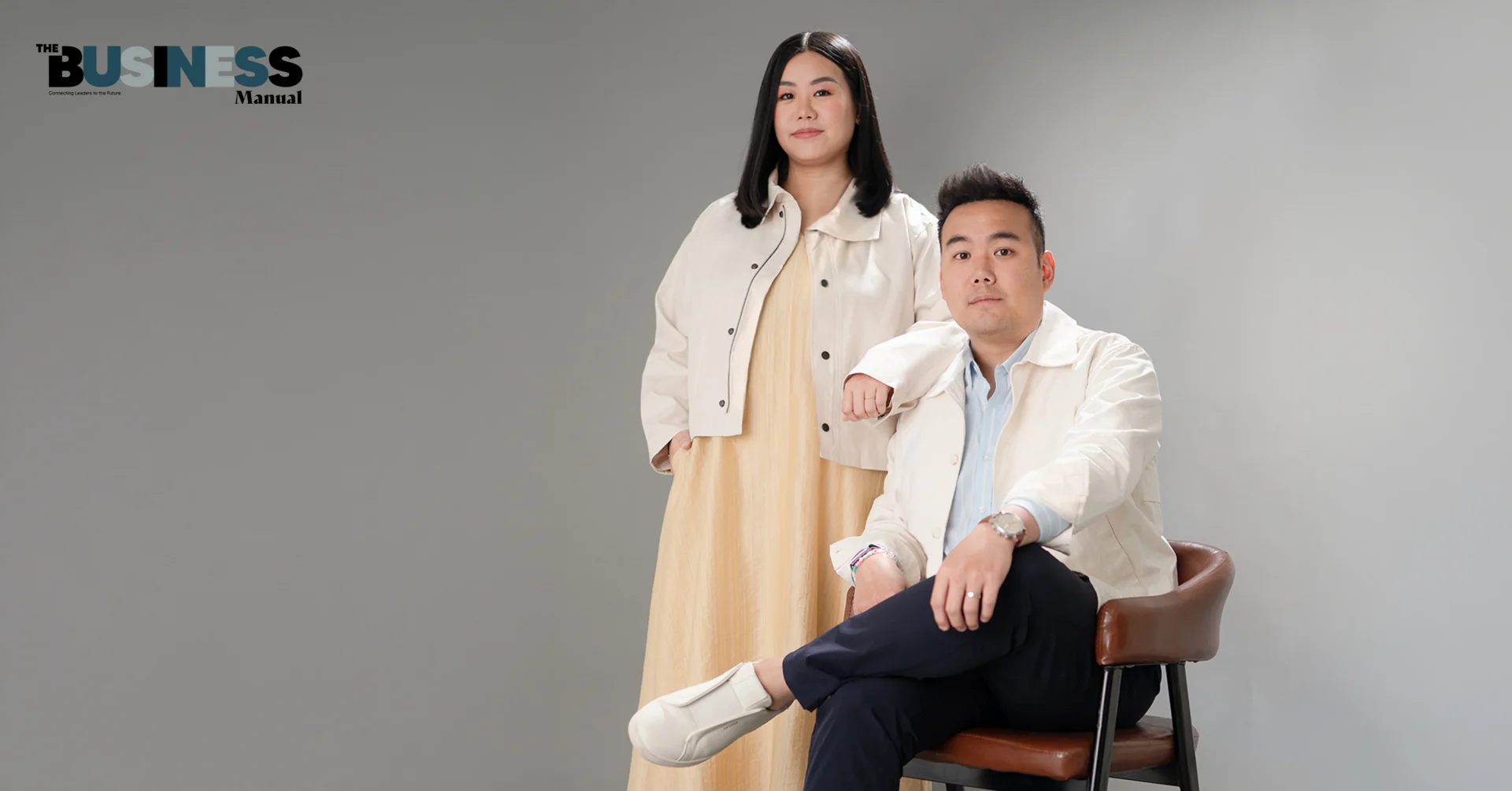
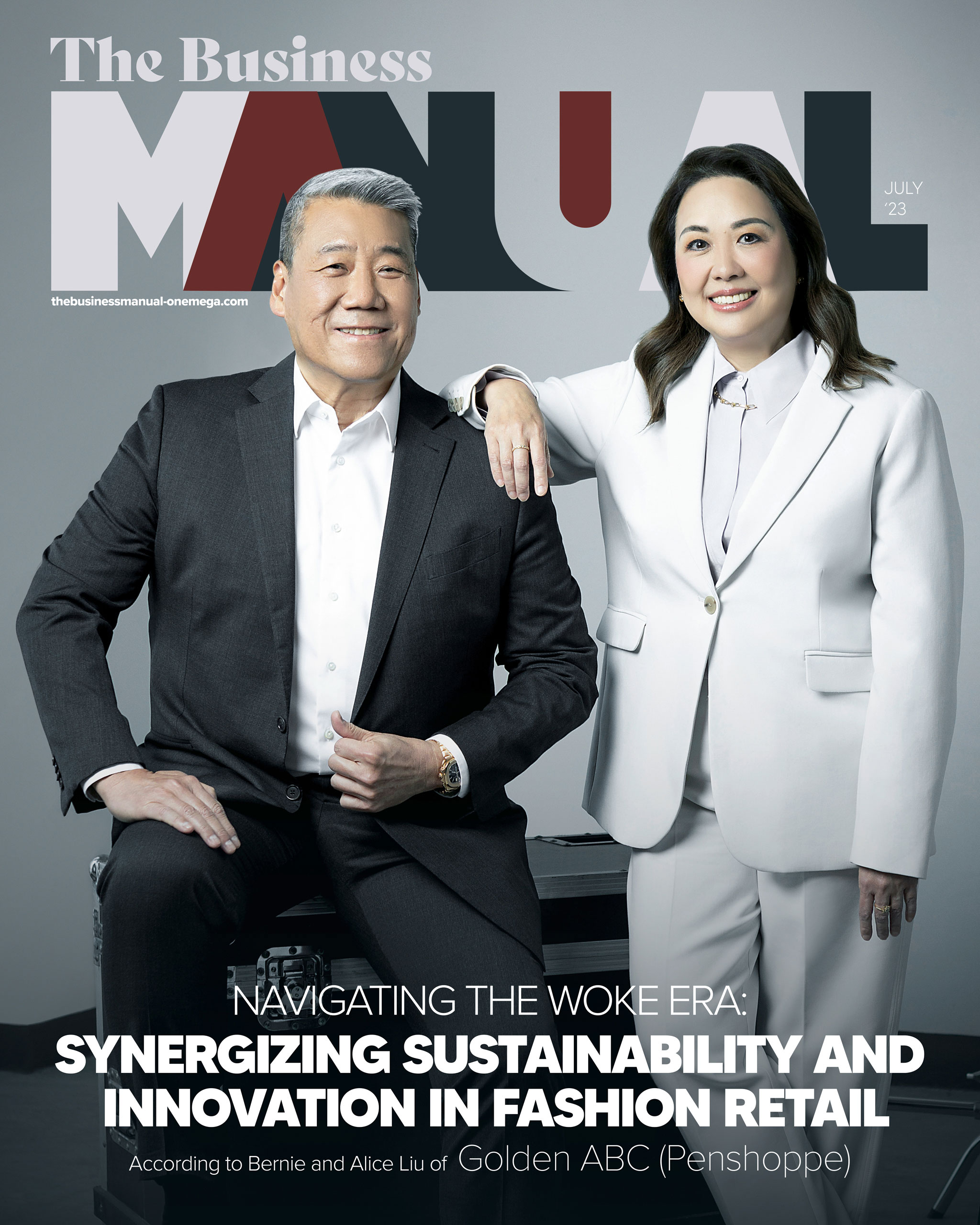
Navigating the Woke Era: Synergizing Sustainability and Innovation in Fashion Retail According to Bernie and Alice Liu of Golden ABC (Penshoppe)



In an ever-changing fashion industry that is ruled by trends, Bernie and Alice Liu of Golden ABC reveal strategies to cater to a new generation of fashion-conscious individuals.
Legacy brands make successful business narratives, having withstood the test of time and the ever-changing trends of the market. Built from the ground up and made to last, these brands have grown into what they are today—thanks to a keen understanding of the market, constant innovation, and pioneering new products or services.
Case in point: Penshoppe, a well-known and well-loved household name among Filipinos. Since its inception in 1986, when it first began as a simple t-shirt company in Cebu, the brand has now grown to dominate retail fashion with its 50% market share. What's more, it has even expanded on international shores, having become a global retail name in Southeast Asia and the Middle Eastern areas.
At the helm of the country's leading fashion retail brand sits Bernie Liu—the current Chairman and CEO of the brand's parent company, Golden ABC. While his name has become synonymous with the brand, what many do not know is that his wife Alice has been his staunch supporter when it all began. And now, the spotlight is on her as she takes on her new role as the President and COO of Golden ABC.
In this exclusive interview with The Business Manual, the husband and wife tandem tell all—from the story of Penshoppe's success to the strategies that led to the company's overwhelming success, the dynamic of working with each other, and what future the couple has in store for Golden ABC.
From Family Business to Personal Brand
Coming from a Filipino-Chinese family, Bernie's roots were founded on entrepreneurship, as his family started and managed businesses of their own. "My late father started a business in the 60s—he was a lumberman," he begins. "We went into a lot of other small businesses until the garment business came about with the partnership with some friends in Manila."
What's more, a little-known fact is that Bernie is a licensed architect himself, which he took up because his family was in the wood (and eventually, furniture) business. "I wanted to build houses [and] build buildings, but my natural inclination to the arts led me to look into the garment business that was started by my parents."
"[From] helping in the apparel business, I [started] Penshoppe in 1986," he says. "The factory was in Manila because we have partners in Manila, but the partnership did not last, so we eventually took over and I saw my parents—particularly my mom—spending more time in Manila while the family was growing up in Cebu."
Back then, manufacturing, especially garments, no less, was big in the Philippines—as there was barely any competition back then. In fact, Bernie admits that to this day, "it still is but not in the scale and scope of what it was then during the 70s when [they] used to export a lot."
However, the manufacturing side was not what drew Bernie in. Using this chance to make a name for himself—and growing the business into so much more—he injected his unique brand into Penshoppe. "I was more interested in what young people were wearing and, during that time, the choices were a bit limited," he explains. "So I saw the opportunity and I applied my sense of artistry to the business."

Find Purpose Beyond Production
But why the name Penshoppe? "I was an architect," he says simply. "I took up architecture, and [the] pen was an icon that most architects use. We wanted to make it sound French-y…[like an] overseas brand, so we added the word 'shoppe.' Not just 'shop,' but [even] the letters —pe."
"It was supposed to be pronounced 'pen-sha-pei,' but people kept pronouncing it as 'pen-shop,' so we took the hyphen away, and it became Penshoppe," he explains. "Our logo was a pen. And [our pieces] were mostly graphic tees because [of] architecture. We drew a lot in pen and ink, and watercolor. So it was mostly graphic tees."
Although shaping the brand of Penshoppe was founded on principles taken from both architecture and art, being a manufacturing company meant producing one item: t-shirts. "The fashion component came much, much later. We were just producing t-shirts, and that is how manufacturing is set. One product line. The bigger the volume, the better. [We] mostly did graphic tees."
But even then, Bernie his sights on something much grander. "Times evolved. Customers’ preferences expanded. That’s when we ventured into fashion," he explains.
"It was actually really a brand for the young people," Alice adds. "I have to admit, the first time I met Bernie, I hadn’t really heard about the brand because the brand was mostly Cebu-based. His dad and my dad worked together, and when he told Bernie that 'Hey, George’s daughter is in town. You might wanna meet up with her’…That’s how it started."
During the formative years of Penshoppe's operations, Bernie was the name and face behind the brand. But it was also that time when he met Alice—who eventually became both his wife and business partner. A business-minded entrepreneur just like Bernie, Alice has always been resourceful as she found ways to earn money in her college days, which include making and selling sandwiches in the dorm, along with flat shoes from Divisoria, which she would buy at wholesale prices and resell.
The result? A good customer base and more spending money for the entrepreneur—learnings which she carried over as she supported her husband from behind the scenes.
Diversify the Brand Into Niche Concepts
Even to this day, doing business has been the foundation of her dynamic with Bernie. "I’ve always worked. It was really because of working together that we got to know each other. It’s always been that kind of partnership," Alice explains.
And it was from working together that the couple started noticing avenues for growth—from a business perspective, that is. "I remember the first few minutes [when] we were starting to work together, I [asked], 'How come we only have clothes for guys? Let’s do something [for] women’s silhouettes and all that,'” she points out.
"That's one of the first ventures that deviated from just being purely graphic prints to experimenting with other forms of silhouettes. And then, we eventually realized that the market is so much bigger than the unisex market—that was very prevalent in the 80s."
Most businesses innovate based on numbers and data, but for Bernie and Alice, a keen eye for opportunities became their North Star. "A lot of the things that we did early on in the business were really more intuitive," Alice admits, adding that they created new products and product lines based on what was lacking or not available in the market.
"The thing with being [an] entrepreneur is that you’re not afraid to try new things. So we experimented. We innovated. We pushed boundaries. I think the biggest challenge we had then was when people told us that no one outside Metro Manila had made it on a national scale," she notes. "And being Cebuanos at heart, we’re really challenged that we can do something about it. We can be the first one. Let’s do it. Let’s use that as a challenge. So that became our driving factor."
As for Bernie, he saw the transition from manufacturing to creating specialized pieces as a form of growth. "Eventually, through the years we became more market-driven," Bernie explains. "It was not manufacturing-centric anymore but market-centric. That’s when we realize that products are made in the factory, but brands are created in the minds of the consumers."
Given the widespread market that the couple wanted to cater to, along with preferences that are just as diverse, what inspired the couple to create different brands? "We realize that no single brand can dominate the minds of the customers, so we wanted to be very clear," he says simply. "Penshoppe, for instance, is really focused on a certain market segment, while the other brands cater to other segments of the market. And that’s when we started creating different brands."
These include:
Memo by Penshoppe
A spin-off concept from the well-loved flagship brand Penshoppe, Memo was founded based on the opportunity to venture into workwear. "We created a sub-brand called Memo by Penshoppe, which eventually became a separate brand by itself," Bernie explains. "We realized that Penshoppe, in order to attract a certain market segment, [we wanted our] product to appeal to that market."
"The moment you veer away from that original position, you actually discourage other markets from entering or patronizing your brand," he warns. "So the first ten years was Penshoppe, then we started experimenting. We realized that there was a niche market for even a more premium [product]."
And this gave rise to Memo by Penshoppe.

OXGN
OXGN, a streetwear brand known for its partnership with pop culture, anime, and cartoons, was made to cater to a younger market. "Something edgier," as Bernie puts it.
"OXGN is a fashion brand designed for all. From cool styles, affordable essentials, and one-of-a-kind collaboration pieces, our customers are sure to find that signature OXGN brand of style," the brand's site reads. "With timeless classics from our GENERATIONS collection, the leveled-up sports-inspired pieces from PREMIUM THREADS, and our inclusive co-gender line COED, our brand serves to make looking cool as easy as breathing."
ForMe
Seeing an opportunity to venture into a purely female brand, given the huge market potential, was something Alice pioneered. "We realized that there is a huge market for purely female brands, so that’s when ForMe came about," she explains.
"We started with a concept of introducing a lady’s brand that focuses on the different body shapes of women and ladies," Bernie adds. "So we tried doing that. We were successful initially, but we realized it had its cap. More and more, we realized after listening to the customers that women did not want to be identified by their body shapes."
Chalking it up as part of the entrepreneurial process, the couple tried again—this time conveying a different message to its market. "Brands evolve through the years, we decided to again reposition it, make it more [fashion-forward] rather than logical. We made a lot of mistakes along the way, but we made and saw a lot of opportunities also along the way," he admits.
Regatta
Just as fashion trends have evolved over the years, so has Golden ABC and its portfolio of brands. With the younger generation in mind, Bernie and Alice Liu acquired Regatta. This leisurewear brand features classic and easy pieces—made for relaxation and the outdoors.
“When GABC wanted to expand, we considered acquiring brands that would complement our portfolio,” Alice explains. “Regatta was our top of mind [choice] because of the heritage it had and the market that it could potentially serve. We brought it in 2009 and have grown it to roughly around 200 stores today.”
Pivot During the Pandemic
The infamous COVID-19 pandemic has hit many businesses and Golden ABC was no exception. Thankfully, however, having a good team and a contingency plan has equipped them for scenarios like this. "I’m glad that I had a good team, and I still do," Bernie expresses. "We had a team that believed in our vision then."
"Pre-pandemic, we were always paranoid—are we prepared for the future? Are we foolproof? Are we ready to embrace the future? And this was long before the pandemic so we addressed our digitalization, our technology, our platform, our communication, the way we engage our employees, and the way our stores were set up."
This meant that communications have already been relegated to online, making the transition more seamless. "We were fortunate that our communication platform was in place," he adds. "We were able to pivot all our employees to work from home because our system enabled us to do that. I know of a lot of companies that were struggling [with] how to communicate and how to coordinate with their employees and their people. We were able to do that."
But even so, Golden ABC's physical stores—over a thousand of them at that—had no choice but to close. Net losses, operating expenses threatening to eat at their funds, and an oversupply of stocks were just some of the problems faced, but the main challenge? "[Knowing] what to tell our people because we ourselves don’t know what was happening."
"There was no playbook. There was really no one telling us that 'In our experience, you should do this,'" the CEO laments. "What was really important was keeping our people notified of what was happening and the answers really didn’t come from us. It actually came from them. They said, 'Sir, we know what’s happening. We see the news. We hear the news. We just need to [know] where we are and what you want us to do.'"
A town hall using the Workplace by Meta was the answer—especially since communication was key in this uncertainty. "We just kept on talking to them, and we’re fortunate that they were very supportive. They understood what was happening, but our first order of the day was to make sure that our people were taken care of," Bernie stresses.
Capitalize on Opportunities Discovered
Despite the uncertainty of how long the pandemic will last, businesses need to pivot—even more so Golden ABC, since it was classified as non-essential. "We realized we really had to pivot fast because we were in a non-essential category," Alice explains. "Clothing was one of the last that opened. How do we continue to sell?"
Shift From Brick and Mortar to Online
"We were fortunate that we had an opportunity with other marketplaces before the pandemic happened, so that became the quick pivot point for Golden ABC as a whole," she continues. "A lot of our brands shifted [their] business online while our brick-and-mortar stores were closed, so we continued to be able to serve our market and our customers remotely."
This also meant setting up Viber groups, especially since everybody was on Viber then. "We were getting our food there. We were getting masks there. So a lot of things were able to Viber," Alice notes. "There’s a market that’s looking for things on Viber. Why don’t you do something there? So [we] started opening chat groups for our customers to let us know what they need and where they need it delivered. It started there."
Following the positive reception from their customers, the online platform took flight. "Instead of waiting for the pandemic to be over, we [did] what we can while everything was on hold. We pivoted and really pushed the boundaries of really being able to work with [fewer] people [and] being able to serve the products remotely to our customers."
Go Back to Basics
"When faced with certain difficult moments, you just have to go back to basics," Bernie advises. "So we asked ourselves the 4Ps of marketing—product, place, promotion, and price. So product-wise, I think we pivoted a lot of alcohol [and] a lot of face masks that were not considered essentials just to keep the suppliers going. Just to keep items."
This also meant reevaluating current operations and adjusting as needed. For advertising, it meant using channels that were accessible to people on lockdown. "We pivoted our channel, which is the place, from brick-and-mortar physical stores to online, so we had to work with them," Bernie shares. "But to be able to do that, we had to support that with proper distribution strategies."