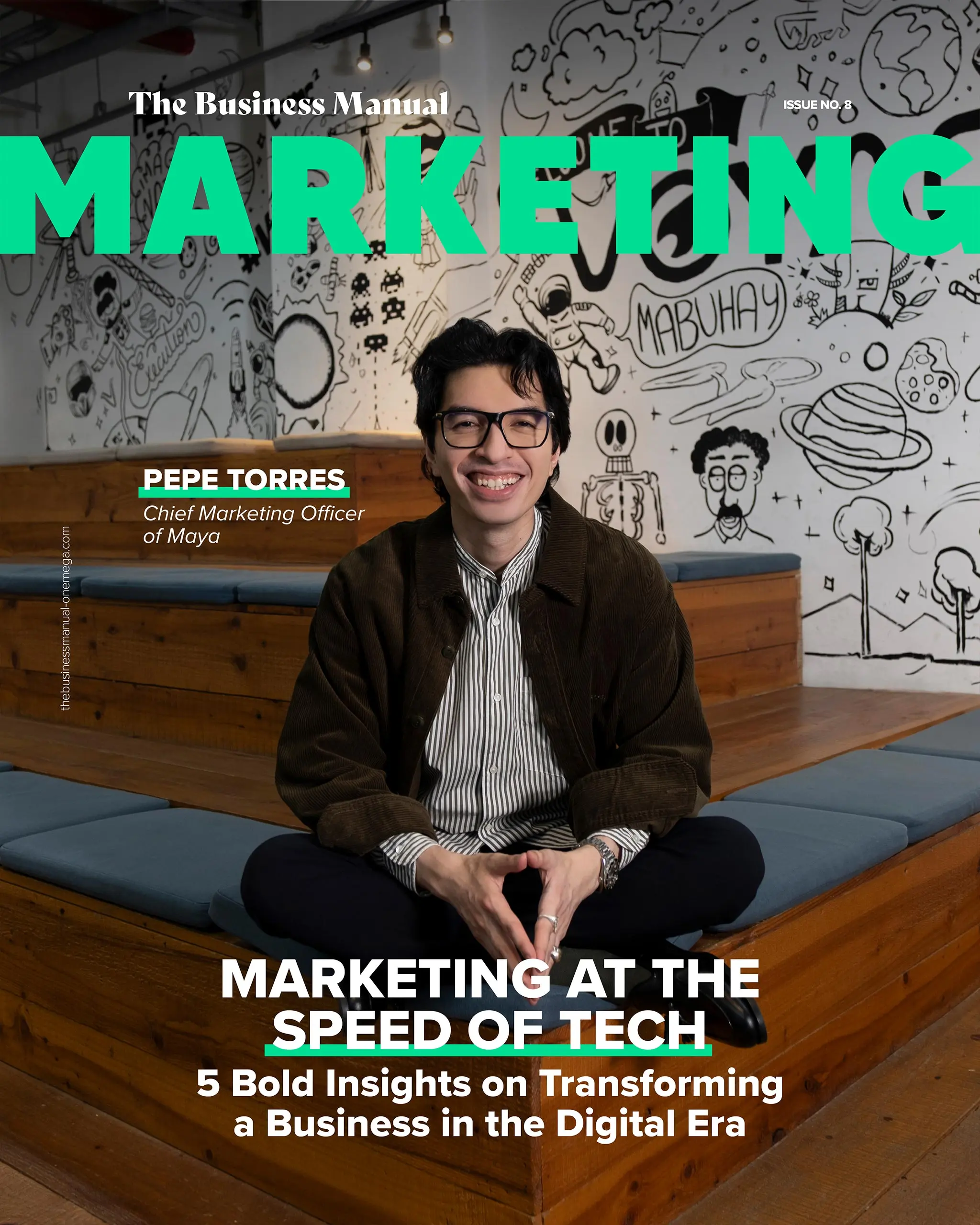
Marketing at the Speed of Tech: 5 Bold Insights on Transforming a Business in the Digital Era


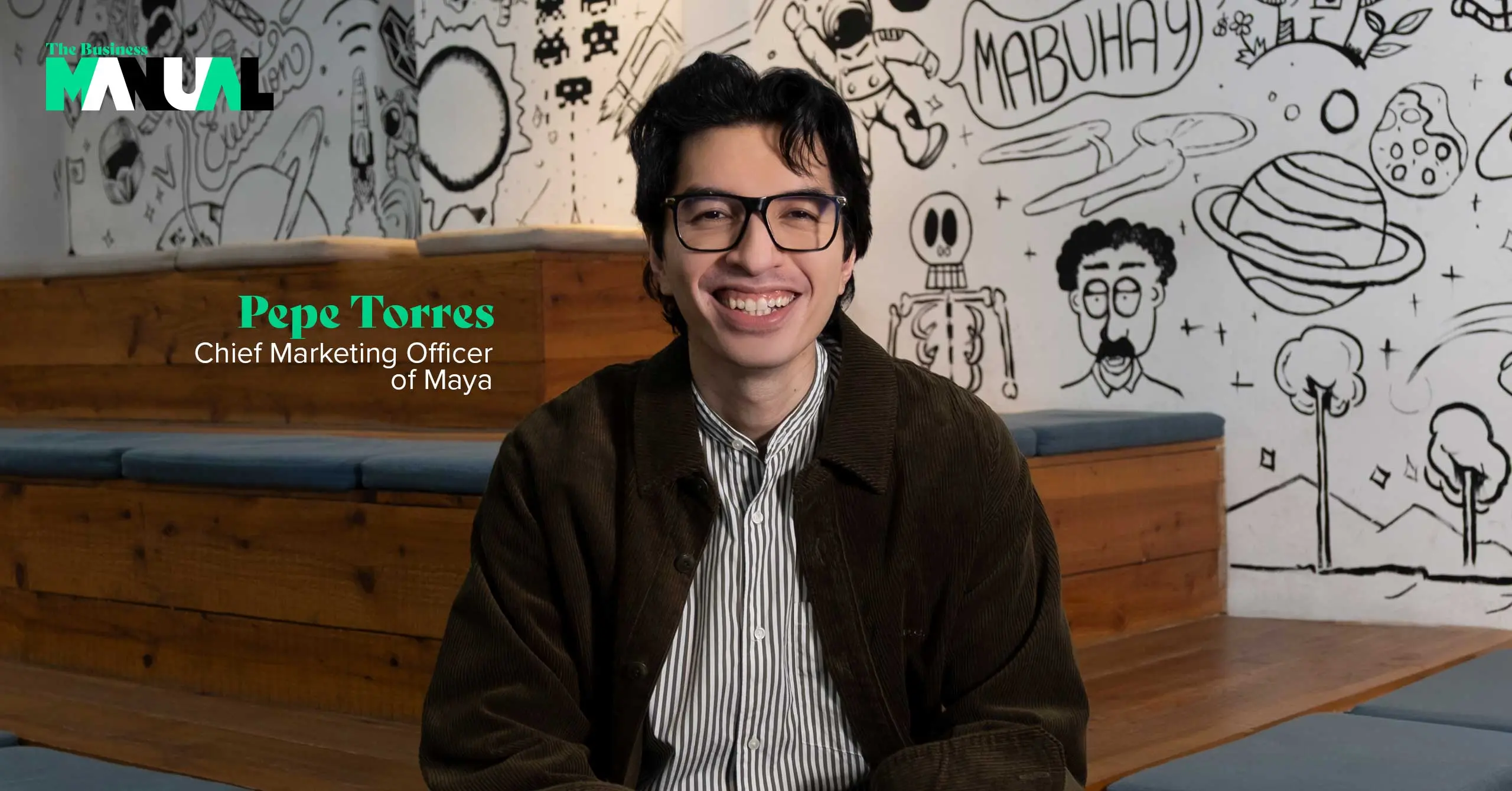
How Maya CMO Pepe Torres led the company’s digital transformation into the country’s number one digital bank.
What a difference a name makes. In 2022, the company formerly known as Paymaya was the country’s second largest e-wallet company, far behind the dominant leader, GCash. Yet after, a complete transformation from e-wallet to full-service digital bank, the fintech company now known as Maya rose to become the country’s number one digital bank. With marketing leading the way in identifying customer needs, defining Maya’s products, and communicating the benefits of these digital products to consumers, it is a showcase of the discipline’s transformative power.
A year later, in 2023, according to the BSP, Maya held approximately 61% of all licensed digital bank accounts in the Philippines–or around 46% of the entire digital-deposit balance. And today, Maya’s reach has only grown as it has widely become recognized as the Philippines’ top digital bank, most recently in 2025 by Forbes and The Financial Times’ The Banker. Its digital products–everything from basic savings accounts to crypto to insurance and investment products accessible from an app–have clearly resonated with Filipinos as their financial habits change to better suit tomorrow. It’s nothing short of a revolution.
Leading this revolution is Maya’s Chief Marketing Officer, Pepe Torres. From rebranding PayMaya into the country’s leading digital bank to building a globally respected brand with world-class marketing, Torres has done it all by being bold, agile, and always putting the customer first. For aspiring entrepreneurs, his journey offers invaluable insights on how modern marketing can transform a business from the inside out.
1. Redefining the Role of Marketing
Pepe Torres begins with a common misconception about marketing. In many Filipino companies, marketing comes last–entering the discussion after the product has been developed and produced. For these companies, marketing is almost an afterthought. It comes into play only to sell–to create packaging, a brochure, or an attractive proposition. In short, to “make things pretty.”
Torres doesn’t see marketing that way. At Maya, he shares, marketing sits alongside product and commercial leadership at the strategy table.
He explains marketing’s role in broad strokes, saying, “Here, the marketing function is very much a thought leader, on equal footing with your commercial leadership and your product leadership. And together, marketing, product, commercial, we work together to develop the strongest possible consumer value propositions, the strongest possible innovations and customer experiences.”
With marketing as a living part of every discipline or department, it led the transformation of Paymaya the e-wallet into Maya the digital bank. Marketing helped identify consumer needs and behaviors and build a bold, new strategy for the company. With this knowledge, it defined the digital products Maya would offer. And only then, knowing what these products could do for consumers, did Pepe Torres and his team create the branding and communication–the traditional idea of marketing–that was required.
Torres continues, “Here, what I think is really unique is we have an equally strong voice in the boardroom, and we are thought leaders in helping the commercial team and the product team figure out what is a consumer value proposition that will actually win in the market.”
This collaborative model proves that marketing is no longer just the final step in a business plan. It’s a core driver of business growth, and entrepreneurs would do well to adopt this mindset early on.
2. Rebranding with Purpose
To reinvent itself, Paymaya was first going to need a new name. This rebranding wasn’t done for its own sake, nor was it done purely for image. It was a reflection of what the company was becoming. It was a necessity.
“That’s a radical transformation,” Pepe Torres says about the company’s reinvention in 2022. “In that regard, rebranding wasn’t the end in mind. It was a necessary outcome.
“If you’re going to be a bank, you’re going to offer way more than payments. And if you stick with Paymaya, then you’re forever going to be limited to just payments… But I looked at the data, and there’s good awareness for Paymaya as a brand.
“And for us, it was a relatively easy decision. Let’s retain some of that awareness as much as possible. Let’s just drop Pay.

“Maya has a nice ring to it.”
The bold transition from PayMaya to Maya wasn’t just a facelift—it was a strategy born from deep consumer insight. What exactly was this insight?
Torres recounts, “One of the most consistent behaviors we’d see among people who use e-wallets is they receive their salary in their traditional bank account. And then they’ll cash in a few thousand pesos at a time in their e-wallet. So I asked them, why? Why do you do that?”
The answer was that consumers enjoyed their e-wallet for its convenience. But they felt that their money was safer in a bank.
Torres saw an opportunity.
“What if we could give Filipinos the convenience of high-tech apps that they want, but also the security of banking that they need?” he asks. “If you’re sick and tired of being the number two e-wallet, let’s change the conversation. Let’s be the number one digital bank.”

This led to Maya’s repositioning as a digital bank, unlocking new services and dramatic growth. Within just five months,, Maya reached 1 million users and secured Php10 billion in deposits. By mid-2023–just a little over a year after its relaunch–it had 2.3 million depositors with Php25 billion in deposits.
These impressive numbers continue to grow. By 2024, Maya had 3.7 million active customers with Php32 billion in deposits.

3. Marketing at the Speed of Tech
Pepe Torres began his career in marketing with P&G, the company that literally invented brand management. It was the ideal place to learn the foundation of his career. But his transition to Airbnb and eventually Maya, taught him how speed, complexity, and agility define the practice of modern marketing.
“In that company [P&G] marketing is the center of the solar system,” Torres says. “You’re most responsible for your P&L and marketing is seen as the critical growth lever for delivering your P&L. And so that responsibility is merged.”
Marketing in Maya–a financial company and a tech company–was a more demanding discipline which required a deep understanding of marketing, finance and digital all at the same time.
“We’re a lot more complex than fast-moving consumer goods,” Torres explains. “There’s the financial and banking side of the product thinking.
“Then of course there’s the digital product side of it. How are we going to make sure that we actually offer really, really great experiences for our customers?
“Then finally there’s the marketing side of it, understanding the consumer insights, figuring out how this technology can actually help solve problems for customers, and bringing it all together in a way that it’s very simple by the time it gets to the customer.”
To succeed, Torres believes that it’s critical to have an agile and technology-driven culture within the company.
Pepe Torres calls it “marketing at the speed of tech.”
He explains, “I learned the fundamentals in P&G. I felt like I learned the agility in Airbnb. [The startup culture was] marketing at the speed of tech. That’s how I look at it.”
![PULL QUOTE I learned the fundamentals in P&G. I felt like I learned the agility in Airbnb. [The startup culture was] marketing at the speed of tech. That's how I look at it. –Pepe Torres, Chief Marketing Officer of Maya](https://assets.thebusinessmanual.ph/wp-content/uploads/2025/06/Pepe-Torres-Chief-Marketing-Officer-Maya-Quote-2-scaled.webp)
To illustrate marketing at the speed of tech, Torres shares the recent soft launch of the Maya Black credit card.
Returning to the synergy between marketing, product and commercial teams, he says this product launch “is the outcome of the product team bringing in really strong product thinking and technological thinking, the commercial team figuring out where we can actually really create financial value for the end customer. But then also the marketing team figuring out what’s the best positioning.”
Together, their work resulted in a uniquely positioned product that proved to be disruptive for the industry. When Maya began accepting applications on May 15, the company received 30,000 applications in just two hours.

4. Ground Yourself in Fundamentals Before Turning to Tech
While Torres embraces new tech like AI, automation and data–Maya, in fact, uses AI to give its users a credit score–he issues a strong warning against chasing trends blindly.
“Just to say you’re an AI-first company, to me that’s very concerning,” Torres says. “I think any company should always be a customer-first company.
“For us, the role that any new technology plays is, how can this help us serve our customers better? It can be in the form of many things that they do not see, like how much more efficiently we might be serving them in the back end, personalizing services and communication solutions. It can be through us being more efficient and more effective with how we communicate to them.”
When it comes to data, which is now increasingly available to marketers, Torres maintains the same focus towards consumers.
He admits that with today’s detailed, real-time data, it’s easy to get addicted to chasing immediate results. But Torres warns against overreacting to every click.
“Now, our data is coming in instantly. When we see somebody sign up, okay, boom. But sometimes, that makes us really zero in on instant gratification… We really have to balance that out. What helps us is we have formed a better understanding of marketing tactics that have shorter term and longer term effects. We try to measure holistic attribution of which marketing investments lead to the right outcomes.”
Torres also emphasizes mastering the fundamentals of marketing. Beyond the tech, the basic understanding of your consumer remains the most crucial part of the job.
Yes, marketers should master the quantitative–data and analysis. But the qualitative–understanding people and their behaviors–is just as important and more powerful.
He says, “[Marketers] have so much data that’s in front of them quantitatively, they don’t spend enough time harvesting the data that’s out there qualitatively. Actually talking to people, actually understanding people’s behaviors and their motivations and where they’re coming from.
“You master the quantitative. You also know how to harvest the qualitative yourself, not just from third parties.”
Entrepreneurs should develop both analytical and empathetic skills—mastering the spreadsheet, yes, but also spending time with consumers and getting to know their needs, which leads to market insight.

5. To Achieve Your Ambitions, Ask for Help
Pepe Torres’s most personal insight? Failure often came when he didn’t ask for help.
Especially for solo founders or small teams, this advice is golden. Don’t isolate. Build your tribe, seek input, and co-create.
For Torres, asking for help isn’t just about sending out an SOS when things get tough. It’s a tool to help one achieve goals and ambitions.
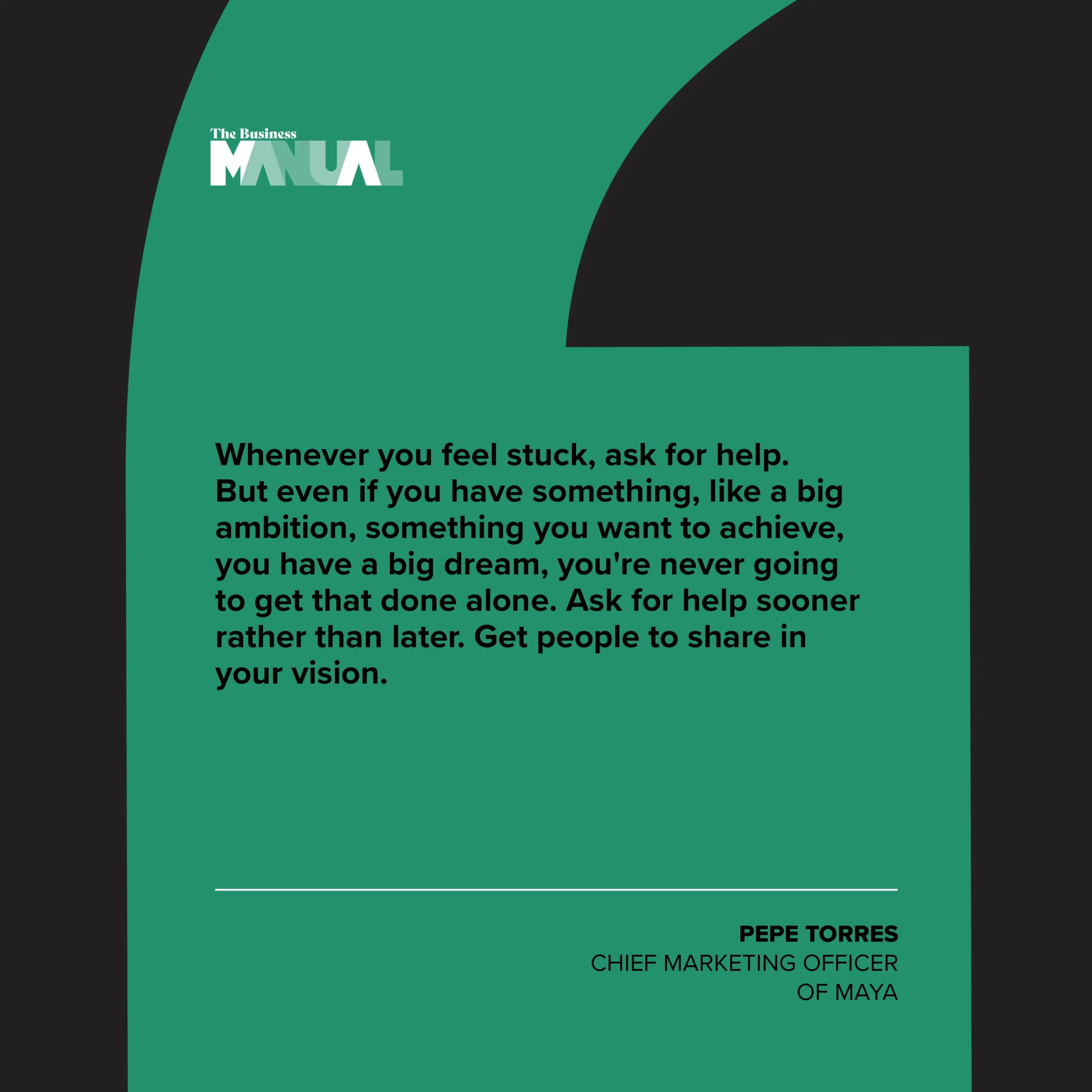
“Whenever you feel stuck, ask for help,” he says. “If you have something, like a big ambition, something you want to achieve, you have a big dream, you’re never going to get that done alone. Ask for help sooner rather than later. Get people to share in your vision.”
Whether you’re launching a startup or leveling up your brand, the lessons from Pepe Torres are clear: Be strategic but also be agile. Data-informed but human-led. Customer-first always. And above all, be brave enough to reimagine what’s possible.
Text VINCENT SALES
Photography ED SIMON of KLIQ INC.
Videography JR RAMIREZ of KLIQ INC.
Art Direction ANDREA SANGCO
Sittings Editors RJ LEDESMA, JILL TAN RADOVAN
Shoot Coordination TONI MENDOZA
Shot on Location LAUNCHPAD BLDG., TV5 COMPOUND, MANDALUYONG