Beyond Beauty Sleep: How Uratex Grew Into a Well-loved Brand, as Told by Founder Natividad Cheng


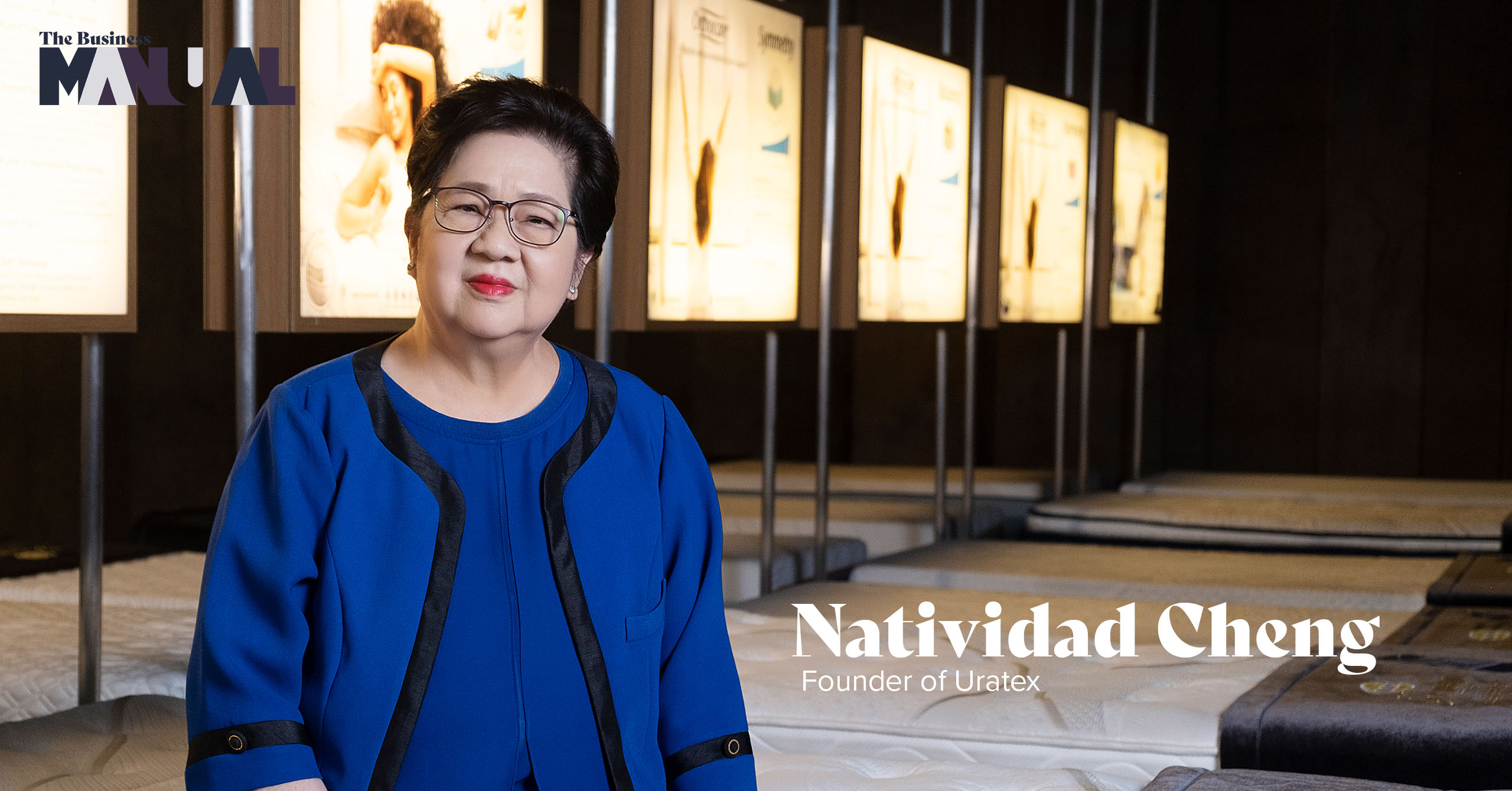
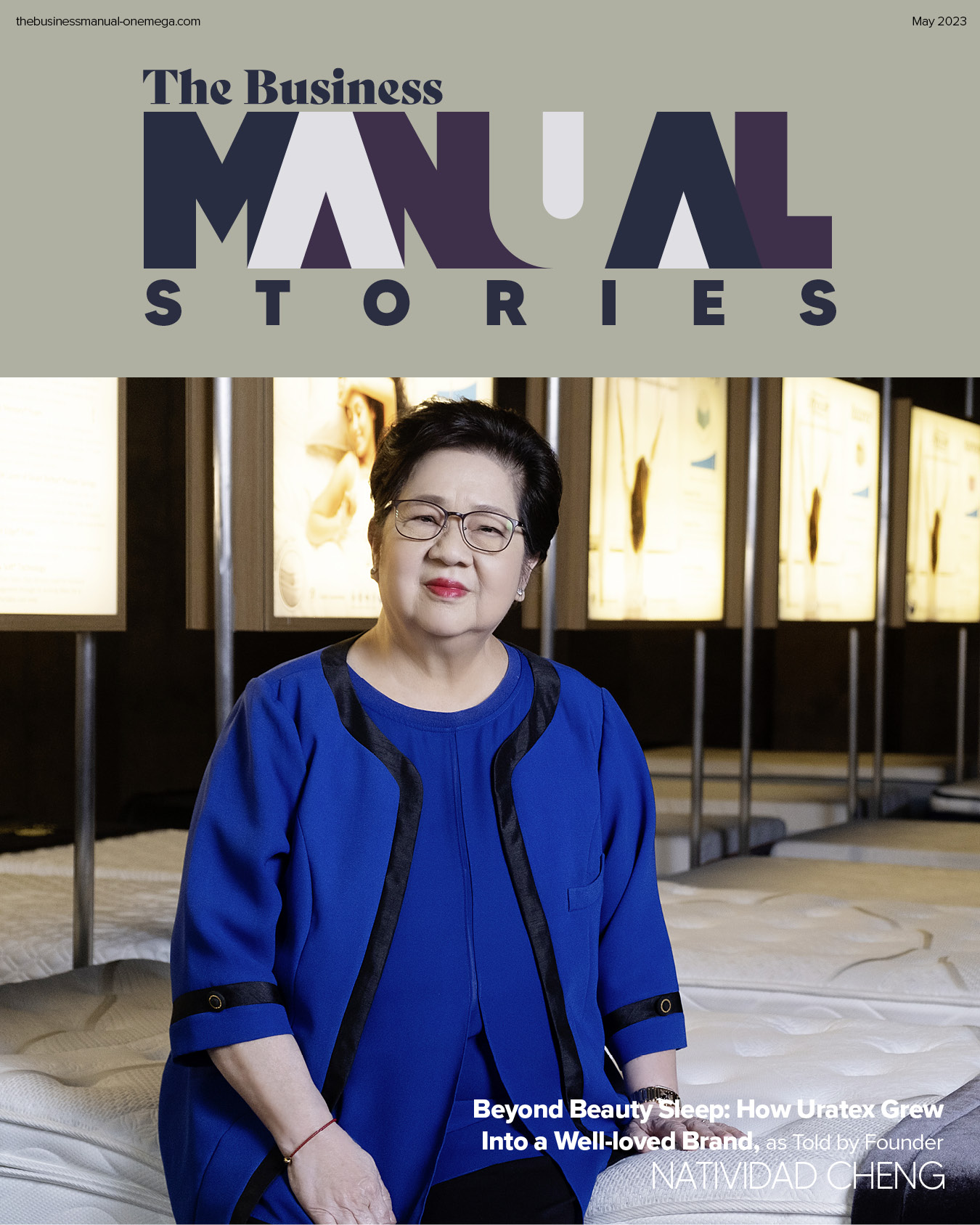
Uratex Founder Natividad Cheng shares how she and her husband built the company from the ground up—transforming it into a household brand and icon that Filipinos remember fondly.
With just PHP 4,000 capital, 10 employees, and a dream born from under a santol tree of providing high-quality foams and affordable mattresses for every Filipino to lie on, Natividad Cheng and her husband, Robert founded Uratex. 55 years after, the company is now the leading foam manufacturer in the Philippines with 25 plants and 18 showrooms, nationwide.
Although Uratex is foremost known for its mattress and bedding, the brand has diversified its portfolio to include a wide range of products that cater to the growing demands of other industries—as well as other companies and partnerships under its wing, Uratex/RGC Group of Companies. The 55-year-old enterprise includes business groups specializing in automotive parts and seats, foams and mattresses, monoblock and home accessories, fabrics, and food packaging.
The success, however, of Uratex did not happen overnight. It was a slow and steady path—filled with trial and error, lessons learned, and challenges faced. But the efforts of this husband and wife duo bore fruit, as the support of their families, employees, suppliers, and friends have paved the way for many successes to come.
In this exclusive interview with The Business Manual, the family matriarch, Natividad Cheng, shares how Uratex has grown to become a household brand that is well-loved by Filipinos.
From Humble Beginnings
Back then, a working woman was unprecedented in a society filled with gender norms. However, for Natividad Cheng and her husband, growing up poor meant needing to make ends meet. “Dati pareho kami. Both of us are working. My salary was only above [the] minimum, then my husband also worked with his grandfather. [His] salary was also PHP 4 a day,” Mrs. Cheng begins.
“Then, we started a family,” she continues. “Iniisip namin paano kakasya yung sweldo namin lalo na kung meron na kaming anak, diba? Kaya naisip namin mag-trading muna kasi limited lang pera namin. We only [had] savings of PHP 4,000. Then, we started trading furniture supplies and construction supplies.”
[Translation: Then, we started a family. We were both thinking about how we can make our salaries fit, especially since we have kids. That’s why we thought of trading first because we had limited funds. We only had savings of PHP 4,000. Then, we started trading furniture supplies and construction supplies.]
Eventually, the couple thought of starting their own business. Thus, in 1968, Polyfoam Chemical Corporation was born. With their capital of PHP 4,000 and the help of 10 employees, the Chengs set up shop in a rented warehouse in Malibay, Pasay, as well as a makeshift office under a santol tree.
“Sa awa ng Diyos, malaki kinita namin dahil we worked siguro from six o’clock hanggang gabi, talagang nagtatrabaho kami. Then my husband, siyang driver, taga-pick up, delivery with one helper only.”
[Translation: Thanks to the grace of God, we earned a lot here—probably because we worked from 6:00 AM until night. We were really working hard! Then my husband, who was the driver, was the one who handled pick up and deliveries with one helper only.]
During the formative years of the business, the Chengs spotted an opportunity in the bedding industry: creating the foam used in mattresses themselves instead of sourcing from elsewhere. “That time may isang factory lang ng foam,” Cheng explains. “Ang makina niya galing din sa Germany. Ang supply niyang chemicals all came from Germany lang din.”
“Sila parang palitaw eh. Ngayon may foaming, may supply. After 2 weeks, wala na naman. Siguro walang planning. Kaya naisip namin, gagawa lang tayo ng negosyo, bakit hindi foam na lang?” Mrs. Cheng muses.
[Translation: At that time, only one factory produced foam. Their machine came from Germany and their supply of chemicals also came from Germany. They’re not consistent. Today, there’s a supply of foam, then after two weeks, there’s none. Probably didn’t plan things out. This was why we thought: why not make a business out of foam?]
“Dun kami nakuha ng ideas. That’s where we got ideas,” she declares. Soon enough, this gave rise to a new product offering that would not only benefit them financially in the long run but also birth newer products in their portfolio.
Growing Pains in Growing a Business
The growth of Uratex/RGC Group, while an upward trajectory, was wrought with challenges, since scaling a business meant needing more funds. “Syempre sa sipag namin, eh pag kulang ng pera, pati wedding ring ko, isasangla ko para may pang-sweldo sa tao. Napakahirap kumuha ng credit line kasi wala pa kaming history na okay. Pero meron namang nagtiwala na pinautang naman kami. Dun kami nagumpisa,” Mrs. Cheng reveals.
[Translation: Despite our hard work, whenever we lacked finances, I pawned (things like) my wedding ring—just so I have money to pay my workers. It was very hard to get a credit line because we don’t have a history yet. But we have people who trust us and lend us money. That’s where we started.]
“Pero kami pag umutang, pag nabenta, hindi ko na hihintayin yung 30 days. Babayaran ko kagad yung supplier. Kaya, yung ibang supplier, pinapautang na kami,” she adds.
[But whenever we borrow money, whenever we sell, we don’t wait for 30 days. We pay back our supplier. This is why our suppliers let us borrow money.]
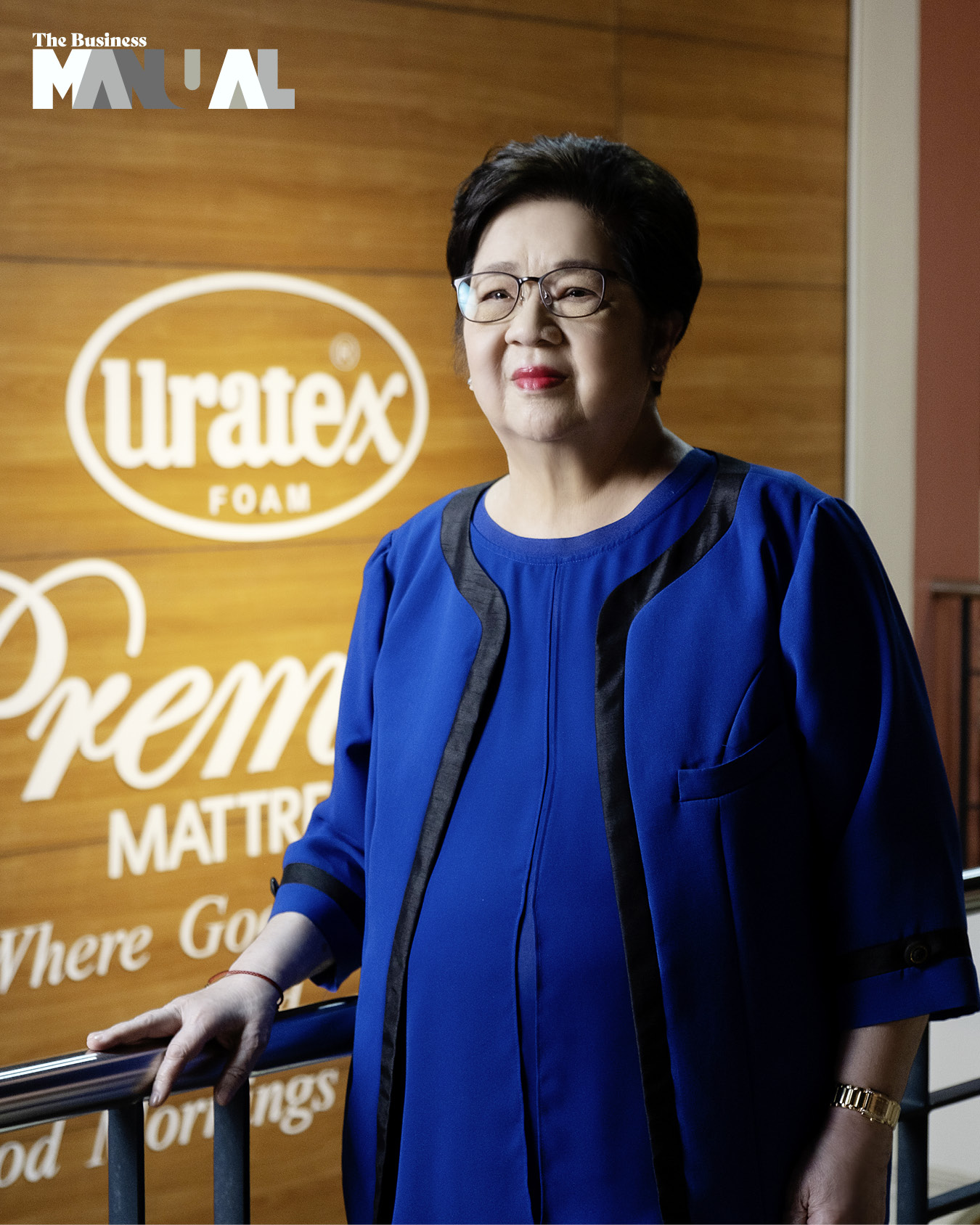
Natividad Cheng on Her Purpose as a Businesswoman
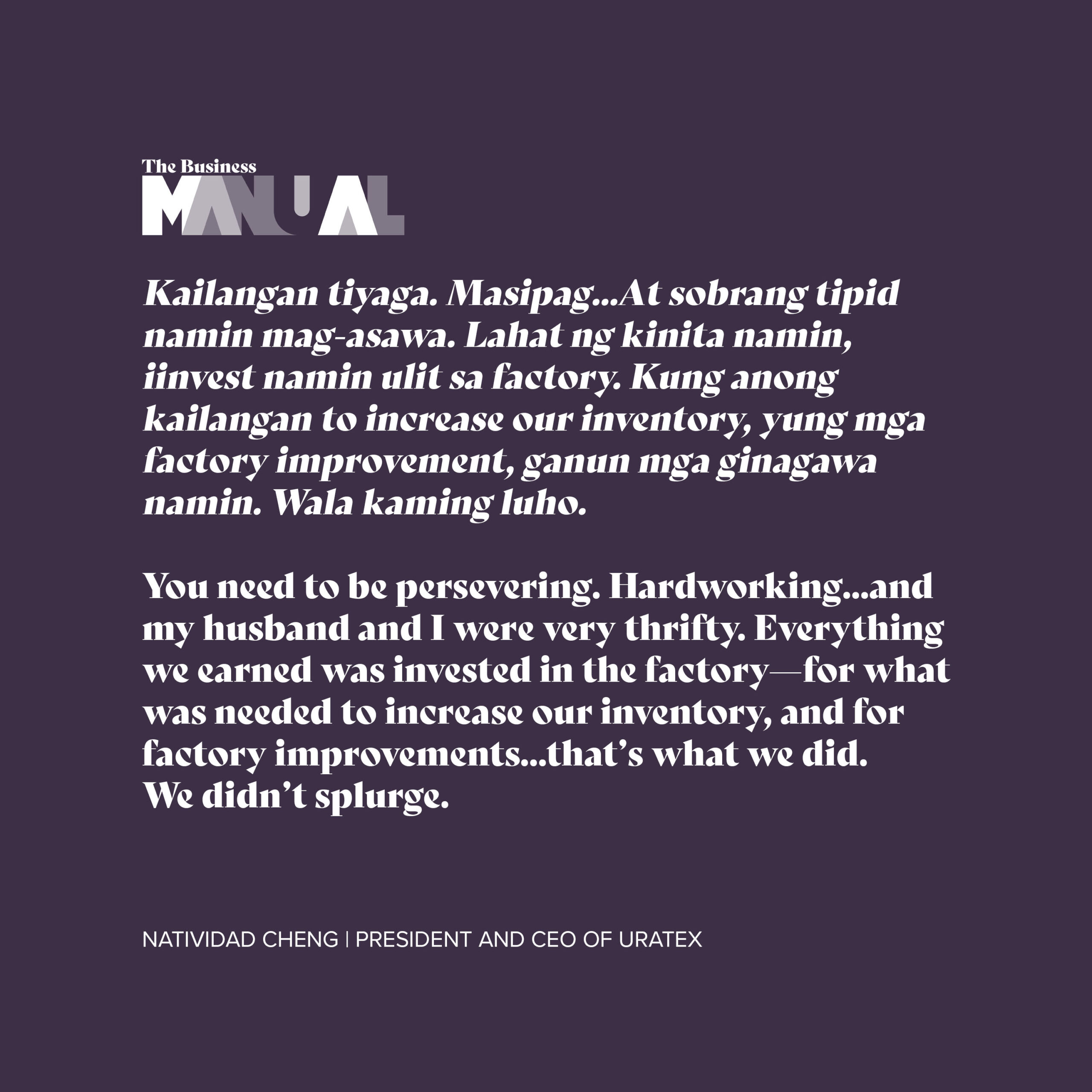
Growing a business likewise comes with its fair share of growing pains, but for Mrs. Cheng—a driven and strong woman ahead of her time—she just powered on. “Kailangan tiyaga. Masipag. Kaya sabi ko nga, ang tulog namin isang gabi wala pang 6 hours,” she says simply. “Siguro mga limang oras okay na sa amin.“
[You need to be persevering. Hardworking. This is why I said we sleep for less than 6 hours every night. Around 5 hours is already okay for us.]
“Sobrang tipid namin mag-asawa. Lahat ng kinita namin, iinvest namin ulit sa factory kung anong kailangan to increase our inventory, yung mga factory improvement, ganun mga ginagawa namin. Wala kaming luho ha.” the matriarch continues.
[Translation: My husband and I were very thrifty. Everything we earned was invested in the factory—for what was needed to increase our inventory and for factory improvements…that’s what we did. We didn’t splurge.]
What’s more, the desire for a better life pushed the couple to work hard. “Malakas yung fighting spirit namin. Syempre galing kami sa hirap, ayaw ko nang bumalik sa hirap,” Mrs. Cheng declares. “Kaya gusto din namin makatulong sa pamilya namin dahil mother ko is a housewife lang, tapos my father was working. Ang sweldo kulang pa sa pamilya. Walo kami magkakapatid eh. Kaya sobrang tipid.”
[Translation: Our fighting spirit was strong. Of course, we used to be poor, but we don’t want to return to being poor. This is why we wanted to help our family since my mother is a housewife and my father was working. His salary was not enough for our family. We’re 8 in the family, so we had to save.]
The matriarch goes on to reveal her living conditions back then—a small space with a single bedroom and a living room. The small bedroom was, of course, for her parents. This pushed her to push for a better life ever since.
“Bahay namin dati isang kwarto lang na yung salas namin yun na yung bedroom namin. Tapos may isang maliit na bedroom para sa parents ko. Ganun. Kaya gusto ko na umalis sa hirap,” she adds.

Bringing Together Business and Motherhood
Eventually, Mrs. Cheng faced yet another setback: the sudden passing of her husband. This was a large loss to bear for the matriarch and her family, but life did not stand still. There was still a business to run, employees to pay, and orders to be fulfilled. And while Mrs. Cheng allowed herself to grieve, she knew that business must still go on.
Thankfully, her kindness was paid tenfold as even her customers and suppliers have reassured and encouraged her all throughout. “[Dahil] biglang namatay si Tatay Robert, ang ginawa namin, kailangan tuloy pa rin negosyo namin,” Mrs. Cheng explains.
“Medyo marami na kaming empleyado. Edi, mabait din mga supplier namin at yung mga customer. Mga malalaking customer, mga multinational—sila mismo nagsabi samin, ‘sige kaya mo naman, sige ituloy ninyo.’ Hanggang lumaki na nang lumaki negosyo namin,” she continues.
[Translation: Because Robert passed away so suddenly, we knew that we needed to still continue the business. We had a lot of employees (that needed to be paid) but our customers and suppliers have been good to us. We’ve had big customers—multinational companies—who told us “You can do it, just continue the business,” until our business, Uratex, grew.]
Without her better half to help her, Mrs. Cheng now faced the challenge of running the business. To do so, she used what she knew as a mother, which was managing a household, to guide her. “Para akong nanay sa bahay. Kailangan marunong kang mag-budget, yun ang importante. Diba dapat kung gumastos, gagastos. Kung di dapat, hindi.”
[Translation: It’s like being a mom at home. You need to know how to budget—that’s important. If you need to spend for something, spend. If not, don’t.]

Natividad Cheng on Innovating and Keeping an Open Mind
All throughout her business journey, the matriarch did not have any mentors to guide her, as her tried-and-tested principles of perseverance, grit, and hard work have served her well. However, she has always believed in the importance of learning, which she did through books, radio, and even from hearing other people talk about business.
“Medyo matiyaga ako magbasa eh at makinig ng radyo,” Mrs. Cheng shares. “Kasi dati wala pang masyadong TV, diba? Pag nasa restaurant kami [ng anak ko], pag sa likod namin, may nagkekwentuhan tungkol sa negosyo, pinakikinggan naming mag-ina. Tapos pag-alis, ‘Ano pinag-usapan?’ ‘Ganito, ganito, ganito.’“
[Translation: I would read and listen to the radio a lot because TV wasn’t very common back then. Whenever I’m at a restaurant with my son. I’d hear people talking about business and I’d listen in. When they leave, I’d ask my son, “What were they saying?” and he’d explain it to me.]
What’s more, some of these conversations have led to new ideas and implementations for their business. Customers have even suggested products that Mrs. Cheng can add to her portfolio, which gave rise to innovations that have proven to be successful to this day. “Minsan na-apply naman namin,” she says proudly. “At saka yung mga kwento-kwento ng mga customer. Mismo ako, pumupunta ako sa customer eh. Oo, kung anong gusto nila, kung anong suggestion nila, sumusunod naman kami.”
[Translation: Sometimes, we’d apply (those ideas)…even from stories that we hear from our customers. I would even personally go to the customer (to talk to them). Yes, whatever product they want or whatever suggestion they give us, we do it.]

Success Secrets of Uratex
While hard work has been at the forefront of the success of Uratex, the reason why it has grown into a household staple among Filipinos is mainly because of an unanswered need in the market: affordable and premium bedding.
This meant investing in state-of-the-art equipment, producing the raw materials themselves, paying close attention to the quality of every mattress put out, as well as constantly improving as technology and practices have become more modern.
1. Never Compromise on Quality
While inflation has kept product prices at an all-time high, Mrs. Cheng believes in never compromising quality. In fact, the businesswoman herself reveals that despite smaller margins, she will never compromise on quality.
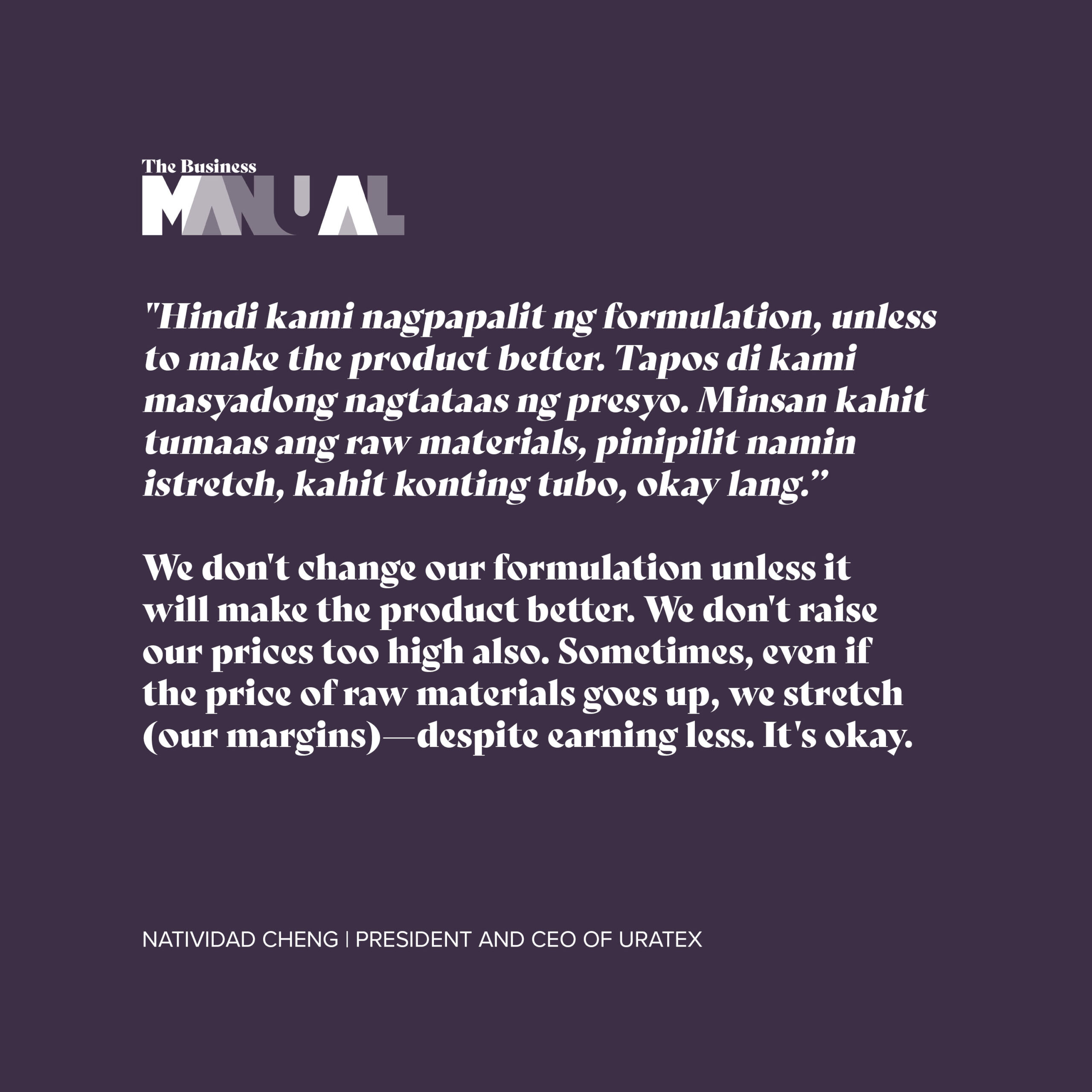
“Unang-una, hindi kami nagpapalit ng formulation, unless to make the product better,” Mrs. Cheng declares. “Tapos di kami masyadong nagtataas ng presyo. Minsan kahit tumaas ang raw materials, pinipilit namin istretch, kahit konting tubo, okay lang.”
“Kasi dami ding lumabas na gumawa ng foam, pero sarado na ngayon. Dahil yun para makalaban sila, nirereduce nila yung quality ng foam,” she laments.
[Translation: First and foremost, we don’t change our formulation, unless it will make the product better. We don’t raise our prices too high also. Sometimes, even if the price of raw materials goes up, we stretch (our margins)—despite earning less. It’s okay.
A lot of people started making foam, but these businesses have closed. This is because in order to stay competitive, they reduce the quality of their foam.]
2. Create a Long-lasting Product
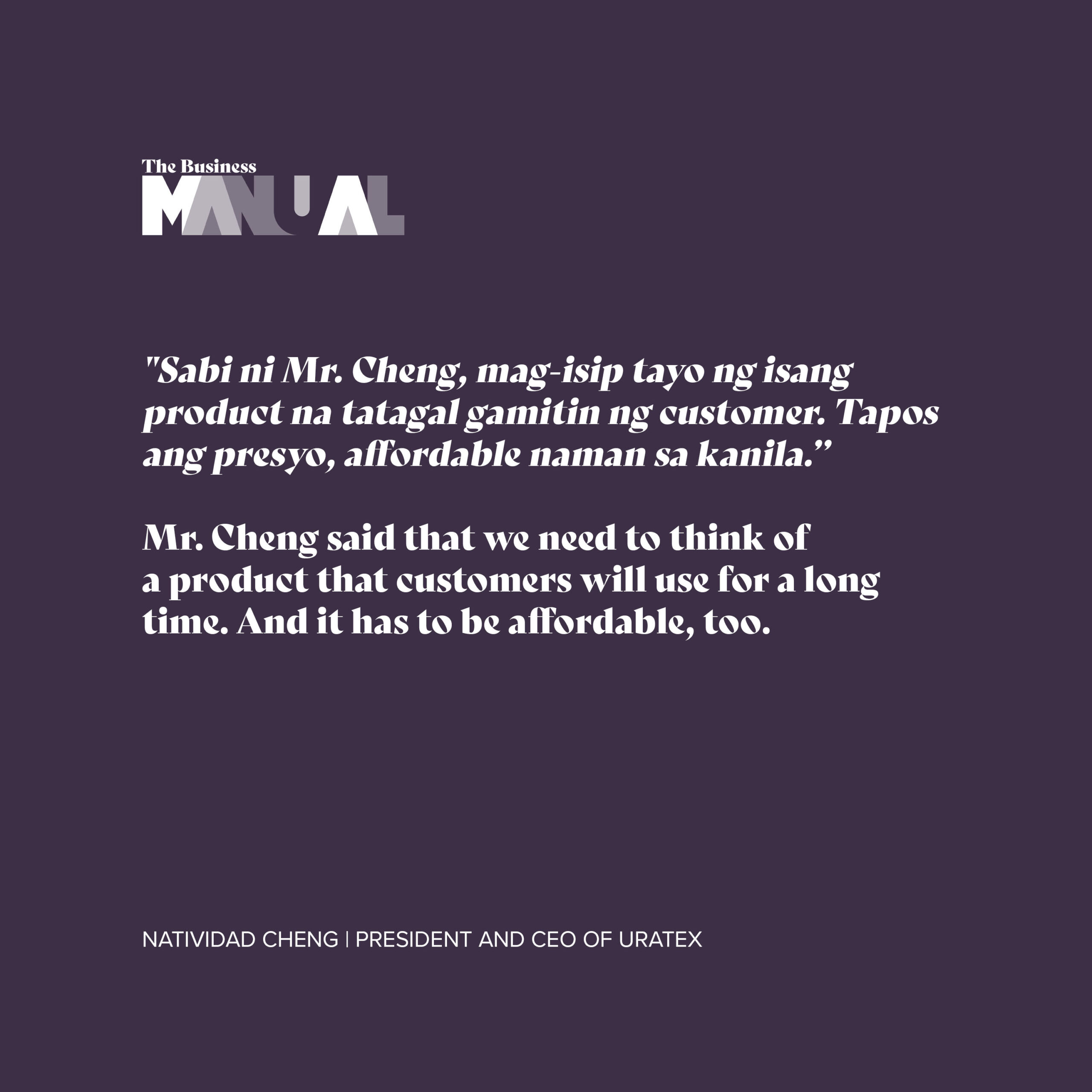
And likewise, a product that will last long is key. This is why Uratex mattresses are made to last. “Sabi ni Mr. Cheng, mag-isip tayo ng isang product na tatagal gamitin ng customer,” she reveals.
“Tapos ang presyo, affordable naman sa kanila. Kaya nakaisip kami, gagawa tayo ng magandang foam para sa public, sa consumers natin. Nakita ng mga customer na ‘aba, ang tagal masira nitong foam ah.’ Kaya balik sila ng balik sa atin. Pag bibili ng new foam, sa atin kumukuha. Tapos nirerekomenda pa nila sa kaibigan nila.”
[Translation: Mr. Cheng said that we need to think of a product that customers will use for a long time. And it has to be affordable, too. This is why we thought of making good-quality foam for the public—our consumers. When they see that our foam takes a long time before it breaks, they keep coming back to us. Whenever they buy new foam, they buy it from us. They even recommend (Uratex) to their friends!]
3. Learn and Innovate
With technology and practices improving over time, it is important for Uratex to remain relevant in the market by offering products that can fit the ever-changing needs of the market. This means working hand-in-hand with suppliers and Mrs. Cheng’s employees.
“Yung mga supplier namin, may mga papakilalang machine makers…Pinapapunta kami para magcheck [at] kausapin mga chemist nila [kung] paano mag-improve ng products natin,” Mrs. Cheng explains.
And while the matriarch used to oversee production herself, she now has her family and team to do those for her. “Itong next month, pupunta naman walong tao namin. Kasama si yung bayaw ko, si William, at si Peachy, my daughter, with eight chemists…yung mga product development [team] ng Uratex para mag-visit sa mga laboratories sa Singapore.”
[Translation: Our suppliers would introduce us to well-known machine makers. They would make us check and talk to their chemists about how to improve our products. Next month, eight of our people (chemists) will be going, together with my brother-in-law William, and my daughter, Peachy. The product development team of Uratex will be visiting laboratories in Singapore.]
In fact, the learning will never stop. “Walang katapusan yan! Pati pagbili ng bagong makina, talagang naka-set na kami ng budget para dyan. Every year yan.“
[Translation: That never ends! Even with buying new machines—that’s set in our budget. Every year.]
Challenges Faced During the Pandemic
Just as many businesses were hit hard by the COVID-19 pandemic in 2020, Mrs. Cheng reveals that Uratex was one of the lucky few who barely suffered any repercussions. “Siguro mga one week, sarado kami. Naghihintay lang kami ng guidelines galing sa gobyerno. Since maraming nag-stay in lalo mga call center, kailangan nila ng kutson para mag-stay in ang mga empleyado nya, edi nag-open kami.“
[Translation: Around one week, we closed. We were waiting for the government to give us guidelines. Since a lot of people were stay-ins, especially in call center companies, they need mattresses for their employees. This is why we eventually reopened.]
As for their own employees, thankfully, a lot of them were stay-ins, while those who initially weren’t, chose to stay in and work, too. All throughout, Mrs. Cheng made sure that they were properly cared for—by feeding them all throughout. “Tapos yung mga empleyado namin, stay in. Yung mga gustong pumasok, stay in. Libreng meals sila mula almusal, lunch, hanggang dinner. Lahat libre lahat.
In fact, business didn’t suffer one bit, as bedding remains as an essential good. “Di naman kami bumaba. Sa tingin ko, na-maintain naman yung negosyo. Pero ngayon pataas na naman ulit,” Mrs. Cheng reveals.
“Kasi yung product natin parang kailangan eh. Kailangang-kailangan eh. Except sa automotive kasi humina yung automotive eh. Pero yung foam, para sa bahay, mattress, packaging namin, mga container, lahat sumipa naman.”
[Translation: Business did not suffer. The way I see it, we were able to maintain it. But now, business is going back up because our products are needed. They’re essential. With the exception of our automotive (business), which went down, our foam, household products, mattresses, packaging, and containers, all did well.]
Future Plans for Uratex
Literally the makings of a one-stop shop, Mrs. Cheng believes that if a product can be made, she will make it. “Kasi volume natin sa Philippines, hindi masyadong malaki. Kaya wala masyadong investment eh. Kaya, kung di namin gagawin, mag-iimport sila. Ang talagang gustong-gusto namin, dumami ang manufacturing sa Pilipinas. Yun lang kailangan natin. Agriculture and manufacturing para may trabaho lahat.“
[Translation: Our volume in the Philippines isn’t very big. This is why we don’t have a lot of investments. This is why if we can’t make a product, people will import it. And what we really want to do is push for more manufacturing here in the Philippines. That’s what we need. Agriculture and manufacturing so everyone will have job opportunities.]
But with growing success and a diverse line of companies and products under its wing, this begs the question: what are expansion plans that Mrs. Cheng has in mind for Uratex?
For one thing, she doesn’t plan to take it to the public with an initial public offering (IPO). After all, expansion in the Visayas and Mindanao has kept her busy to date—even more so in Luzon and Metro Manila—as there is a growing market in those parts. “Kung tutuusin mo, malaki ang market ng Visayas [at] Mindanao kaya nag-expand kami sa Vis-Min and outside Metro Manila,” she opines.
Surprisingly, neither are there plans of going global. “Kaya di mo kailangang mag-negosyo sa abroad. Unang-una, di naman natin kilala yung nasa abroad. Pero nag-eexport kami. Napakarami naming ineexport na mattress sa USA. Daming containers isang buwan!“
[This is why we don’t need to do business abroad. For one thing, we don’t know people from abroad. But we do export. We export a lot of mattresses to the US. That’s a lot of containers every month!]
Wise Words of Advice from Natividad Cheng of Uratex
Backed by many years of experience, Mrs. Cheng is undeniably a fountain of knowledge. When asked about her learnings and what she can advise aspiring businesspeople and entrepreneurs, she has this to say:
How to Establish Good Relations with Suppliers
Building connections is key in every business and for Mrs. Cheng, this translates to building a long-lasting relationship with suppliers.
“Kung anong pinag-usapan namin ng mga suppliers, dapat sumunod tayo. Lalo na sa mga creditors. Yun ang importante. Bayaran natin kagad ang supplier, para by mouth kinikwento nila, ‘Ito, okay bentahan tong polyfoam, itong mga grupo nila, talagang nagbabayad kahit wala sa due date,’” she opines.
[Translation: Whatever you agreed on with your suppliers, you should honor your word. Most especially with creditors. That’s important. Pay your suppliers right away, so that when they talk about you, they say “It’s okay to sell to them. They pay early, even before the due date.”]
How to Establish a Good Relationship with Customers
A business will not be where it is without the support of its customers. Thus, Mrs. Cheng stresses the importance of building long-lasting connections that will not only encourage them to buy from you again but also so that they will grow to love the brand.
“Sa customer, nakikisama ako. Lahat ng pyesta, binyag, kasalan, nandun ako. Dati halos nagagalit na asawa ko, ‘Ano ba yan linggo, tatlong party pupuntahan mo,'” she recalls. “Medyo malayo pa. Dagupan, kahit saan ako nakakarating. Last two weeks ago, [sa] pyesta sa Pampanga, limang bahay pinuntahan ko. Binisita ko mga customer namin. Talagang pinupuntahan ko.”
[I go to where my customers are—every fiesta, baptism, wedding…I’m there. Before, my husband would get angry at me and say, “Why are you going to three parties in a week?” Some of them are even far! I’ve even gotten to Dagupan. Last two weeks ago, I went to five houses during a fiesta in Pampanga. I visited my customers. I would personally go over!]
But for new customers, she enlisted the help of her children, as her age has made her unable to travel far. “Pero yung mga bagong customer, yung anak ko, mga manugang ko na lang yung pumupunta. Kasi di na siguro kaya ng katawan ko eh,” she admits.
How to Deal with Competition
Competition is part and parcel of running a business, but Mrs. Cheng remains unperturbed in the face of many growing brands here in the country. After all, the many years that Uratex has been around made it a top-of-mind choice, and it will take time for other brands to build this for themselves.
“Basta we try to improve our products tapos eh good price, by mouth na lang yung nagke-kwento eh. Kaya yung mga malalaking multinational companies, sila mismo ah, nag-invite samin na pumunta sa Japan, sa Germany para mag-observe,” the matriarch reveals. “Kaya malaki trust nila sa amin. Pag may gusto silang ipagawang bagong product, related sa foam, binibigay sa amin. Kami ang gumagawa para sa kanila.“
[Translation: We just try to improve our products and give them at a good price. Word of mouth gets our brand out. This is why multinational companies personally invite us to go to Japan and Germany to observe them. This is because they really trust us. If they want to have a product related to foam made, they give it to us. We make it for them.]
How to Expand Your Business
Eventually, Uratex diversified its services to include more than just mattresses and foam. In fact, 1974 saw the production of bed springs in Valenzuela, thanks to connections built in the bedding industry—followed by the production of car seats for well-known brands like Toyota, Mitsubishi, Chrysler, Benz, and Nissan in 1975
And now, textiles, auto parts, houseware, and even food containers have joined the company’s product line! Aside from creating these products based on what their customers asked of them, the constant innovation always started from a need that needed to be addressed.
“[Parang] customer namin, Japanese automotive, ang gusto nila, may local supply. Sasabihin samin, ‘Pwede ba gumawa kayo ng tela para sa automotive?’ Edi gagawa rin kami. Study muna, okay pala to. Pati sa fabrics for the furniture, sabay na,” Mrs. Cheng shares.
“Sasabihin naman nung isang Hapon, ‘Pwede ba gumawa kayo ng muffler?’ Che-check namin, ‘Aba, may magandang market!’ Gawa na naman kami ng muffler. Gawa naman kami ng lift spring. Lahat na ginagawa na namin eh,” she adds.
[Translation: Just like one of our customers—a Japanese automotive—they wanted a local supplier. They asked us, “Can you make upholstery for automotive?” Then, of course, we’d make it. We studied it—turns out it was okay. Then from there, we created fabrics for furniture.
Another Japanese person would ask us “Can you make a muffler?” We’d check—yes, there’s a good market for that!—then we’d make it. We’d also make the lift springs. We make all of it!]
On the other hand, some customers would ask Mrs. Cheng to create a product because there are sub-par options out there. “May customer naman, related sa foam at mattress, [naghahanap] ng monobloc. Dami naming customer eh, may higit 2000 eh. Sasabihin ng customer, ‘Gawa naman kayo monobloc kasi pangit yung nakukuha namin.’ Edi gagawa naman kami pag okay yung project study namin.“
[Translation: We have customers from our foam and mattress line (who were looking for)monobloc chairs. A lot of customers are looking for that, about 2,000 of them! They would tell me: “Please make monobloc chairs because the ones we get aren’t good. We’d make it when our studies have shown that it will be successful.]
How to Become a Successful Businessperson
And finally, for aspiring businesspeople and entrepreneurs, Mrs. Cheng shares how she was able to successfully grow her business from the ground up.
“Kailangan lahat ng kikitain mo, wag naman ubusin,” she cautions. “Wag tayong bibili ng luho na hindi natin kailangan. Iplano natin. Kaya kami pag may pera, improve yung machinery namin o papatayo kami ng warehouses ng additional factory. Yun, di mo uubusin sa luho. Eh kami naman, pamilya namin, hindi maluho. Nasanay na kami.“
[Translation: You shouldn’t spend all of your profits. Don’t splurge on unnecessary things. Plan ahead. This is why whenever we have money, we use it to buy new machinery or build warehouses or factories. We don’t overspend. My family and I…we don’t spend. We’re used to it.]
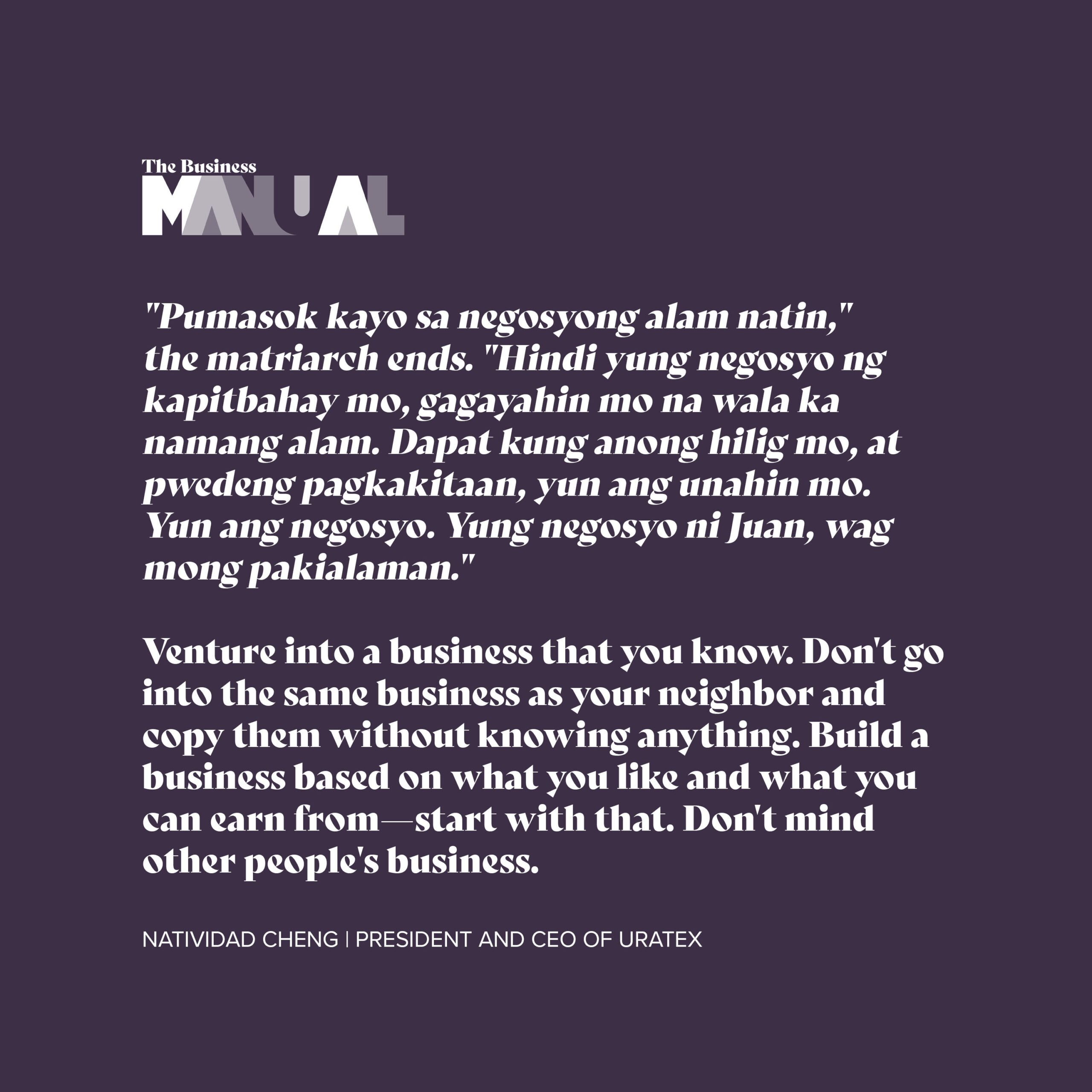
“Pumasok kayo sa negosyong alam natin,” the matriarch ends. “Hindi yung negosyo ng kapitbahay mo, gagayahin mo na wala ka namang alam. Dapat kung anong hilig mo, at pwedeng pagkakitaan, yun ang unahin mo. Yun ang negosyo. Yung negosyo ni Juan, wag mong pakialaman.“
[Translation: Venture into a business that you know. Don’t go into the same business as your neighbor and copy them without knowing anything. Build a business based on what you like and what you can earn from—start with that. Don’t mind other people’s business.]
Text DIANE NICOLE GO
Photography ED SIMON of KLIQ, INC.
Videography JR RAMIREZ of KLIQ, INC.
Video Producer MIGUEL LIM
Art Direction MARC YELLOW
Sittings Editor RJ LEDESMA
Shoot Coordination PILAR ANGLIONGTO and TONI CALINGASAN
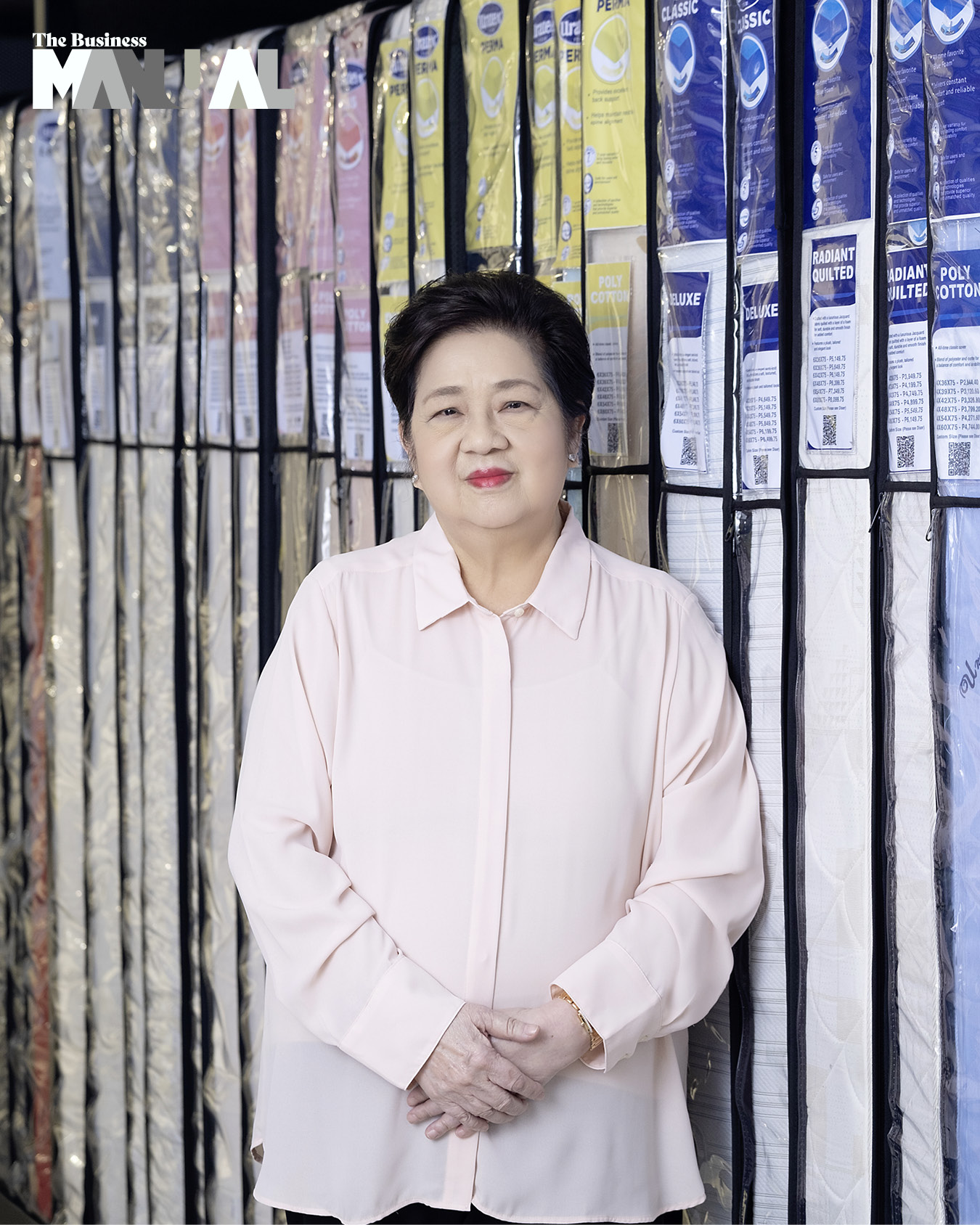
Shot on Location URATEX MILLER SHOWROOM
Special Thanks to CHERRY WONG-TAN
More From Behind the Business